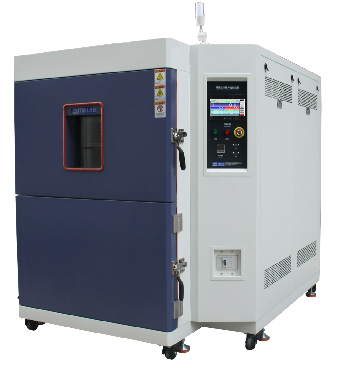
Key Features & Advantages
-
Tailored Temperature Configurations: Choose from three temperature profiles tailored to your specific testing standards: Option A (-20°C to +150°C), Option B (-40°C to +150°C), or Option C (-70°C to +150°C) for extreme low-temperature evaluation.
-
Premium Material Construction: * Interior: Built with corrosion-resistant SUS304# mirror-polished stainless steel, ensuring effortless cleaning and zero contamination during high-humidity cycles.
-
Superior Thermal Insulation: A high-performance combination of rigid polyurethane foam and premium fiberglass insulation minimizes thermal bridging and keeps the outer shell safe to touch, even at +150°C.
-
Robust Refrigeration System: Equipped with world-renowned French Tecumseh fully hermetic piston compressors. This system delivers rapid cooling rates (e.g., from +20°C to -70°C in approx. 90 minutes) with exceptional energy efficiency and low noise.
-
Comprehensive Safety Architecture: Your laboratory and specimens are protected 24/7 by a multi-layered safety network, including fuse-free breakers, dry-scorch protection, compressor overpressure/overheating sensors, fan overload protection, and an easily accessible Emergency Stop button.
Technical Specifications
| Technical Parameter |
Specification Details (GDJS-408L) |
| Model |
GDJS-408L |
| Internal Volume |
408 Liters |
| Interior Dimensions (WxHxD) |
600 × 850 × 800 mm |
| Exterior Dimensions (WxHxD) |
1100 × 1750 × 1400 mm (Subject to final configuration) |
| Temperature Range Options |
A: -20°C to +150°C | B: -40°C to +150°C | C: -70°C to +150°C |
| Humidity Range |
20% RH to 98% RH |
| Control Accuracy |
Temperature: ±0.5°C | Humidity: ±3% RH |
| Chamber Uniformity |
Temperature: ≤±0.5°C | Humidity: ≤±5% RH |
| Heating Performance |
-20°C to +100°C: ~35 min | -40°C to +100°C: ~45 min | -70°C to +100°C: ~60 min |
| Cooling Performance |
+20°C to -20°C: ~40 min | +20°C to -40°C: ~55 min | +20°C to -70°C: ~90 min |
| Total Weight / Power |
Approx. 400 kg / AC380V 7.5KW |
Standard Configuration & Accessories
Every GDJS-408L chamber comes fully equipped with the following high-quality components to ensure it is ready for immediate operation:
-
Multi-Layer Observation Window: Dual-pane hollow tempered glass with an integrated anti-condensation heating system and internal illumination for clear viewing of tests.
-
Access Port: A standard 50mm test hole located on the left side, complete with a silicone plug, allowing for easy cable routing and power-on testing of specimens.
-
Shelving: Two layers of heavy-duty, adjustable stainless steel specimen racks.
-
Water Management: Built-in high-capacity water storage tank with an automated water refilling loop.
-
Consumables Bundle: High-quality humidity wick yarn pack and a heavy-duty power cable included.
FAQ
Q1: Which temperature option (A, B, or C) is right for my application?
A: This depends on your industry testing standards. Option A (-20°C) is ideal for standard commercial electronics and consumer goods. Option B (-40°C) is commonly specified for automotive components and industrial plastics. Option C (-70°C) is recommended for defense, aerospace, and advanced material testing under extreme climatic conditions.
Q2: How does the window stay clear during high-humidity and low-temperature cycles?
A: The GDJS-408L is equipped with a heated, multi-pane hollow tempered glass window. The invisible internal heating element prevents frost, condensation, and misting, ensuring clear visibility throughout the entire test cycle.
Q3: Can I get a custom size or a larger access port?
A: Yes. While the 408L is a standard versatile volume, ITM-LAB offers custom engineering options, including larger access ports (e.g., 100mm), reinforced shelving for heavier samples, and custom outer dimensions to fit your laboratory layout. Contact our technical team for custom configurations.