Product Overview
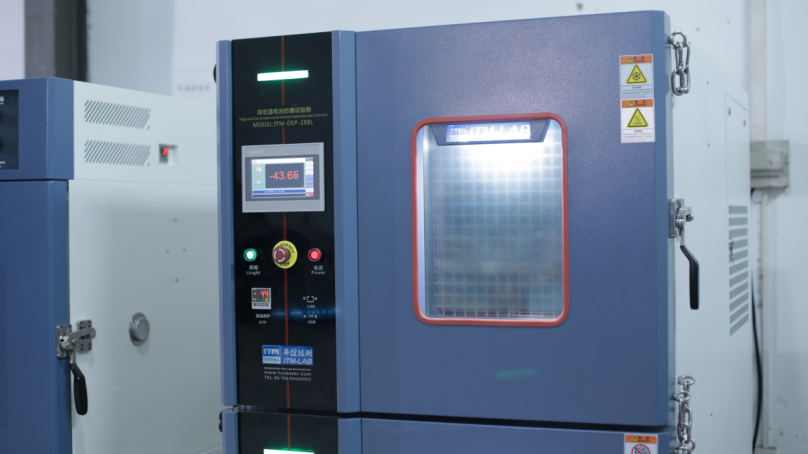
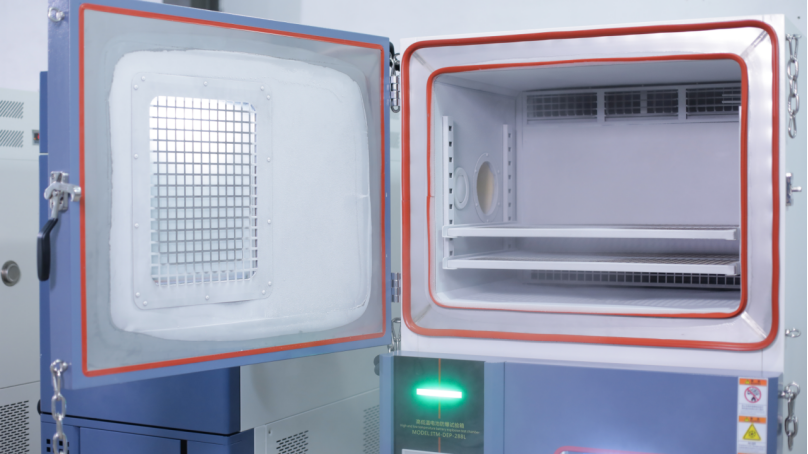
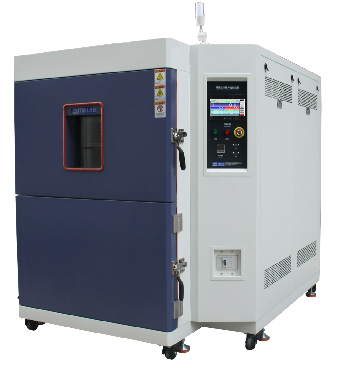
The ITM-LAB KTB Series Rapid Temperature Change Chamber is designed for accelerated temperature cycling, Environmental Stress Screening (ESS), and high- and low-temperature reliability testing of electronic and industrial products.
Available in 250L, 500L and 1000L chamber capacities, the KTB Series supports temperature configurations down to −70°C and up to +150°C, with 5°C/min, 10°C/min and 15°C/min heating-rate options.
For rapid temperature testing, however, the headline rate is only part of the specification. The required temperature interval, specimen size, specimen weight, fixture mass and heat load should also be considered when selecting a chamber.
KTB Series at a Glance
| Specification | KTB Series |
|---|---|
| Chamber Capacity | 250L / 500L / 1000L |
| Temperature Range | −40°C to +150°C / −70°C to +150°C |
| Heating Rate Options | 5 / 10 / 15°C/min |
| Humidity Range | 20–98% RH* |
| Temperature Fluctuation | ±0.5°C |
| Temperature Deviation | ±1.5°C |
| Temperature Uniformity | ≤2.0°C |
| Power Supply | AC 380V |
*Humidity capability depends on the selected configuration and operating conditions.
Need help selecting a configuration? Send us your temperature profile, specimen dimensions, specimen weight and applicable test standard.
[ Request a Configuration ] [ Send Your Test Profile ]
Built for Rapid Thermal Stress Testing
A conventional high- or low-temperature test evaluates how a product behaves under a fixed environmental condition.
Rapid temperature cycling adds another important variable:
How does the product respond when temperature changes repeatedly?
Electronic assemblies and mechanical structures often contain materials with different coefficients of thermal expansion. During repeated heating and cooling, these materials expand and contract at different rates.
Over multiple cycles, this thermal stress can expose weaknesses that may remain hidden during steady-state testing, including:
- Solder joint fatigue
- PCB and component cracking
- Connector instability
- Seal degradation
- Material delamination
- Mechanical deformation
- Intermittent electrical faults
- Early-life component defects
The purpose is not simply to make the chamber hot or cold quickly. The objective is to reproduce a controlled and repeatable thermal profile according to the required reliability test.
Applications
The KTB Series is designed for rapid temperature cycling and reliability evaluation across electronics-intensive industries where repeated thermal stress may affect components, assemblies and electrical connections.
Automotive Electronics
ECUs, sensors, displays, connectors, control modules and power electronics.
Consumer Electronics
PCBs, control boards, displays, connectors and electronic assemblies.
Semiconductor & Electronic Components
IC packages, semiconductor modules, PCBs and electronic components.
Aerospace & Communication Equipment
Avionics modules, communication electronics, sensors and control units.

Imported configuration
> High-Ramp Thermal Train
Driven by twin German semi-hermetic compressors running eco-friendly DuPont HFC R404A/R23 refrigerants, supported by Danfoss expansion valves and a heavy-duty Emerson oil separation loop.
> Zero-Overshoot Airflow Dynamics
Features dual 1HP Taiwanese TECO circulation motors paired with multi-blade centrifugal aluminum alloy fans to enforce uniform top-delivery and bottom-return climate mapping.
> Intelligently Automated BTHC Modality
The system automatically shifts refrigerant flow velocities based on real-time loads, completely turning off excess cooling stages during constant phases to optimize power consumption.
> Multi-Tiered Fail-Safe Security
Outfitted with independent Omron over-temperature protectors, German Schneider electromagnetic safety switches, automated phase-loss barriers, and live specimen power-off interlocks.
KTB Series Model Comparison
The KTB Series is available in 250L, 500L and 1000L standard workspace capacities.
| Specification | KTB 250L | KTB 500L | KTB 1000L |
|---|---|---|---|
| Chamber Capacity | 255L | 500L | 1000L |
| Internal Size (mm) | 700 × 500 × 700 | 800 × 700 × 900 | 1000 × 1000 × 1000 |
| Temperature Range | −40~+150°C / −70~+150°C | Same | Same |
| Temperature Fluctuation | ±0.5°C | ±0.5°C | ±0.5°C |
| Temperature Deviation | ±1.5°C | ±1.5°C | ±1.5°C |
| Temperature Uniformity | ≤2.0°C | ≤2.0°C | ≤2.0°C |
| Heating Rate Options | 5 / 10 / 15°C/min | 5 / 10 / 15°C/min | 5 / 10 / 15°C/min |
| Humidity Range* | 20–98% RH | 20–98% RH | 20–98% RH |
| Approx. Weight | 350 kg | 480 kg | 700 kg |
| Power Supply | AC 380V | AC 380V | AC 380V |
*Humidity performance depends on the selected chamber configuration and operating temperature.
Choosing Chamber Capacity
Do not select chamber size only by checking whether the specimen physically fits inside.
Additional space may be required for:
- Air circulation
- Test fixtures
- Sensors and thermocouples
- Electrical cables
- Multiple specimens
- Loading and unloading clearance
For rapid temperature cycling, adequate airflow around the specimen is especially important because it affects heat transfer.
| Capacity | Internal Size (W × H × D) | Typical Test Samples | Recommended For |
|---|---|---|---|
| 250L | 700 × 500 × 700 mm | PCBs, ECUs, sensors, small electronic modules | Compact Components |
| 500L | 800 × 700 × 900 mm | Multiple ECUs, displays, controllers, medium-sized assemblies | Medium Assemblies / Multi-Sample Testing |
| 1000L | 1000 × 1000 × 1000 mm | Large electronic assemblies, large modules, multiple test samples | Large Assemblies / Higher Test Loads |
How the KTB Chamber Works
A typical rapid temperature cycling test follows a programmed sequence rather than a single fixed temperature condition.
01 — Set the Test Profile
Define the required:
Starting Temperature → Target Temperature → Transition Requirement → Dwell Time → Number of Cycles
02 — Establish the Starting Condition
The refrigeration, heating and circulation systems bring the chamber to the programmed starting condition.
03 — Run the Temperature Transition
The controller adjusts heating or refrigeration output according to the programmed profile.
04 — Maintain Air Circulation
Forced-air circulation distributes conditioned air throughout the workspace.
05 — Hold at the Target Condition
The chamber maintains the programmed condition for the required dwell period.
06 — Repeat Automatically
The sequence continues according to the programmed number of cycles.
Temperature curves and operating data can be recorded throughout the test for later review.
Safety Protection
Rapid-temperature chambers often operate for long periods with substantial heating and refrigeration loads.
Typical KTB protection functions include:
-
Independent over-temperature protection
-
Compressor overload protection
-
Refrigeration high/low-pressure protection
-
Phase-loss and phase-sequence protection
-
Electrical overload protection
-
Circulation fan protection
-
Water-system monitoring where applicable
-
Alarm indication
-
Emergency stop
-
Specimen power interlock where configured
Additional protection can be configured according to the specimen and application.
Supported Test Standards
The KTB Series can be configured to support environmental testing based on relevant IEC 60068 procedures.
| Test Standard | Test Method | Typical Purpose | KTB Application |
|---|---|---|---|
| IEC 60068-2-14 | Change of Temperature | Evaluates the effects of specified temperature changes on components, equipment and products. | Rapid temperature change / temperature cycling |
| IEC 60068-2-1 | Cold | Evaluates product performance and reliability under low-temperature conditions. | Low-temperature testing |
| IEC 60068-2-2 | Dry Heat | Evaluates product performance and reliability under elevated-temperature conditions. | High-temperature testing |
| IEC 60068-2-30 | Damp Heat, Cyclic | Evaluates products under cyclic temperature and high-humidity conditions. | Temperature & humidity cycling* |
Example Custom Configuration: KTB-225L
Not every rapid-temperature application fits a standard chamber size.
For projects involving different workspace dimensions, temperature ranges, transition requirements or facility interfaces, the KTB platform can also be configured around a specific test profile.
One example configuration is:
| Specification | Example KTB-225L |
|---|---|
| Chamber Volume | 225L |
| Internal Size | 500 × 750 × 600 mm |
| Temperature Range | −55°C to +125°C |
| Linear Temperature Change Rate | Up to 12°C/min, no load* |
| Temperature Fluctuation | ±0.5°C |
| Temperature Deviation | ≤±1.5°C |
| Temperature Uniformity | ≤2.0°C |
| Interior Material | SUS304 Stainless Steel |
| Access Port | Ø100 mm |
| Cooling Method | Water-Cooled |
| Power Supply | Three-Phase AC 380V |
*This is a configuration-specific example and should not be interpreted as the standard specification for every KTB model.
This example also illustrates why chamber selection should begin with the test profile and specimen condition, rather than chamber volume alone.
Standard or Custom Configuration?
A standard KTB model may be suitable when the required workspace, temperature range and test profile fit an established configuration.
Customization may be appropriate when the project includes:
- Non-standard specimen dimensions
- High specimen mass
- Powered specimens with significant heat dissipation
- Special temperature transition requirements
- Additional feed-through ports
- External electrical connections
- Special fixtures
- Additional safety protection
- Custom communication interfaces
- Specific facility requirements
For custom applications, the complete test condition should be reviewed before the chamber configuration is finalized.
How to Select the Right KTB Configuration
A chamber-selection request should not begin and end with:
“I need a 10°C/min chamber.”
A more useful selection process is:
Temperature Range
→ Heating / Cooling Requirement
→ Sample Size & Weight
→ Heat Load
→ Humidity Requirement
→ Test Standard
→ KTB Configuration
These inputs provide a better basis for determining chamber capacity, refrigeration configuration and required thermal performance.

Why ITM-LAB?
Rapid temperature chamber performance depends on more than chamber volume or compressor capacity.
The complete system should be selected around the actual test condition.
Application-Based Selection
Configuration recommendations consider temperature profile, specimen dimensions, specimen mass, fixture weight and heat load.
Multiple Chamber Sizes
Standard workspace capacities include:
250L / 500L / 1000L
Temperature Options Down to −70°C
Configurations are available for demanding low-temperature reliability testing.
5 / 10 / 15°C/min Options
Different heating-rate configurations are available according to the required test profile.
Engineering Customization
Workspace dimensions, access ports, specimen connections, safety functions and control options can be adapted for specific projects.
Manufacturer Support
ITM-LAB provides support from initial chamber selection through manufacturing, installation, operation and after-sales service.
FAQ
- What is a rapid temperature change chamber?
A rapid temperature change chamber is an environmental test chamber designed to perform controlled high- and low-temperature transitions at faster rates than conventional steady-state chambers.
It is commonly used for temperature cycling, ESS and accelerated reliability testing.
- What is the difference between rapid temperature cycling and thermal shock?
Rapid temperature cycling normally changes the environmental temperature around a specimen while it remains inside one chamber.
Thermal shock testing typically subjects the specimen to much more abrupt transitions between separate hot and cold environments.
The correct method depends on the applicable test procedure and the failure mechanism being evaluated.
- Is 10°C/min based on chamber air or specimen temperature?
This should be defined in the performance specification.
Chamber air normally responds faster than a physical specimen. Sample mass, material, fixture and heat load can all affect the specimen temperature response.
- Does chamber size affect rapid temperature performance?
Yes.
Larger working volumes generally require greater heating and refrigeration capacity. Specimen mass and heat load also influence the required system configuration.
- Should I choose 5°C/min, 10°C/min or 15°C/min?
Choose the rate according to the required test profile rather than automatically selecting the highest value.
The temperature interval, specimen condition and measurement method should also be considered.
- Can the KTB Series perform humidity testing?
Humidity configurations are available with a stated range of 20–98% RH, subject to operating temperature and selected chamber configuration.
- Can ITM-LAB customize the chamber?
Yes.
Custom configurations can be developed for special workspace dimensions, specimen connections, heat loads, safety requirements and temperature profiles.
Send Us Your Test Profile
Selecting a rapid temperature change chamber becomes much easier once the actual test condition is defined.
Send us:
Temperature Range
Required Heating Rate
Required Cooling Rate
Sample Dimensions
Sample Weight
Heat Load
Humidity Requirement
Test Standard
Our engineers can use these inputs to evaluate the appropriate KTB chamber capacity, refrigeration configuration and rapid-temperature system for your application.
[ Request a Quote ] [ Send Your Test Profile ]