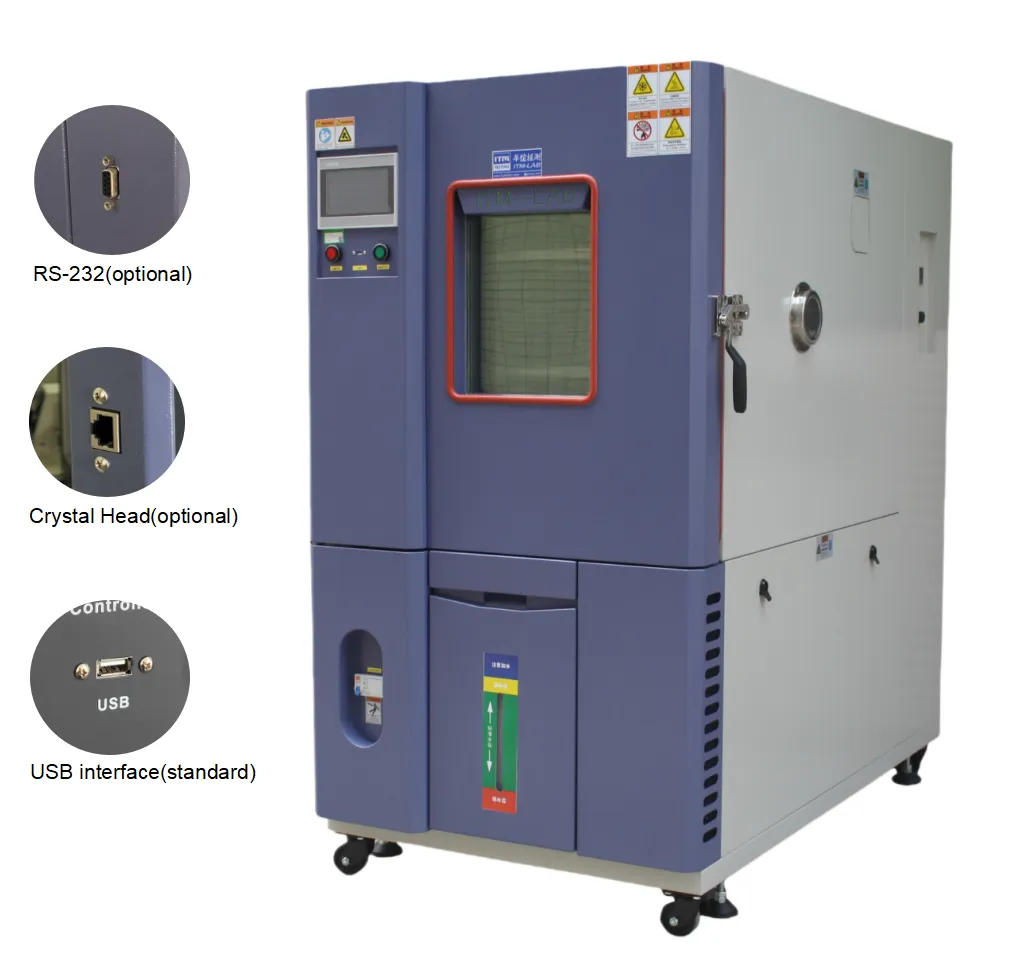
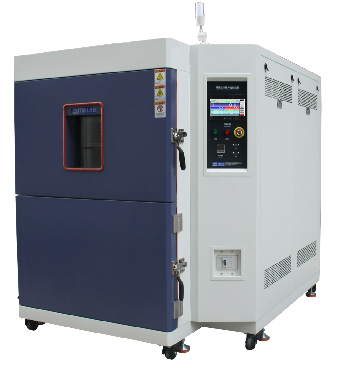
Temperature and Humidity Test Chamber(Climate Chamber) Model:GDJS
![]()
1. Product Overview & Key Features
The ITM-LAB GDJS Series Programmable constant temperature and humidity test chamber (also known as a Climate Chamber) is an essential engineering tool designed to evaluate the environmental reliability and structural integrity of electronic products, automotive components, semiconductors, and advanced materials.
By simulating extreme industrial climates—ranging from scorching heat and sub-zero freezes to alternating damp heat cycles—the GDJS series provides quality control departments and third-party testing laboratories with rigorous, repeatable stability data.
-
Premium Material Construction: Features a heavy-duty cold-rolled steel exterior with an electrostatic protective spray coating, coupled with an acid-resistant SUS304 stainless steel interior chamber.
-
Superior Thermal Insulation: Reinforced with a dual-layer barrier consisting of rigid polyurethane foam and ultra-fine eco-friendly glass fiber cotton, minimizing thermal leakage and maximizing power efficiency.
-
Condensation-Free Observation: Outfitted with a 3-layer vacuum panoramic glass window (30x40cm) paired with an automated micro-heating frame element to completely eliminate frost and moisture condensation during low-temperature cycles.
-
Advanced Safety Integration: Standard configuration includes built-in over-temperature protection, sensor fault detection, pressure balance ports, and a dual-stage safety circuit.
2. Standard-Compliant Test Frameworks
The GDJS Series is hard-coded and structurally aligned to meet the industry's most demanding international testing criteria:
-
IEC 60068-2-1:2007 – Environmental Testing: Cold / Low-Temperature Tests
-
IEC 60068-2-2:2007 – Environmental Testing: Dry Heat / High-Temperature Tests
-
IEC 60068-2-78:2007 – Test Cab: Steady-State Damp Heat Protocols
-
IEC 60068-2-30:2005 – Test Db: Alternating Damp Heat (Cyclic Performance Testing)
3. Comprehensive Technical Specifications
Model Capacity & Electrical Index
| Standard Model |
Effective Volume |
Internal Chamber Size (WDH) |
External Chamber Size (WDH) |
Machine Net Weight |
Power Parameters |
| GDJS-100L-B/C |
100 Liters |
400 * 500 * 500 mm |
650 * 1250 * 1670 mm |
~200 KG |
AC 220V / 3.0 KW |
| GDJS-150L-B/C |
150 Liters |
500 * 500 * 600 mm |
750 * 1250 * 1770 mm |
~260 KG |
AC 380V / 4.5 KW |
| GDJS-225L-B/C |
225 Liters |
500 * 600 * 750 mm |
750 * 1500 * 1850 mm |
~300 KG |
AC 380V / 5.5 KW |
| GDJS-408L-B/C |
408 Liters |
600 * 800 * 850 mm |
800 * 1700 * 2020 mm |
~400 KG |
AC 380V / 7.5 KW |
| GDJS-800L-B/C |
800 Liters |
1000 * 800 * 1000 mm |
1250 * 1700 * 2170 mm |
~600 KG |
AC 380V / 10.0 KW |
| GDJS-1000L-B/C |
1000 Liters |
1000 * 1000 * 1000 mm |
1250 * 1900 * 2170 mm |
~700 KG |
AC 380V / 11.0 KW |
Performance Profile (Air-Cooled, No-Load Ambient 5°C to 25°C, RH <=85%)
-
Temperature Range Options: -40°C to +150°C OR -70°C to +150°C (Dependent on B/C Model Selection)
-
Humidity Control Span: 20% to 98% RH
-
Temperature Fluctuation: +/-0.5°C
-
Humidity Fluctuation: +/-1% RH
-
Temperature Uniformity: <=2.0°C (Across the entire -40°C to +150°C range)
-
Temperature Deviation: <= +/-1.0°C
-
Humidity Deviation: +/-3% RH
-
Heating Dynamic Rate: >=3.0°C / minute (Total average, non-linear, no load)
-
Cooling Dynamic Rate: >=1.0°C / minute (Total average, non-linear, no load)
-
Thermal Overshoot Threshold: <=2.0°C
-
Internal Tray Loading Limit: 20 KG maximum chamber shelf bearing capacity
-
Acoustic Noise Output: <=70dB (A-weighted sound level)
-
Data Communications: Standard configuration includes USB interface; RS-232 or Crystal Head ports are optionally available.
4. Primary Industrial Applications
The GDJS series is heavily utilized across global manufacturing supply chains for component qualification:
-
Consumer Electronics: Multi-environment testing of printed circuit boards (PCBs), smartphones, capacitors, and lithium-ion battery modules.
-
Automotive Hardware: Reliability stress screening for dashboard electronics, LED lighting clusters, sensors, and interior polymer materials.
-
Aerospace Components: Accelerated aging tests on complex wire harnesses, connective seals, and high-altitude avionics.
-
Material Engineering: Assessing structural changes, moisture absorption, and thermal degradation of plastics, coatings, and composite alloys.
5. Laboratory Facility Requirements & Site Preparation
To guarantee optimal cooling efficiency and calibration accuracy, the installation environment must adhere to the following operational parameters:
-
Ambient Temperature Profile: Maintain a consistent 5°C to 35°C environment.
-
Relative Humidity Limit: Less than or equal to 85% RH.
-
Atmospheric Stability: 80 kPa to 106 kPa with zero localized high-amplitude structural vibrations.
-
Air Purity: Free from explosive gases, corrosive chemicals, high dust concentrations, or intense electromagnetic radiation fields.
-
Dissipation Clearance: Maintain a minimum 600mm clear boundary on the left, right, and back faces of the machine enclosure to allow unrestricted condenser heat rejection.
-
Testing Prohibitions: Never place volatile, explosive, highly corrosive, or hazardous chemical agents inside the chamber for environmental testing or ambient storage.
6. Frequently Asked Questions (FAQ)
Q: What is the main operational difference between the Method B and Method C models?
A: The designator specifies the lower limit of the temperature range capability. "B" models are engineered to cool down to a minimum of -40°C, while "C" models utilize an advanced cascade refrigeration architecture to reliably reach -70°C, catering to aerospace and military-grade testing prerequisites.
Q: Can I run custom wires or external power connections directly to my test samples while the chamber is active?
A: Yes. Every GDJS chamber comes standard with a pre-machined, silicone-sealed test access port (available in 50mm or 100mm diameters) located on the left panel. This allows you to route power leads, signal lines, or data acquisition cables into the working zone without breaching thermal or humidity seals.
Q: How does the system manage frost buildup when executing continuous low-temperature programs?
A: The GDJS chamber utilizes an optimized, automated bypass defrost cycle alongside a micro-heated anti-frost frame on the 3-layer vacuum observation window. This ensures that even during prolonged sub-zero testing runs, the viewing window remains completely transparent, and frost formation on the cooling coils is minimized.
7. Global Engineering Support & Quotations
Partner with ITM-LAB to elevate your environmental compliance testing infrastructure. Our engineering division provides tailored hardware modifications, multi-point calibration services, and tailored specimen rack layouts.