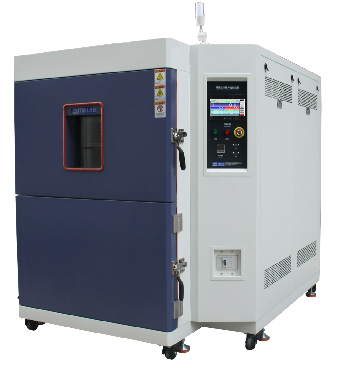
1. Product Details & Deep Dive
Preventing Electronic Component Thermal Failure
For hardware engineers and quality control directors, unpredictable thermal stress is the leading cause of early field failures. A component or sub-assembly that operates perfectly at room temperature can experience sudden solder joint cracking, dielectric breakdown, or signal drift when subjected to sub-zero arctic freezes or intense ambient heat.
The ITM-LAB GDW Series High and Low Temperature Test Chamber provides a heavily insulated, highly reproducible environment to force these latent design defects to the surface before your product reaches mass production. By simulating harsh, accelerated thermal environments under strict laboratory conditions, the GDW series delivers the precise engineering metrics required to certify product reliability, clear international compliance compliance, and eliminate costly field recalls.
Advanced Thermodynamic Engineering & Hardware Highlights
-
Innovative BTHC Climate Regulation: Unlike traditional on/off refrigeration cycling that causes massive, unstable thermal overshoot, our Balanced Temperature Control (BTHC) system intelligently modulates refrigerant flow rates in real time. By automatically trimming away redundant cooling output during constant-temperature testing phases, it maintains a razor-thin +/-0.5°C control threshold while significantly lowering long-term laboratory electricity overheads.
-
Zero-Stratification Air Distribution: The GDW series utilizes a specialized upper-discharge and lower-return air circulation architecture. Driven by heavy-duty low-voltage asynchronous motors and multi-wing aluminum alloy centrifugal fans with high/low temperature resistant blades, it completely eliminates internal thermal dead zones, guaranteeing an outstanding chamber-wide temperature uniformity of <= 1.0°C.
-
Premium European & Japanese Refrigeration Cores: Built around industrial-grade piston reciprocating compressors (utilizing premium brands like France Tecumseh, Japan Hitachi, or Germany Bitzer depending on specific test limits), the GDW system runs on non-fluorine, eco-friendly DuPont HFC R404A or R23 refrigerants. Paired with Danfoss thermal expansion valves and multi-stage finned evaporators treated with a hydrophilic membrane, it ensures robust cooling performance even under maximum continuous specimen loads.
2. Technical Specifications Matrix
Chamber Dimensions & Capacity Configurations
| Standard Model |
Effective Volume |
Internal Chamber Size (WDH) |
External Chamber Size (WDH) |
Equipment Net Weight |
Power Consumption |
| GDW-100L-B/C |
100 Liters |
400 * 500 * 500 mm |
650 * 1670 * 1250 mm |
~200 KG |
AC 220V / 3.0 KW |
| GDW-150L-B/C |
150 Liters |
500 * 500 * 600 mm |
750 * 1770 * 1250 mm |
~260 KG |
AC 380V / 4.5 KW |
| GDW-225L-B/C |
225 Liters |
500 * 600 * 750 mm |
750 * 1850 * 1500 mm |
~300 KG |
AC 380V / 5.5 KW |
| GDW-408L-B/C |
408 Liters |
600 * 800 * 850 mm |
800 * 1700 * 2020 mm |
400 KG |
AC 380V / 7.5 KW |
| GDW-800L-B/C |
800 Liters |
1000 * 800 * 1000 mm |
1250 * 1700 * 2170 mm |
600 KG |
AC 380V / 10.0 KW |
| GDW-1000L-B/C |
1000 Liters |
1000 * 1000 * 1000 mm |
1250 * 1900 * 2170 mm |
700 KG |
AC 380V / 11.0 KW |
Standardized Performance & Structural Metrics
-
Temperature Target Span: Option B: -40°C to +150°C | Option C: -70°C to +150°C
-
Temperature Fluctuation Margin: +/-0.5°C
-
Maximum Temperature Deviation: <= +/-1.0°C
-
Spatial Temperature Uniformity: <= 1.0°C (Evaluated across the entire test zone)
-
Heating Dynamic Velocity: >= 3.0°C / minute (Total average, non-linear, no-load state)
-
Cooling Dynamic Velocity: >= 1°C / minute (Total average, non-linear, no-load state)
-
Thermal Transition Overshoot: <= 2°C
-
Chamber Maximum Shelf Load: 20 KG maximum weight capacity
-
System Acoustic Noise Level: <= 70dB (A-weighted sound level)
-
Internal Chamber Material: Anti-corrosive, mirror-finish SUS304 stainless steel plate
-
Insulation Barrier: Hard polyurethane foam + ultra-fine eco-friendly glass fiber cotton
-
Observation Window: 3-layer vacuum glass (30x40cm) with automated micro-heating anti-frost elements
-
Standard Access Port: One 50mm or 100mm sealed test hole on the left panel (Glove holes optional)
3. Proven Reliability Backed by 27+ Years of Expertise
Selecting an environmental chamber is a long-term capital investment for any calibration laboratory. Low-tier alternatives frequently suffer from severe sensor drift, compressor valve leakage, and poor spatial uniformity over time.
-
27+ Years of Engineering Heritage: Every GDW unit is engineered and assembled within our ISO-certified manufacturing infrastructure, incorporating nearly three decades of advanced thermodynamic R&D.
-
Global Enterprise Trust: Our testing platforms are trusted by Fortune 500 corporations and Tier-1 quality labs across more than 100 countries, ensuring seamless compliance with international MIL, ISO, and IEC protocols.
-
Flexible Facility Customization: Beyond standard capacities, ITM-LAB provides engineering modifications—ranging from custom internal shelving layouts to specialized multi-channel communication arrays—tailored to your exact test lab blueprints.
4. Laboratory Maintenance & Preventive Calibration
To ensure your GDW chamber retains its tight +/-0.5°C accuracy and passes strict third-party compliance audits, our service engineers recommend the following facility protocols:
-
Chamber Sanitation: Regularly clean the SUS304 mirror-finish stainless steel interior to eliminate dust or volatile chemical deposits outgassed by test items during high-temperature cycles.
-
Condenser Airflow Boundaries: Maintain a strict minimum of 600mm open clearance on the left, right, and rear faces of the machine enclosure to allow unrestricted heat rejection from the air-cooled fins.
-
Annual Traceable Calibration: Schedule an annual multi-point sensor calibration to counteract natural PT100 platinum sensor drift and ensure auditable testing baselines.
5. Frequently Asked Questions (FAQ)
Q: How does the GDW Series achieve better energy efficiency compared to standard chambers?
A: Standard chambers use brute-force heating to oppose a constantly active cooling system, which wastes massive amounts of electricity. ITM-LAB’s BTHC system calculates the precise thermal load needed. It switches off unnecessary cooling stages during constant temperature holds, stabilizing your environment while reducing power draws.
Q: Can I interface the chamber directly with an automated laboratory data collection network?
A: Yes. Every GDW unit features a multi-port communication block containing an external USB port as standard, with RS-232 and Crystal Head ports available as options. We also include our proprietary remote control software to log, monitor, and run profiles directly from a centralized lab PC.
Q: What are the exact clearance requirements for installing the GDW chamber?
A: To ensure adequate heat rejection from the air-cooled forced convection condenser fins, you must maintain at least 600mm of open space around the left, right, and back panels of the machine housing. The chamber should operate in an environment between 5°C and 35°C with a relative humidity of <=85%.
6. Elevate Your Thermal Testing Infrastructure
Don’t risk unexpected field failures or rejected supplier batches. Secure reliable, standard-compliant environmental data with ITM-LAB’s proven testing architecture. Contact our application engineering team today to review your testing protocols, request a custom chamber footprint, or secure an optimized commercial quote.