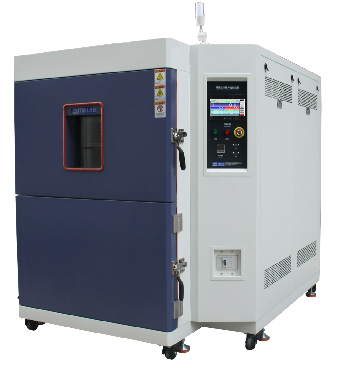
The CTS Series 3-Zone (Three Tank Type) Thermal Shock Test Chamber from ITM-LAB is engineered for high-precision environmental stress screening. Designed to detect hidden defects in electronic components, 3C products, new energy vehicle batteries, and aerospace materials, this high-performance chamber subjects test samples to rapid, extreme temperature transitions between pre-heated and pre-cooled zones.
Unlike conventional two-zone chambers, the three-zone structural design keeps the test sample stationary in the middle chamber, minimizing mechanical stress and preventing external disturbance during testing.
Why Choose ITM-LAB CTS Series Thermal Shock Chamber?
-
Stationary Sample Testing (3-Zone Design): The test area remains stationary. Pneumatic valves seamlessly control the high-speed intake of hot or cold air, making it ideal for testing fragile components, heavy battery cells, or live electrical setups.
-
Advanced Energy-Saving Technology (BTHC System): Utilizing the Balanced Temperature and Humidity Control (BTHC) mode, the system automatically regulates the refrigerant flow based on real-time thermal loads. It cuts off redundant cooling capacity during constant phases, saving up to 30% energy.
-
Rapid & Precise Temperature Recovery: Equipped with heavy-duty finned Ni-Cr electric heating tubes and multi-stage hydrophilic membrane evaporators, ensuring temperature fluctuation stays within ≤±0.5℃ and uniformity within ≤±2℃.
-
Global Brand Components for Maximum Reliability: Built with world-class refrigeration components including German Bitzer or French Tecumseh compressors, Danfoss expansion valves, and Japanese Saginomiya solenoid valves.
How Does the 3-Zone (Three-Tank) Thermal Shock Chamber Work?
The CTS Series consists of three distinct isolated zones:
-
Hot Zone (Pre-heating): Upper chamber, pre-heats up to +200°C.
-
Cold Zone (Pre-cooling): Lower chamber, pre-cools down to -60°C.
-
Test Zone (Ambient/Sample Area): The middle chamber where the specimen is placed.
During a thermal shock cycle, the specimen does not move. High-efficiency pneumatic damper valves open and close sequentially, forcing high-velocity hot or cold air into the test zone. This achieves a drastic temperature drop or rise within seconds without moving the sample physically.
Technical Specifications
| Model |
CTS-50L |
CTS-100L |
CTS-150L |
| Inner Chamber Size (WxDxH) |
350 x 350 x 400 mm |
500 x 400 x 500 mm |
600 x 500 x 500 mm |
| External Dimensions |
Customized configurations available based on final cooling method |
|
|
| Structural Design |
Three-Zone Type (Upper Hot, Middle Test, Lower Cold) |
|
|
| Temperature Range |
-40℃ to +150℃ |
|
|
| Preheating Range / Time |
RT to +200℃ / Approx. 30 mins (Average, non-linearity, no load) |
|
|
| Precooling Range / Time |
-10℃ to -60℃ / Approx. 60 mins (Average, non-linearity, no load) |
|
|
| Temp. Fluctuation / Deviation |
≤±0.5℃ / ≤±2℃ |
|
|
| Temperature Uniformity |
≤±2℃ |
|
|
| Max. Specimen Load |
5 KG |
15 KG |
20 KG |
| Air Circulation System |
Low-voltage asynchronous motor with multi-wing centrifugal fan & aluminum alloy blades |
|
|
| Temperature Sensor |
High-precision PT100 Platinum Resistance Sensor |
|
|
Premium Material Construction & Critical Components
-
Chamber Enclosure: Heavy-duty external steel shell with high-quality mirror paint coating; Inner chamber fully constructed with corrosion-resistant SUS304# stainless steel.
-
Thermal Insulation: Dual-layer protection using high-density Hardamine lipid foam and premium glass cotton to prevent thermal leakage.
-
Refrigeration System: Options for French Tecumseh fully enclosed piston compressors or German Bitzer semi-hermetic compressors utilizing a two-stage cascade eco-friendly refrigeration cycle (R404A & R23 non-fluorine refrigerants).
-
Control System & Safety: High-precision contactless switching driven by the controller output signal via Swiss Carlo Gavazzi solid-state relays (SSR) for spark-free, long-lifespan heating control.
Target Applications & Testing Standards
Our CTS Series Thermal Shock Chambers comply with global testing standards including MIL-STD-881F, IEC60068-2-14, JIS C0025, and GB/T2423.22. It is widely utilized in:
-
3C Electronics: PCBAs, semiconductors, microchips, and smartphones.
-
Automotive & EV Battery: New energy battery cells, modules, and automotive electronic control units (ECUs).
-
Aerospace & Defense: Connectors, sensors, and structural materials subjected to extreme atmospheric transitions.
https://www.itm-lab.com/contact.html
Frequently Asked Questions (FAQ)
Q1: What is the main advantage of a 3-zone thermal shock chamber over a 2-zone chamber?
A: In a 2-zone chamber, the basket moves the sample physically up and down between hot and cold zones, which can cause mechanical vibrations and wire-bonding failures. In an ITM-LAB 3-zone chamber, the sample remains stationary. The temperature changes rapidly by switching pneumatic air valves, preventing physical shock to fragile components and allowing for easy live-load (power-on) cable connections.
Q2: Can the external dimensions of the CTS series be customized?
A: Yes. Depending on whether you choose air cooling or water cooling, and based on your laboratory space constraints, ITM-LAB offers custom external housing layouts. Please contact our engineering team for exact physical drawings.
Q3: Does the cooling system use eco-friendly refrigerants?
A: Absolutely. All ITM-LAB environmental chambers utilize advanced green refrigerants, specifically R404A and R23, which comply fully with international environmental protection standards and F-gas regulations.