As the global automotive industry moves toward electrification, battery safety and performance testing have become more critical than ever. A battery test chamber is essential for simulating the harsh conditions that batteries face in real-world use—high temperature, low temperature, humidity, and thermal cycling. But choosing the right battery test chamber requires careful consideration of your specific battery type and testing goals. This guide will help you select a battery test chamber that meets your needs for EV, lithium-ion, or industrial batteries.
First, consider the temperature range you need. Battery testing often requires extreme temperatures—for EV batteries, you may need a range of -40°C to 150°C to simulate cold weather and thermal runaway scenarios. For lithium-ion batteries, a range of -20°C to 100°C is typically sufficient, but ensure the chamber can maintain stable temperatures for extended periods (many tests require 24/7 operation).
Safety features are non-negotiable for battery testing. Batteries can catch fire or explode if tested improperly, so look for a chamber with safety features like explosion-proof windows, fire suppression systems, gas exhaust, and over-temperature/over-pressure protection. Additionally, the chamber should be made of fire-resistant materials to minimize risk.
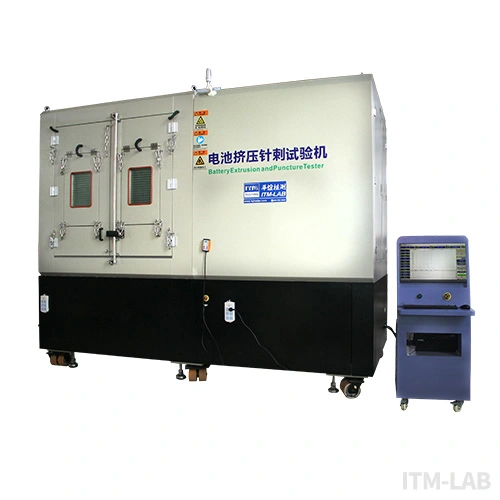
Evaluate the chamber’s uniformity and control system. Battery testing requires precise temperature and humidity control—look for temperature uniformity of ≤ ±2°C and humidity uniformity of ≤ ±3%RH. The control system should be programmable, with support for thermal cycling, steady-state testing, and data logging. This ensures you can simulate real-world conditions and track test results accurately. For reliable battery testing solutions, consider ITM-LAB Battery Test Chambers, which are designed with safety and precision in mind for EV and industrial battery testing.
Finally, check compliance with industry standards (IEC 62133, UN 38.3) and consider the chamber’s size. Ensure the chamber can accommodate your battery samples, including fixtures and wiring. By focusing on temperature range, safety features, uniformity, and compliance, you’ll choose a battery test chamber that ensures your batteries are safe and reliable.