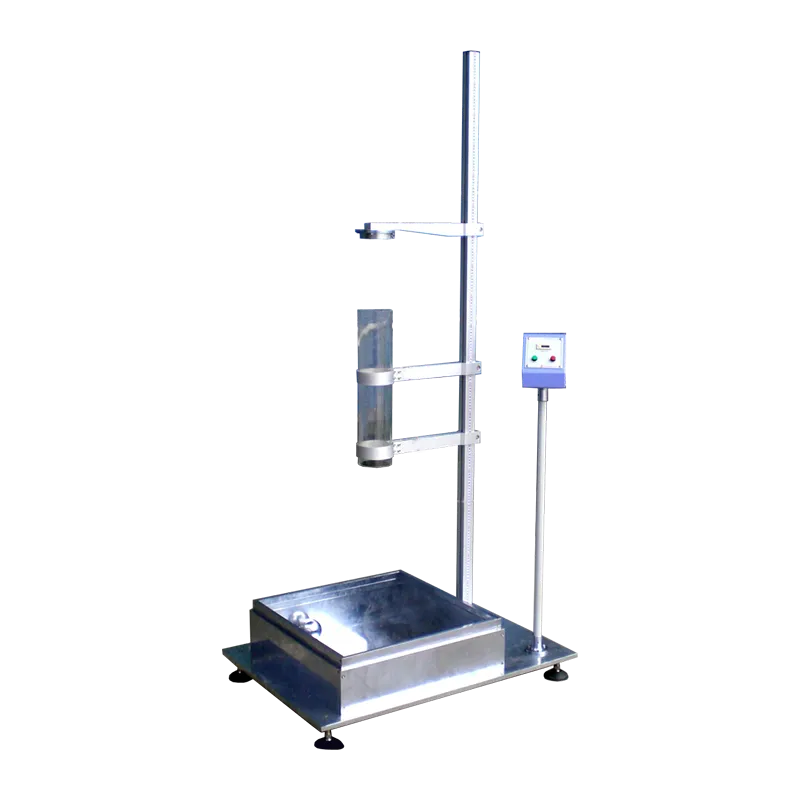
Product Overview
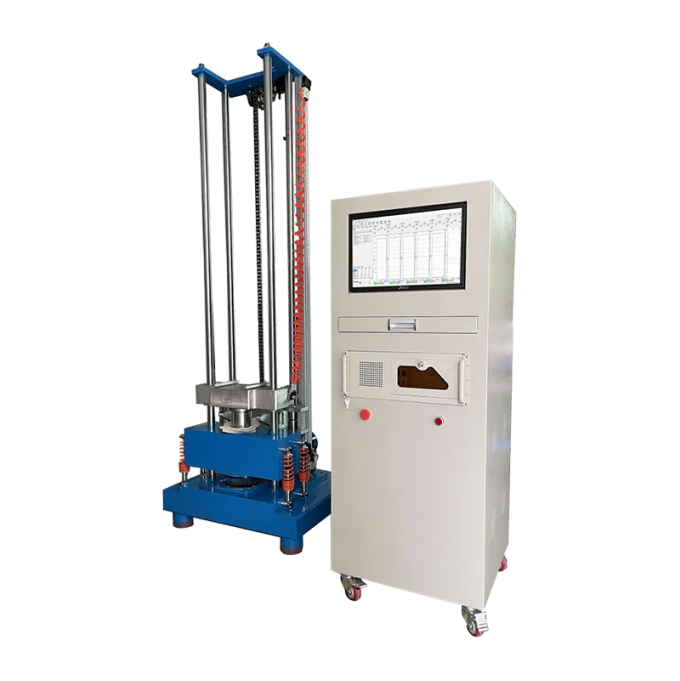
ITM-LAB launched the Vertical Impact Crash Tester RS-6150 Series – a fully automatic pneumatic lifting impact and collision test system, designed to accurately measure and evaluate the impact resistance of products and packages. This equipment simulates the shock waves and impact energy that products may encounter during transportation, installation, and daily use, helping manufacturers identify structural weaknesses, optimize product design and packaging structure, and ensure product reliability before mass production.
It is widely used in daily quality control and product reliability verification, trusted by global customers including CATL, BYD, Foxconn, and Midea. Unlike ordinary impact testers, the RS-6150 Series integrates stability, precision, and versatility, with a trouble-free working time of over 1000 hours, perfectly adapting to long-term, high-intensity testing needs of laboratories and production lines.
Key Features
Multi-Model Optional for Diverse Needs: 5 models (RS-6150-50 to RS-6150-800) with rated loads ranging from 50kg to 800kg, covering small electronic components to large industrial parts, meeting different product sizes and testing requirements.
Versatile Impulse Waveforms for Real-Scenario Simulation: Supports half-sine, back-peak sawtooth, and trapezoidal waveforms, accurately mimicking various real impact situations in actual use (e.g., transportation collision, accidental drop), ensuring test results are consistent with real-world performance.
Free-Fall Impact Form for Accurate Data: Adopts free-fall impact design, completely simulating the actual impact conditions of products, avoiding deviations caused by artificial force, and ensuring the authenticity and reliability of test data – consistent with the core working principle of vertical impact testing equipment.
Adjustable Parameters for Multi-Standard Adaptation: Each model is equipped with adjustable peak acceleration ranges and pulse durations, flexibly fitting various international and national test standards, eliminating the need for multiple equipment investments.
Stable & Durable for Long-Term Use: With an average trouble-free working time ≥1000h, the RS-6150 Series is built with high-quality materials and exclusive patented technology (supported by multiple utility model patents), ensuring stable operation even in high-intensity testing scenarios.
Global Standard Compliance: Fully meets international and national standards including IEC68-2-27, MIL-STD-810F, GB/T2423.5, GB/T360.23, and GB/T150.18, making test results recognized and trusted by global certification institutions and customers. It also aligns with the standard requirements for vertical impact testing equipment in industrial and electronic product testing.
Precise Calibration for Reliable Data: Acceleration amplitude, pulse width, uniformity, and transverse motion ratio all meet the requirements of JJG541-88, with annual calibration services (ITM-LAB calibrates over 80,000 sensors yearly) to ensure long-term data accuracy.
Test Standards (Test Method & Parameters)
|
Test Standard
|
Test Method
|
Key Technical Requirements
|
|
IEC68-2-27
|
Mechanical impact test for electronic and electrical products; free-fall impact test with specified waveforms, check product structural integrity and performance after impact.
|
Impulse waveforms: half-sine/back-peak sawtooth/trapezoidal; peak acceleration: 150~4000m/s²; pulse duration: 1.5~40ms
|
|
MIL-STD-810F
|
Environmental test for military and industrial products; simulate transportation, installation impact scenarios, verify product durability.
|
Rated load: 50~800kg; impact form: free-fall; maximum collision frequency: 20~80 times/min
|
|
GB/T2423.5
|
Environmental test for electrical and electronic products; impact resistance test, evaluate product reliability under mechanical impact.
|
Temperature: 0~40℃; humidity: <85%RH; power supply: AC380V±10% 50Hz
|
|
GB/T360.23 & GB/T150.18
|
Impact test for industrial components and packaging materials; test impact resistance to avoid product damage during transportation.
|
Table size: 400*500~1000*1200mm; reliability: trouble-free working time ≥1000h
|
|
JJG541-88
|
Calibration standard for impact testing equipment; calibrate acceleration amplitude, pulse width, uniformity to ensure data accuracy.
|
Acceleration uniformity meets standard requirements; annual calibration supported
|
Technical Specifications
|
Parameter
|
RS-6150-50
|
RS-6150-100
|
RS-6150-200
|
RS-6150-400
|
RS-6150-800
|
|
Rated load (kg)
|
50
|
100
|
200
|
400
|
800
|
|
Impulse waveform
|
Half-sine, back-peak sawtooth, trapezoidal
|
|
Impact form
|
free-fall
|
|
Sine wave peak acceleration (m/s²)
|
150~4000
|
150~3000
|
150~2000
|
150~1500
|
150~1000
|
|
Post-peak sawtooth peak acceleration (m/s²)
|
150~2000
|
150~2000
|
150~600
|
150~600
|
150~500
|
|
Trapezoidal peak acceleration (m/s²)
|
300~1000
|
300~1000
|
300~600
|
300~600
|
300~500
|
|
Sine wave pulse duration (ms)
|
40~1.5
|
40~2
|
40~3
|
40~6
|
30~6
|
|
Post-peak sawtooth pulse duration (ms)
|
18~3
|
18~3
|
18~6
|
18~6
|
18~6
|
|
Trapezoidal pulse duration (ms)
|
12~6
|
|
Table size (W×D)
|
400*500
|
600*600
|
600*800
|
800*1000
|
1000*1200
|
|
Overall dimensions (W×D×H)
|
1040*880*1880
|
1200*1030*1882
|
1250*1150*2200
|
1450*1350*2300
|
1950*1550*3110
|
|
Maximum collision frequency (times/min)
|
80
|
60
|
50
|
30
|
20
|
|
Table weight (kg)
|
1800
|
2500
|
2600
|
3800
|
5200
|
|
Power supply
|
AC380V±10% 50Hz
|
|
Environmental conditions
|
Temperature: 0~40℃; Humidity: <85%RH
|
|
Reliability
|
Average trouble-free accumulated working time ≥1000h
|
|
Applicable standard
|
IEC68-2-27, MIL-STD-810F, GB/T2423.5, GB/T360.23, GB/T150.18
|
|
Calibration standard
|
Acceleration amplitude, pulse width, uniformity and transverse motion ratio meet the requirements of JJG541-88
|
Applications
Leveraging ITM-LAB’s rich experience in multiple industries (automotive, electronics, new energy, packaging, etc.), the RS-6150 Series is widely used to test the impact resistance of products and packages across various fields, including:
- Electronic products: Mobile phones, computers, connectors, and other small electronic components (tested with RS-6150-50/100 models)
- Automotive parts: Engine components, transmission parts, and vehicle accessories (tested with RS-6150-200/400 models), supporting the global automotive electrification trend
- Packaging materials: Cartons, plastic boxes, and packaging for industrial products, avoiding product damage and recalls due to packaging failure
- Toys, communication equipment, and industrial components: Any product that may be impacted during transportation, installation, or use
The RS-6150 Series helps R&D teams optimize product structure and QC teams ensure product reliability, effectively reducing product damage and customer complaints, and supporting enterprises to enter the global market smoothly. It is also suitable for production line batch quality inspection and third-party laboratory certification scenarios.
Choose the Right Model for Your Needs
With 5 models covering rated loads from 50kg to 800kg, the RS-6150 Series is tailored to different product sizes and testing scenarios. Whether you need to test small electronic components (RS-6150-50) or large industrial parts (RS-6150-800), ITM-LAB has the perfect model to meet your needs. Our R&D team (accounting for 40% of the company) can also provide customized adjustments based on your specific testing requirements.
Get a Customized Proposal
As a trusted partner of over 10,000 global customers, ITM-LAB is committed to providing personalized testing solutions. Share your test specimen size, rated load needs, and applicable standard, and our professional engineering team will recommend the best RS-6150 model, plus a free quote and detailed technical parameters. We reply within 24 hours, with no obligation.
FAQ
Q1: How many models are available for the RS-6150 Series?
A1: There are 5 models in total, from RS-6150-50 to RS-6150-800, with rated loads ranging from 50kg to 800kg, covering small electronic components to large industrial parts.
Q2: What impulse waveforms does the RS-6150 Series support?
A2: It supports three types of impulse waveforms: half-sine, back-peak sawtooth, and trapezoidal, which can accurately simulate various real impact scenarios in actual use.
Q3: What test standards does this series comply with?
A3: It fully meets international and national standards including IEC68-2-27, MIL-STD-810F, GB/T2423.5, GB/T360.23, and GB/T150.18, and its calibration meets the requirements of JJG541-88.
Q4: What is the impact form of the RS-6150 Series?
A4: It adopts free-fall impact design, which completely simulates the actual impact conditions of products, avoiding data deviations caused by artificial force, ensuring the authenticity of test results – consistent with the working principle of professional vertical impact testing equipment.
Q5: Can ITM-LAB provide customized adjustments for the RS-6150 Series?
A5: Yes. Our R&D team accounts for 40% of the company, and we can provide customized adjustments based on your specific test specimen size, rated load and applicable standard needs.
ITM-LAB provides 24/7 technical support, professional installation training, and a complete after-sales system to protect your investment. Whether you have questions about model selection, testing standards, or after-sales service, feel free to contact us:
- Phone: +8618102960079
- Email: sales2@itm-lab.com
- Address: No. 32, Qiaoxin East Road, Qiaotou Town, Dongguan City, Guangdong Province, China