
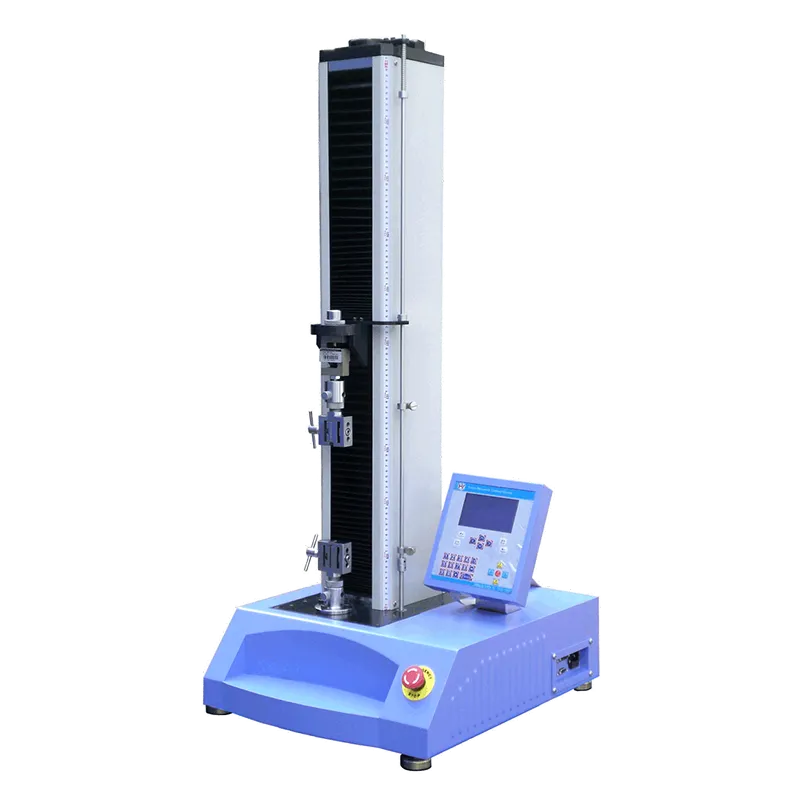
Universal Testing Machine: Complete Technical Guide and Specifications
What is a Universal Testing Machine?
A Universal Testing Machine (UTM), also known as a universal tensile machine, is a versatile scientific instrument used to perform mechanical testing on materials under tension, compression, flexure (bending), and shear forces.

The "universal" designation refers to its ability to conduct multiple types of tests simply by changing the modular fixtures and software test methods.
Universal Testing Machine Definition
According to ASTM E4 and ISO 7500-1, a UTM is a mechanical testing apparatus that applies controlled force to test specimens while measuring load and deformation.4https://www.zwickroell.com/products/static-materials-testing-machines/universal-testing-machines-for-static-applications/#:~:text=The%20universal%20tensile%20testing%20machine,the%20specimen%20and%20records%20it.
Key System Components
-
Load Frame: The physical structure, available in single-column (low capacity) or dual-column (high capacity) designs.
-
Actuator: The drive system, either Electromechanical (servo motor and ball screw) or Hydraulic (oil-driven cylinder).5https://amlinstruments.co.uk/advice/types-of-universal-testing-machine/
-
Load Cell: A precision strain gauge transducer that measures the force applied (Class 0.5 or 1.0 accuracy).
-
Crosshead: The moving beam that travels vertically to apply force to the specimen.6https://www.torontech.com/articles/what-is-a-universal-testing-machine/#:~:text=Back%20to%20top-,3.,ball%20screws%20and%20servo%20motors.
-
Control System: A closed-loop PID controller integrated with data acquisition software.
-
Test Fixtures: Interchangeable grips, platens, and jigs tailored for specific material shapes.7https://www.zwickroell.com/products/static-materials-testing-machines/universal-testing-machines-for-static-applications/#:~:text=In%20addition%2C%20universal%20testing%20machines,grips%2C%20compression%20platens%2C%20extensometers%2C
Primary Functions and Test Types
The UTM's versatility allows for a wide range of material characterization tests:8https://aanddtech.com/2025/04/03/understanding-universal-testing-machines-matter/#:~:text=UTMs%20can%20perform%20various%20types,indispensable%20for%20quality%20control%20and
1. Tensile Testing
-
Action: Pulling a specimen until it breaks.
-
Metrics: Ultimate tensile strength (UTS), yield strength, elongation at break.9
-
Standards: ISO 6892-1, ASTM E8 (metals), ISO 527, ASTM D638 (plastics).
2. Compression Testing
-
Action: Applying crushing force to a specimen between two plates.
-
Metrics: Compressive strength, modulus of elasticity.
-
Standards: ISO 604, ASTM D695 (plastics), ASTM C39 (concrete).
3. Flexural Testing (Bending)
-
Action: Applying force at 3 or 4 points to bend a specimen.
-
Metrics: Flexural strength, flexural modulus.
-
Standards: ISO 178, ASTM D790 (plastics), ASTM C78 (concrete).
4. Specialized Tests
-
Shear Testing: Measuring the resistance of adhesives or fasteners (ASTM D732).10
-
Peel Testing: Measuring bond strength at 90° or 180° angles (ASTM D903).11
-
Tear Testing: Measuring tear resistance of films or rubber (ASTM D624).
Working Principle and Operating Mechanism
The operation of a computerized UTM involves four critical stages:
-
Force Generation: A servo motor drives a precision ball screw (Electromechanical) or a hydraulic pump drives a cylinder (Hydraulic) to move the crosshead.12
-
Force Measurement: A load cell (using a Wheatstone bridge strain gauge) detects the load.13 This signal is amplified and converted by a 24-bit ADC.
-
Displacement & Strain: Crosshead travel is measured by an optical encoder. For precise material deformation, an Extensometer is attached directly to the specimen.14
-
Closed-Loop Control: Feedback from the load cell and encoder allows the PID controller to maintain a perfectly constant test speed regardless of how much resistance the material offers.
Types of Universal Testing Machines
By Drive System
| Feature | Electromechanical UTM | Servo-Hydraulic UTM |
| Capacity | 0.5 kN to 300 kN | 100 kN to 2000 kN |
| Best For | Plastics, textiles, medical devices | Structural steel, concrete, rebar |
| Speed Control | Extremely precise (0.001 mm/min) | High force at lower speeds |
| Maintenance | Low (lubrication) | High (oil changes, filters) |
By Frame Configuration
-
Single Column: Compact benchtop units for forces up to 5 kN.15 Ideal for thin films and medical packaging.
-
Dual Column: Rigid frames for high loads (5 kN to 2000 kN). Used for general material testing.
-
Horizontal: Used for testing long specimens like wire ropes, cables, or chains that exceed vertical frame height limits.
Technical Specifications (ITM-LAB Models)
| Model | Capacity | Test Space | Speed Range | Load Class | Price (USD) |
| ITM-3E | 3 kN | 600 mm | 0.001-500 mm/min | 0.5 | $10,000-$14,000 |
| ITM-50E | 50 kN | 1000 mm | 0.001-500 mm/min | 0.5 | $22,000-$32,000 |
| ITM-100E | 100 kN | 1200 mm | 0.001-500 mm/min | 0.5 | $32,000-$45,000 |
| ITM-600H | 600 kN | 1200 mm | 0.01-300 mm/min | 1.0 | $75,000-$110,000 |
Industry Applications
-
Automotive: Seat belt strength (FMVSS 209), steering wheel impact, and adhesive bonding.
-
Aerospace: Composite laminate testing (ASTM D3039) and fastener shear.
-
Medical: Surgical suture strength, syringe plunger force, and catheter tensile strength.16
-
Construction: Rebar tensile properties (ASTM A370) and concrete compression (ASTM C39).
-
Packaging: Corrugated box crushing and film puncture resistance.
Software and Data Management
Modern UTMs are computerized, offering significant advantages over manual/analog systems:17
-
Real-time Graphing: Instant display of Stress vs. Strain curves.
-
Method Library: Pre-configured templates for ISO and ASTM standards.
-
Automatic Analysis: Instant calculation of Yield Strength (0.2% offset), Modulus, and Peak Load.
-
Audit Trails: Compliance with FDA 21 CFR Part 11 for medical and pharmaceutical industries.
Maintenance Schedule
-
Daily: Clean grip faces and zero the load cell.18
-
Monthly: Lubricate ball screws and check hydraulic fluid levels.
-
Annually: Professional ISO 7500-1 calibration (required for certification).
Frequently Asked Questions
Q: What is the difference between a tensile tester and a UTM?
A: A tensile tester is designed only for pulling. A UTM is a multi-purpose frame that can pull (tension), push (compression), and bend (flexure) by swapping fixtures.19
Q: Which load cell accuracy class do I need?
A: Class 0.5 (±0.5% error) is the gold standard for material certification and R&D. Class 1.0 is generally sufficient for routine quality control in manufacturing.20
Q: How do I choose the right capacity?
A: Calculate your expected maximum load and apply a 1.2 to 1.5 safety factor. For example, if your material breaks at 8 kN, a 10 kN or 12 kN machine is appropriate.
