
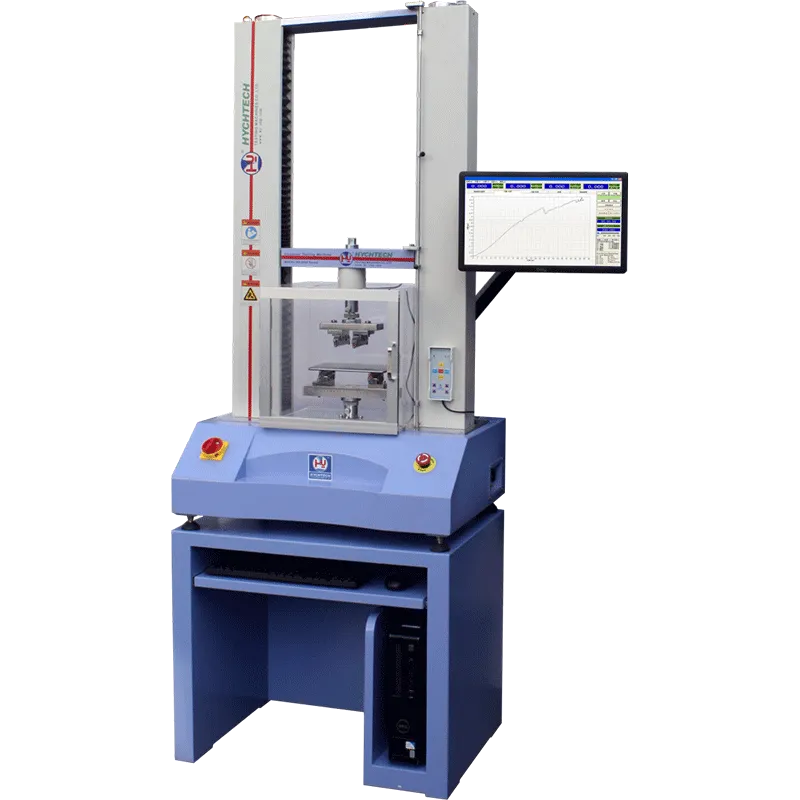
tensile testing machine: Ultimate Guide to Tensile Strength Testing (2025)
Reading Time: 12 mins | Focus: ASTM/ISO Standards, Equipment Selection, & Procedures
What is a Tensile Testing Machine?
A tensile testing machine (also known as a tensile tester or a Universal Testing Machine/UTM) is a precision instrument designed to measure how materials behave when pulled apart. It provides critical data regarding a material's strength, ductility, and elastic properties by applying controlled force until the specimen deforms or breaks.
How the Tensile Test Works
-
Grip: A specimen is secured at both ends.
-
Pull: One grip moves at a controlled speed while the other remains stationary.
-
Measure: A load cell measures force, while an extensometer tracks elongation.
-
Analyze: Software converts this data into a stress-strain curve to calculate mechanical properties.
1. Essential Components of a Tensile Tester
| Component | Function | Why It Matters |
| Load Frame | Structural skeleton | Ensures rigidity and perfect alignment. |
| Drive System | Electromechanical or Hydraulic | Controls the speed and force of the pull. |
| Load Cell | Force Transducer | The "scale" that measures tension in Newtons or kN. |
| Grips/Jaws | Specimen anchors | Prevents slippage, which is the #1 cause of test error. |
| Extensometer | Strain measurement | Measures actual material stretch (more accurate than crosshead travel). |
2. Types of Tensile Testing Machines
By Force Capacity
-
Low-Force (< 5 kN): Best for textiles, films, and medical devices. (Approx. –).
-
Medium-Force (5-100 kN): The "all-rounder" for plastics, composites, and thin metals. (–).
-
High-Force (100-600 kN): Built for heavy-duty alloys and aerospace components. (–).
-
Very High-Force (> 600 kN): Hydraulic systems for structural steel and heavy industry. (+).
By Drive System: Electromechanical vs. Hydraulic
Expert Tip: Electromechanical systems are preferred for plastics and composites due to their precision and clean operation. Hydraulic systems are reserved for very high-capacity metals testing where massive force is the priority.
3. Materials, Applications, and Standards
Metals & Alloys
-
Key Tests: Yield strength, UTS, Young’s modulus.
-
Standards: ASTM E8/E8M, ISO 6892-1.
-
Setup: High-force frame with wedge grips and a clip-on extensometer.
Plastics & Polymers
-
Key Tests: Tensile modulus, elongation at break.
-
Standards: ASTM D638, ISO 527.
-
Setup: Medium-force frame, pneumatic grips to prevent specimen damage.
Rubber & Elastomers
-
Key Tests: 100%/300% Modulus, tear resistance.
-
Standards: ASTM D412, ISO 37.
-
Setup: High-travel frames (for high elongation) and roller or pneumatic grips.
Textiles & Films
-
Key Tests: Breaking strength, puncture resistance, seal strength.
-
Standards: ASTM D5034, ASTM D882.
-
Setup: Low-force benchtop systems with specialized film/fabric grips.
4. Key Measurements Defined
Ultimate Tensile Strength (UTS)
The maximum stress a material withstands before breaking.
Yield Strength
The point where a material stops stretching elastically and begins to deform permanently. Most metals use the 0.2% Offset Method.
Elastic Modulus (Young's Modulus)
A measure of stiffness. It is the ratio of stress to strain in the linear elastic region.
-
Steel: ~200 GPa
-
Aluminum: ~70 GPa
-
Plastics: 1-5 GPa
5. Selecting the Right Grips & Extensometers
The accuracy of your data depends heavily on the interface between the machine and the material.
-
Wedge Grips: Best for hard metals and rigid plastics.
-
Pneumatic Grips: Best for high-volume testing and soft materials (prevents "necking" at the grip).
-
Video Extensometers: The modern standard. Non-contact measurement that tracks visual markers—perfect for high-elongation materials like rubber.
6. Maintenance & Troubleshooting
Common Testing Issues
| Problem | Likely Cause | Solution |
| Slippage | Low grip pressure | Increase PSI or change jaw face (serrated). |
| Grip Breaks | Jaws too sharp/tight | Use "dogbone" specimens or softer jaw faces. |
| Inaccurate Modulus | Frame compliance | Always use an extensometer for modulus data. |
Calibration Requirements
To maintain ISO 17025 or ASTM E4 compliance, machines must be calibrated annually by a certified technician using NIST-traceable weights.
7. Buying Guide Summary (2025)
When choosing a machine, consider the "Three S's":
-
Strength: Does the load cell cover your strongest material plus a safety margin?
-
Stroke: Is the frame tall enough for your most ductile (stretchy) material?
-
Standards: Does the software include pre-set templates for ASTM/ISO?
Key Takeaways for 2025:
-
✅ Match Capacity: Aim for tests to fall between 10% and 90% of the load cell capacity.
-
✅ Automate: Modern software (2025 versions) significantly reduces human error in calculation.
-
✅ Precision: Never rely on crosshead travel for modulus; use an extensometer.
Would you like me to generate a technical comparison table for specific ASTM vs. ISO testing procedures mentioned here?
