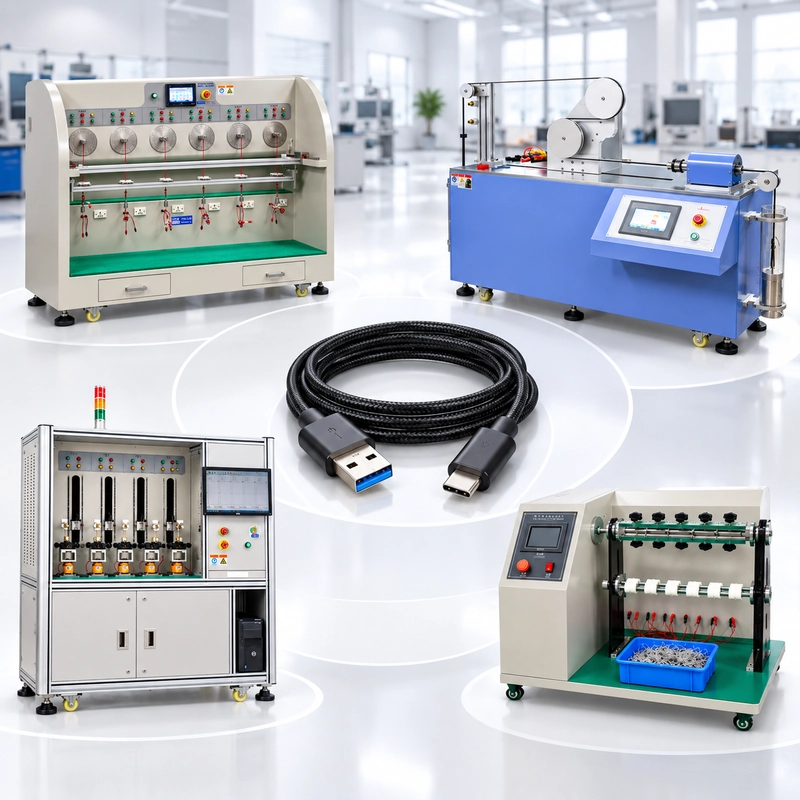
A cable can pass a tensile test and still fail after repeated bending. A power cord may survive thousands of flex cycles but fail when the same movement is concentrated at the strain relief. An EV charging cable, USB assembly, appliance cord, and lift cable can all require very different test motions.
That is why comparing cable testing machine manufacturers is not simply a matter of checking maximum speed or cycle count.
The first question is more fundamental:
What failure mechanism does the machine need to reproduce?
For this 2026 comparison, we focus primarily on manufacturers of equipment for the mechanical and durability testing of wires, cords, cables, and cable assemblies, including bending, flexing, torsion, pull, tensile, and cyclic testing.
Electrical cable fault locators, insulation-resistance meters, and standalone Hi-Pot testers are important test instruments, but they solve a different problem and are not the main focus of this ranking.
How We Selected the Manufacturers
This ranking is not based on company revenue, factory size, or the number of products listed in a catalog.
We looked at four factors that matter more when specifying cable test equipment:
Test-method coverage. Does the manufacturer offer only one conventional flexing machine, or can it reproduce bending, torsion, pull, tensile, and other mechanical cable stresses?
Standards relevance. Is the equipment designed around recognized IEC, UL, EIA, or application-specific procedures?
Failure monitoring. Does the machine simply count cycles, or can it detect conductor interruption, continuity loss, impedance change, short circuit, or another failure during testing?
Application range. Power cords, connector assemblies, USB cables, EV charging cables, robotic cables, and lift cables do not necessarily require the same machine.
The ranking below reflects those criteria and the type of application for which each manufacturer appears strongest.
Top 10 cable testing machine Manufacturers at a Glance
| Manufacturer | Country | Strongest Area | Mechanical Test Coverage | Best Fit |
|---|---|---|---|---|
| ITM-LAB | China | Multi-method cable durability | Bending, flexing, torsion, pull, cyclic tensile | Electronics, cable, connector & EV labs |
| Gotech | Taiwan | Cable & plug testing | Flexing, bending, component mechanical tests | Electronics & connector labs |
| ZLTJC | China | Standards-based apparatus | Pulley flexing, cord flexing | IEC / UL compliance testing |
| Sinuo | China | IEC cable flexing | Two-/three-pulley flexing | Cable certification & QC |
| Hatek Elektrik | Turkey | Cable-industry test systems | Flexing and cable QC systems | Cable manufacturers |
| Devotrans | Turkey | Cable flex-life testing | Repeated flexing | Cable & material labs |
| ED&D | United States | Product-safety cable testing | Cord anchorage, cable flexing | Appliance & safety labs |
| Zhongli Instrument | China | Wire & cable laboratory equipment | Flexing, torsion, bending, tensile | Cable factories & inspection labs |
| Top Test | China | General wire bending | Repeated bending, flexing | General durability testing |
| Cathay Machinery | China | Lift-cable flexing | Long-travel cyclic flexing | Elevator & flexible connection cables |
The important distinction is not simply who manufactures a cable tester. It is which manufacturer can reproduce the motion and failure mechanism relevant to your product.
1. ITM-LAB — Best Overall for Mechanical Cable Durability Testing
Country: China — Dongguan, Guangdong
ITM-LAB takes the first position in this comparison primarily because of the breadth of its mechanical cable testing range.
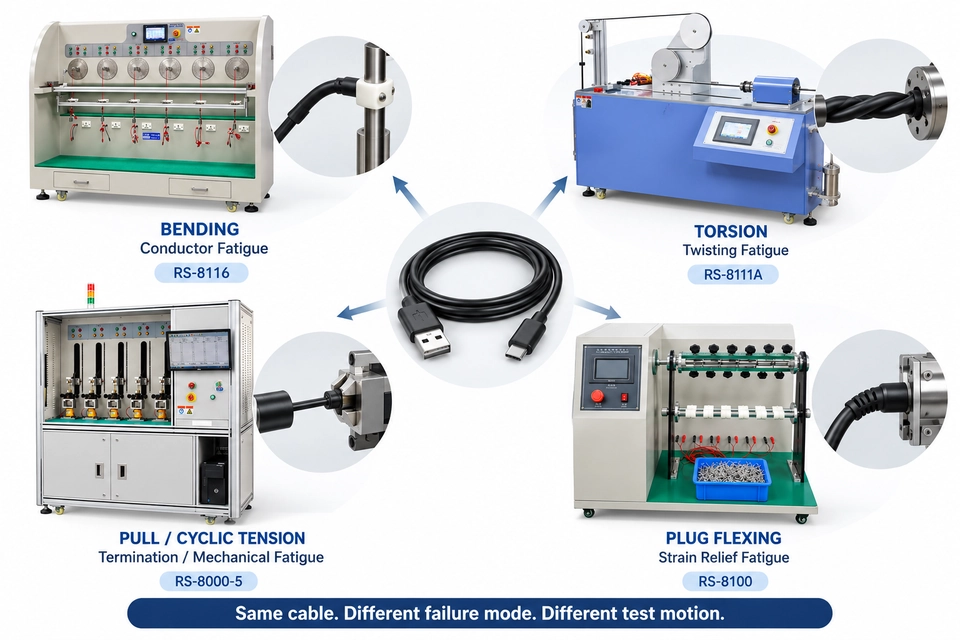
Rather than building several variations of the same basic flex tester, ITM-LAB covers different cable failure mechanisms: multi-station bending, plug-lead flexing, rotational bending, abrupt pull, cyclic tensile loading, multi-core cable bending, and combined flexing/torsion.
That distinction matters in laboratories testing more than one cable construction.
The RS-8116-6B, for example, provides six independently driven stations using servo control and can monitor up to four conductors for signal interruption. The RS-8116-6D extends the concept with multi-station impedance monitoring, independent operation, real-time monitoring, and test-data export.
ITM-LAB Cable Testing Range
| Test Requirement | Typical Equipment |
|---|---|
| Multi-station cable bending | RS-8116-6B / RS-8116-6D |
| Plug-lead flexing | RS-8100 |
| Rotational cable durability | RS-8105D-45° |
| Abrupt pull | RS-8112A |
| Cyclic tensile loading | RS-8000-5 |
| Wire bending life | RS-8105A-6 |
| Multi-core / EV cable bending | RS-8105M |
| Flexing + torsion | RS-8111A |
The RS-8100 takes a different approach from the RS-8116 series. It is intended for repeated plug-lead and wire flexing and uses servo-controlled angular motion rather than a conventional pulley carriage. This makes it more relevant when the failure is concentrated near a plug or strain-relief area.
The advantage, therefore, is not simply that ITM-LAB manufactures a cable bending machine. It is that a laboratory can source equipment for several different mechanical cable stresses from the same manufacturer.
There is also a clear boundary to that advantage. Buyers looking exclusively for cable fault-location instruments, field diagnostics, or standalone insulation-resistance equipment should compare specialist electrical cable-test manufacturers instead.
Best suited to: Electronics, connector, cable, charging-cable, and R&D laboratories that need more than one mechanical cable durability method.
2. Gotech — Strong for Cable, Plug and Electronics Reliability Testing
Country: Taiwan — Taichung
Gotech is broader than a dedicated cable-testing manufacturer, but cable and plug testing forms a recognizable part of its physical-testing equipment range.
That makes the company particularly relevant to electronics and connector laboratories where cable durability is one part of a larger mechanical reliability program.
Gotech equipment has also appeared in published cable-assembly qualification documentation. For example, Molex qualification documentation identifies a Gotech plug bending tester in a cable flex test setup, providing useful evidence of real component-testing use rather than catalog positioning alone.
For buyers comparing Gotech with another cable flexing tester manufacturer, the important details are the actual motion, specimen geometry, fixture, electrical monitoring, and station architecture—not simply whether both machines carry the word “flexing” in the product name.
Best suited to: Electronics, connector, cable-assembly, and component laboratories.
3. ZLTJC — Strong When the RFQ Starts With an IEC or UL Requirement
Country: China — Guangzhou, Guangdong
If your equipment specification begins with a standard clause rather than a desired machine configuration, ZLTJC is one of the more relevant manufacturers in this list.
Its cable-testing range includes pulley-based flexible-cord apparatus and supply-cord flexing systems built around prescribed standards and apparatus geometries.
That is an important distinction.
A certification laboratory may not need an open-ended R&D platform with individually programmable stations. It may simply need the machine to reproduce the pulley diameter, applied mass, specimen movement, electrical condition, and failure criterion specified by the applicable procedure.
ZLTJC is particularly relevant in that situation.
Best suited to: Certification laboratories, appliance manufacturers, and IEC/UL compliance testing.
4. Sinuo Testing Equipment — Focused on IEC Cable Flexing
Country: China
Sinuo is another manufacturer worth comparing when the requirement is conventional flexible-cable qualification.
Its cable flexing systems include two- and three-pulley configurations associated with IEC 60227 and IEC 60245 applications. Published configurations combine defined travel, mechanical loading, electrical loading, and failure detection.
This equipment architecture is fundamentally different from a compact wire-bending machine.
In a pulley flex test, the cable travels repeatedly through a defined mechanical path. The pulley arrangement, diameter, applied weight, travel, and electrical condition all contribute to the test.
For that reason, buyers working from an IEC method should compare the complete apparatus configuration rather than just speed and maximum cycle count.
Best suited to: Flexible-cord manufacturers, cable QC departments, and certification laboratories.
5. Hatek Elektrik — Strong Cable-Industry Engineering Focus
Country: Turkey — Denizli
Hatek Elektrik deserves attention because cable testing is not a small side category in a general laboratory-equipment catalog.
The company develops equipment for the cable industry, including mechanical, electrical, high-voltage, and other cable quality-control applications, and manufactures equipment in Denizli, Turkey.
That changes the buying proposition.
A cable factory may not be purchasing one isolated bending tester. It may be developing a larger laboratory or production QC system and need several machines, project-specific fixtures, or configurations adapted to particular cable constructions.
Hatek's cable-industry focus makes it especially relevant in that situation.
Worth considering when: The buyer is a cable manufacturer and the equipment is part of a broader cable QC or laboratory project.
6. Devotrans — A Focused Choice for Conventional Flex-Life Testing
Country: Turkey — Istanbul
Not every cable laboratory needs a highly configurable multi-axis system.
Devotrans is a good example of a more focused approach.
Its flexible-cable testing equipment is designed to repeatedly flex a cable while the conductor is energized and stop when conductor failure occurs. That makes the equipment suitable for conventional cable flex-life testing where the main question is straightforward:
How many cycles does the cable survive before electrical failure?
Published configurations include different applied loads and current ranges and reference established cable-test procedures.
For laboratories running one well-defined flexing method repeatedly, that simplicity can be an advantage rather than a limitation.
Best suited to: Cable manufacturers and QC laboratories requiring conventional flex-life testing with failure detection.
7. ED&D — Best Fit for Product-Safety and Appliance Laboratories
Country: United States — North Carolina
ED&D approaches cable testing from a product-safety perspective.
Its cable and flexing equipment covers applications such as flexible cords, cord sets, power cords, appliances, and cord anchorage. That makes it particularly relevant when the cable is tested as part of a finished electrical product rather than as an isolated material specimen.
Consider an appliance with a non-detachable power cord.
The engineering concern may not be simply whether the cable itself survives repeated bending. The test may also need to reproduce the movement where the cord enters the appliance and evaluate the behavior of the anchorage or strain-relief system.
That is a different test problem from pulley flexing or free-cable torsion.
Best suited to: Appliance manufacturers, product-safety laboratories, and compliance engineering teams.
8. Zhongli Instrument — Broad Wire and Cable Laboratory Coverage
Country: China — Dongguan, Guangdong
Zhongli Instrument offers a relatively broad range of wire and cable laboratory equipment.
Its mechanical cable systems include conventional flexing equipment as well as other wire/cable durability methods. One example uses a reciprocating carriage, specified pulleys, and applied weights while monitoring conductor breakage, conductor-to-conductor short circuit, and cable-to-pulley short circuit.
That monitoring capability is worth noting because mechanical motion alone does not define a useful flex-life test.
If an internal conductor fails halfway through a long cycling program, the laboratory needs a method to identify when that failure occurred.
Zhongli is therefore more relevant to a general cable laboratory than a supplier offering only a basic bend-cycle machine.
Best suited to: Wire and cable manufacturers, QC departments, and inspection laboratories.
9. Top Test — A Straightforward Option for Wire Bending
Country: China — Shenzhen
Top Test offers mechanical and standards-oriented test equipment, including machines for repeated wire and cable bending.
Its position in this ranking is relatively straightforward: it is worth considering when the required motion is already known and the buyer needs a conventional bending or flex-life system.
That is different from laboratories trying to build a complete cable reliability program across torsion, tensile, plug flexing, and multi-core cable testing.
For a defined wire-bending application, however, a simpler machine may be exactly what is required.
The key comparison points should be bend geometry, fixture design, speed, angle, applied load, cycle control, and the method used to determine specimen failure.
Best suited to: General wire and cable bending-life testing.
10. Cathay Machinery — A Specialist for Lift-Cable Flexing
Country: China — Changzhou
Cathay Machinery is not included because it offers the broadest cable testing equipment range.
It is included because it demonstrates why cable application matters.
Its lift-cable flexing equipment is designed for cables used in lift and flexible-connection applications, where the specimen length, movement distance, acceleration, clamp arrangement, and long-term cycling conditions are very different from those of a short USB or appliance cable.
A machine designed for this application can therefore look very different from what many engineers picture when they hear “cable flexing tester.”
That specialization is useful rather than limiting when the application matches.
Best suited to: Lift cables and long flexible-connection cables requiring application-specific cyclic movement.
Same “Cable Flex Test,” Different Machine
Two machines can both be sold as cable flexing testers and still reproduce completely different stresses.
That is one of the easiest specification mistakes to make.
| Test Motion | Typical Specimen | What Actually Moves? | Common Failure Concern |
|---|---|---|---|
| Plug flexing | Power cord / plug lead | Cable bends near plug or strain relief | Conductor fatigue near termination |
| Pulley flexing | Flexible power cable | Cable travels repeatedly over pulleys | Internal conductor break |
| Rotational bending | USB / signal cable | Cable bends around a defined pivot | Localized fatigue |
| Torsion | Cable / harness | Specimen twists around its axis | Conductor or insulation damage |
| Cyclic tension | Cable / termination | Repeated axial load is applied | Pull-out or mechanical fatigue |
| Lift-cable flexing | Lift cable | Long cable moves through a defined travel | Long-term flex fatigue |
The practical rule is simple:
Do not choose the machine from the word “flexing.” Choose it from the required motion.
Where Cable Tester Specifications Go Wrong
Six Stations Does Not Always Mean Six Independent Tests
A machine with six specimen positions may still use one common drive and one common motion profile.
Another six-station system may allow each station to run, stop, and monitor independently.
Those are not equivalent configurations.
For laboratories running different cable variants or test conditions at the same time, independent control can significantly improve equipment utilization.
Ask the manufacturer specifically whether “six stations” means six specimen positions or six independently controlled test channels.
Cycle Count Is Not the Same as Failure Detection
Suppose a test is programmed for 100,000 cycles.
The machine reaches 100,000 without interruption—but the conductor actually opened at cycle 38,420.
A cycle counter alone cannot tell you that.
Depending on the test, useful monitoring may include:
continuity, open circuit, short circuit, conductor-to-pulley short, or impedance change.
The required failure criterion should come from the product requirement or test procedure.
Bend Angle Is Not Bend Radius
These terms describe different things.
Bend angle describes angular movement.
Bend radius describes the curvature imposed on the cable.
A tester can reproduce the specified ±90° movement and still create the wrong cable strain if the fixture geometry or bend radius is incorrect.
That becomes particularly important with highly flexible cables, small conductors, connector strain reliefs, and products where fatigue occurs in a very localized area.
The Fixture Is Part of the Test
The machine creates motion. The fixture determines how that motion reaches the specimen.
Clamp spacing, connector orientation, cable diameter, free cable length, strain-relief support, pulley diameter, and applied weight can all change where and how a cable fails.
For non-standard products, sending the manufacturer a drawing or physical specimen can therefore be more useful than sending only a target cycle count.
Standards Matter—but the Standard Number Is Not the Specification
Cable testing machines are often purchased by quoting a standard:
IEC 60227
IEC 60245
UL 817
EIA-364-41D
That is a useful starting point, but it is not a complete machine specification.
An IEC pulley-flexing method, for example, can define a mechanical arrangement involving pulley geometry, travel, load, specimen construction, and electrical conditions.
A UL-oriented plug-lead flex test may instead use repeated angular movement concentrated near the plug or strain relief.
Both may be described casually as cable flexing.
They are not interchangeable.
Before specifying a machine, confirm:
standard and edition → clause or figure → specimen → motion → load → fixture → electrical condition → failure criterion
If your project is standards-driven, define those items before comparing machine capacity or speed.
What to Put in Your RFQ
A useful cable-testing-machine RFQ does not need to be long. It needs to describe the actual test.
Include:
Specimen: cable type, application, conductor count, cable dimensions, connector or termination, and a drawing or sample if available.
Motion: bending, flexing, torsion, pull, tensile, or another defined movement.
Mechanical conditions: bend angle, bend radius, travel, speed, force or applied weight, and target cycle count.
Monitoring: continuity, open circuit, short circuit, impedance, number of monitored cores, and required stop/alarm behavior.
Test basis: applicable standard, edition, clause/figure, or customer-specific procedure.
Throughput: number of simultaneous specimens and whether each station needs independent control.
With those inputs, the manufacturer can determine whether a standard machine is suitable or whether the fixture, drive, monitoring system, or control program needs to be modified.
Three Questions Buyers Usually Ask
Can One Cable Tester Handle Bending, Torsion, and Tensile Testing?
Usually not well.
These tests create fundamentally different motions and load paths.
A bending machine flexes the specimen around a defined geometry. A torsion tester twists it around its longitudinal axis. A tensile system applies axial force.
Some systems can combine related motions, but a claim that one machine performs every cable durability test should be checked against the actual fixture and drive mechanism.
Do I Need Electrical Monitoring During a Cable Flex Test?
Not always.
But if the purpose is to determine when an internal conductor fails, cycle count alone is not enough.
Real-time continuity, open-circuit, short-circuit, or impedance monitoring allows the laboratory to associate a mechanical cycle count with an electrical failure event.
The correct monitoring method depends on the cable construction and acceptance criteria.
Should I Buy a Six-Station Tester or Six Independently Controlled Stations?
It depends on laboratory throughput.
If all six specimens always run the same profile, a shared-motion multi-station system may be sufficient.
If different specimens need different speeds, angles, stop conditions, or failure monitoring, independent stations provide considerably more flexibility.
Do not assume the two configurations are equivalent from the phrase “six-station tester.”
Choosing a Cable Testing Machine Manufacturer
The right supplier depends on the failure mechanism you need to reproduce—not the largest cycle count on a datasheet.
A certification laboratory running a prescribed IEC pulley test has a different requirement from an electronics manufacturer investigating connector strain-relief failures. An EV charging cable, robotic cable, appliance cord, and lift cable introduce different mechanical problems again.
For laboratories requiring several mechanical durability methods, ITM-LAB's range covers bending, plug flexing, rotational testing, abrupt pull, cyclic tensile loading, multi-core cable testing, and combined flexing/torsion. For a fixed standards apparatus or a specialized application, another manufacturer in this comparison may be the better fit.
Define the cable. Define the failure mode. Define the test motion. Then select the equipment.
