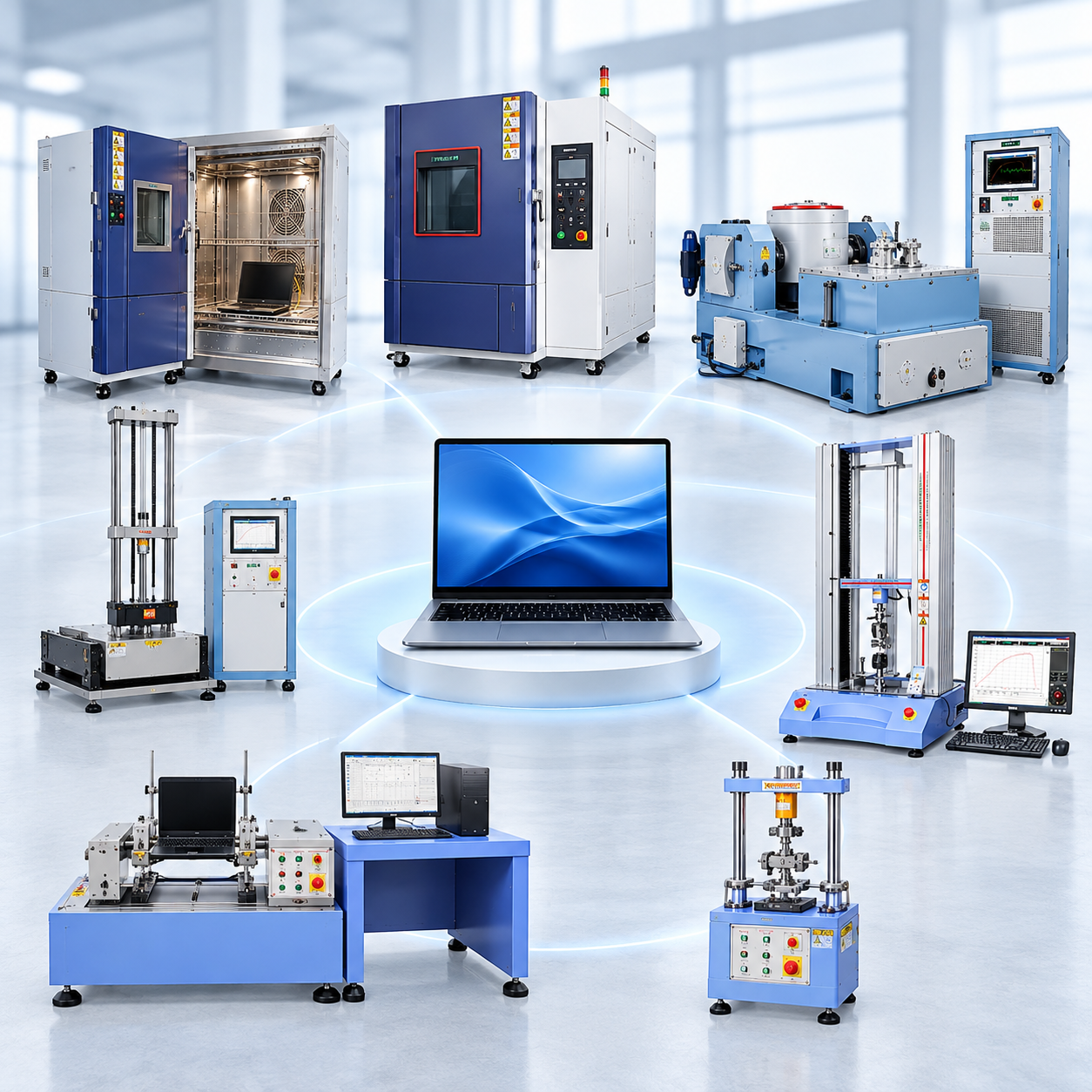
There is no single category of “electronics reliability test equipment.”
A laptop reliability lab may contain an environmental chamber, vibration system, shock machine, connector force tester and hinge torque tester. A semiconductor lab may care much more about thermal cycling and electrical monitoring. An automotive electronics lab may put vibration, shock and temperature near the top of the list.
So the manufacturers below are not ten companies making the same machine.
They represent different parts of the reliability-testing landscape. Some are environmental specialists. Some are strongest in vibration or mechanical testing. Others cover several physical test disciplines.
For buyers, that distinction is more useful than a simple brand ranking.
10 Manufacturers at a Glance
| Manufacturer | Where It Is Strongest | Typical Fit |
|---|---|---|
| ESPEC | Environmental chambers, thermal cycling, HALT/HASS | Electronics environmental reliability |
| Thermotron | Environmental + vibration systems | Combined environmental/dynamic labs |
| Weiss Technik | Environmental simulation | Climate-intensive reliability programs |
| IMV | Vibration testing | Dynamic reliability |
| ETS Solutions | Vibration and shock systems | Electronics / automotive dynamic testing |
| Instron | Force and mechanical characterization | Components and assemblies |
| Chroma ATE | Electrical and functional test | Semiconductor / power / electronics |
| SUGA Test Instruments | Material and environmental durability | Coatings, surfaces, materials |
| Haida | Broad laboratory equipment range | General-purpose laboratories |
| ITM-LAB | Environmental + dynamic + mechanical + durability testing | Multi-system electronics reliability labs |
This is not a best-to-worst ranking. The useful shortlist depends on what you need to test.
1. ESPEC
ESPEC is one of the obvious names to look at when the requirement is mainly environmental.
Temperature, humidity, thermal cycling and thermal shock are central parts of its portfolio. Qualmark also sits within the ESPEC group, adding HALT/HASS capability for teams that want to push a design beyond normal qualification limits and identify weaknesses earlier in development.
Where ESPEC stands out: environmental simulation and accelerated reliability.
For a lab dominated by climatic testing, ESPEC is a logical company to include in the RFQ list.
2. Thermotron
Thermotron is interesting because it crosses the boundary between environmental and dynamic testing.
The company supplies environmental chambers as well as electrodynamic vibration systems, and its AGREE systems are designed around combined temperature, humidity and vibration applications.
That matters more than it may sound.
A PCB can pass temperature cycling and pass vibration separately, yet behave differently when thermal expansion and mechanical excitation occur together.
Thermotron therefore makes particular sense for labs where environmental and vibration testing need to coexist or be combined.
3. Weiss Technik
Weiss Technik is primarily an environmental-simulation supplier in the context of electronics reliability.
Its equipment range covers temperature and humidity testing, thermal cycling, thermal shock and more specialized environmental conditions.
I would put Weiss on the shortlist when climatic testing represents a large percentage of the lab workload, especially when the DUT ranges from small electronic assemblies to larger integrated systems.
Its role here is straightforward: environmental simulation is the specialty.
4. IMV
IMV is a different type of company from the three above.
Its strength is vibration.
For an electronics engineer investigating PCB resonance, connector intermittency, solder fatigue or structural response under random vibration, that specialization matters more than having a catalog covering ten unrelated test categories.
A vibration system also needs to be evaluated as a system—not simply by shaker force. Fixture mass, DUT mass, displacement, velocity, acceleration and the required PSD all affect whether the specified test can actually be run.
If vibration is a major part of the validation program, IMV belongs on the shortlist.
5. ETS Solutions
ETS Solutions occupies a similar dynamic-testing space, with vibration and shock systems for electronics, automotive and other reliability applications.
The useful comparison here is usually not:
Which shaker has the larger force number?
It is:
Can the shaker + amplifier + controller + fixture reproduce our required profile with the actual payload?
That is the engineering question that matters.
ETS Solutions is therefore most relevant to laboratories with a substantial vibration and shock workload.
6. Instron
Instron does not compete directly with an environmental-chamber company, and that is exactly why it belongs on this list.
Electronics reliability also involves mechanical questions:
- How much force pulls a connector or component from an assembly?
- What load damages a housing?
- How strong is an adhesive joint?
- How does a PCB respond to bending?
- What happens to a component under compression?
Instron's electronics and microelectronics testing solutions cover tensile, compression, bend, peel and shear applications across a broad range of force levels.
For mechanical characterization, Instron remains a specialist rather than a general reliability-equipment supplier.
7. Chroma ATE
Chroma represents another part of the reliability problem: electrical and functional behavior.
A temperature chamber tells you the environment.
A shaker tells you the mechanical input.
Neither automatically tells you whether a power rail dropped out, communication failed or electrical performance drifted during the test.
Chroma's broader portfolio covers semiconductor, power electronics, batteries and other electronic test applications.
For many electronics programs, physical stress equipment and electrical test equipment therefore work together rather than replace one another.
8. SUGA Test Instruments
SUGA becomes relevant when the concern moves from the circuit itself to the materials surrounding it.
Think about plated contacts, coatings, polymer housings, displays and surface finishes.
These materials can degrade long before a product experiences a dramatic mechanical failure, and the degradation can eventually affect electrical or mechanical performance.
SUGA's strength is therefore best described as material, surface and environmental durability testing.
It is a more specialized fit than a general electronics reliability supplier, but a useful one for the right lab.
9. Haida
Haida takes the broad-catalog approach, covering multiple environmental and mechanical test categories.
That can make procurement easier for a general-purpose laboratory that wants several types of equipment from fewer suppliers.
But with a broad supplier, I would still evaluate each system independently.
A large catalog does not tell you whether a particular chamber can handle your DUT heat load, whether a vibration system can run your loaded profile, or whether a force tester has the right measurement range and fixture.
Breadth is useful. Test capability still has to be checked machine by machine.
10. ITM-LAB
ITM-LAB is also a broad supplier, but its useful position in electronics reliability is more specific: physical reliability testing across several stress categories.
Instead of looking at the product catalog machine by machine, it is easier to see the range through a typical electronics validation program.
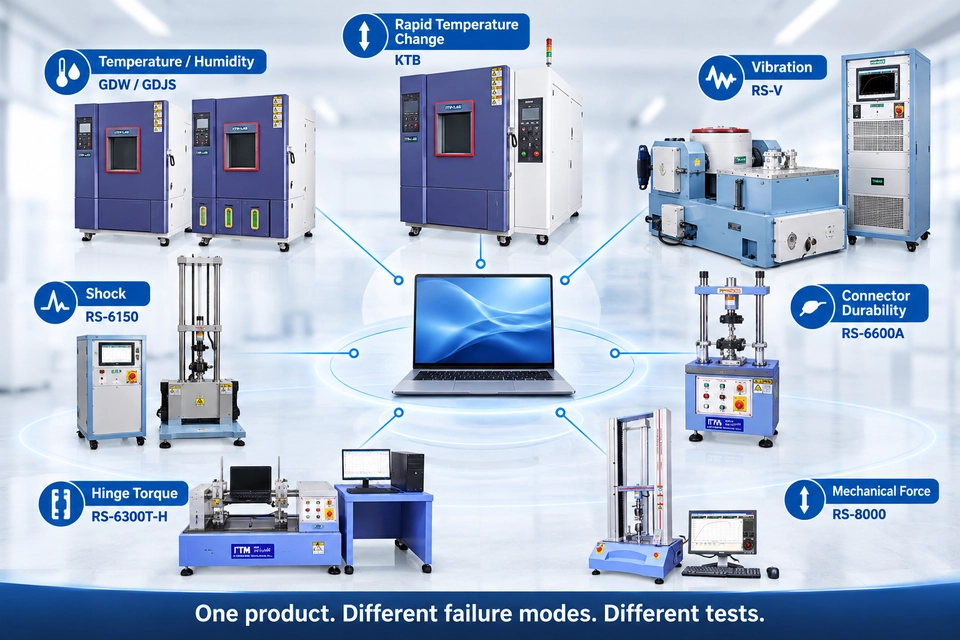
Environmental
Temperature and humidity testing is covered by the GDW / GDJS families.
Where faster temperature transitions are required, KTB configurations cover 5, 10 and 15°C/min rates.
For temperature combined with reduced pressure or altitude, GDJZ systems extend the environmental side of the lab.
Vibration, shock and drop
The RS-V Series covers random vibration.
The RS-6150 is used for mechanical shock.
The RS-DP Series covers controlled and repeated drop applications.
These systems address different events; a drop tester is not a substitute for a shock machine, and a shock machine is not a substitute for a vibration shaker.
Force and mechanical testing
For component and assembly force testing, ITM-LAB's UTM range spans:
RS-8010A — 50 N to 5 kN
RS-8000 — 10 to 50 kN
RS-8000A — 100 to 300 kN
This covers work ranging from relatively low-force electronics and component testing to substantially heavier structural tests.
Connectors, hinges and mechanisms
This is an area where the ITM-LAB electronics portfolio becomes more specific.
The RS-6600A is designed around connector insertion, extraction and retention testing with synchronized force-displacement data.
The RS-6300 Series covers torque applications including hinges and rotating mechanisms.
There are also dedicated systems for repeated button, touch, folding, rotating and other device-level durability tests.
That gives ITM-LAB a useful position when the project is not just “buy an environmental chamber,” but something closer to:
We are building an electronics reliability lab and need to cover several physical failure modes.
A Laptop Is a Good Example
Take a laptop as the DUT.
The reliability plan might look something like this:
| What are we concerned about? | Test |
|---|---|
| PCB / solder fatigue | Temperature cycling |
| Moisture sensitivity | Temperature + humidity |
| Transport / operating vibration | Random vibration |
| Mechanical impact | Shock |
| USB port wear | Insertion / extraction cycling |
| Hinge degradation | Torque / life testing |
| Housing strength | Controlled force testing |
No single machine answers all seven questions.
And this is the main reason ITM-LAB's product breadth matters.
The advantage is not simply having more equipment models. It is being able to configure environmental, dynamic, mechanical and interface-durability systems around the same electronic product.
One Point Engineers Should Not Ignore: Test Input Is Not DUT Response
This is where equipment specifications can become misleading.
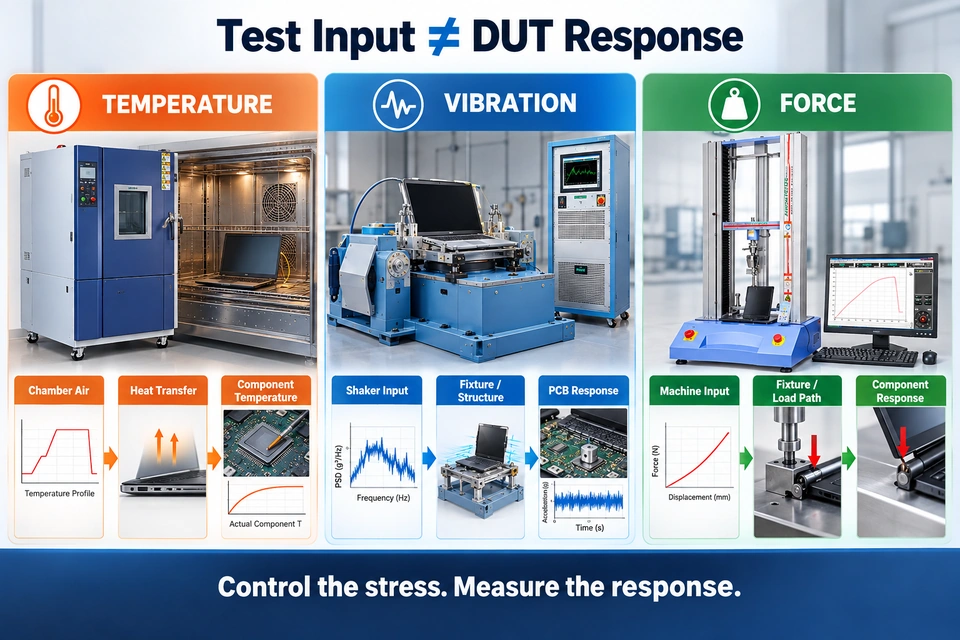
If chamber air reaches −40°C, the PCB does not instantly reach −40°C.
If a vibration table is controlled at 8 Grms, every point on the PCB does not experience exactly 8 Grms.
If a test-machine crosshead moves 5 mm, the component itself has not necessarily deformed 5 mm.
In each case there is something between the machine and the result:
Temperature: chamber air → heat transfer → component temperature
Vibration: shaker → fixture → enclosure → PCB response
Force: actuator → fixture → load path → local deformation
A useful reliability test therefore needs both sides:
Control the stress. Measure the DUT response.
This is more important than comparing headline machine specifications alone.
Which Manufacturer Should Go on Your RFQ List?
There is no useful universal answer.
If most of the workload is temperature, humidity and thermal cycling, start with environmental specialists.
If vibration dominates the validation program, look closely at dynamic-system manufacturers.
If the problem is component strength, adhesion, bending or structural force, mechanical-testing specialists deserve more attention.
If electrical behavior during stress is the central issue, physical reliability equipment needs to be paired with appropriate functional measurement.
And if the project involves several physical reliability disciplines, a multi-system supplier becomes more relevant.
Before requesting quotations, define at least:
DUT → Failure Concern → Test Method → Stress → Required Measurement
Only then does equipment comparison become meaningful.
FAQ
What equipment is commonly used in an electronics reliability lab?
A typical lab may include temperature/humidity chambers, thermal-cycling systems, vibration and shock equipment, drop testers, universal testing machines, connector durability testers and torque/life test systems. The actual combination depends on the product and its expected failure modes.
Is environmental testing enough for electronics reliability?
Usually not. Environmental testing addresses temperature, humidity and related stresses, but electronics can also fail from vibration, shock, drop, connector wear, mechanical loading and repeated operation. The required test scope depends on the product.
Can one supplier provide several reliability test systems?
Yes. Some manufacturers specialize in one discipline, while others cover several categories. ITM-LAB, for example, covers environmental, vibration, shock, drop, mechanical force, connector and torque testing for physical reliability programs.
How should I select reliability test equipment?
Start with the DUT and the failure mechanism you need to investigate. Then define the applicable procedure, stress input and required measurement before choosing the machine.
Start With the Product, Not the Equipment List
For a new reliability lab, I would not begin by making a shopping list of chambers, shakers and force testers.
I would start with:
What are we testing?
How can it fail?
What stress reproduces that failure?
What do we need to measure?
The equipment list follows from those answers.
For projects involving several physical reliability disciplines, ITM-LAB can configure environmental, dynamic, mechanical and durability systems around the product and test requirements rather than starting with individual machine model numbers.
