
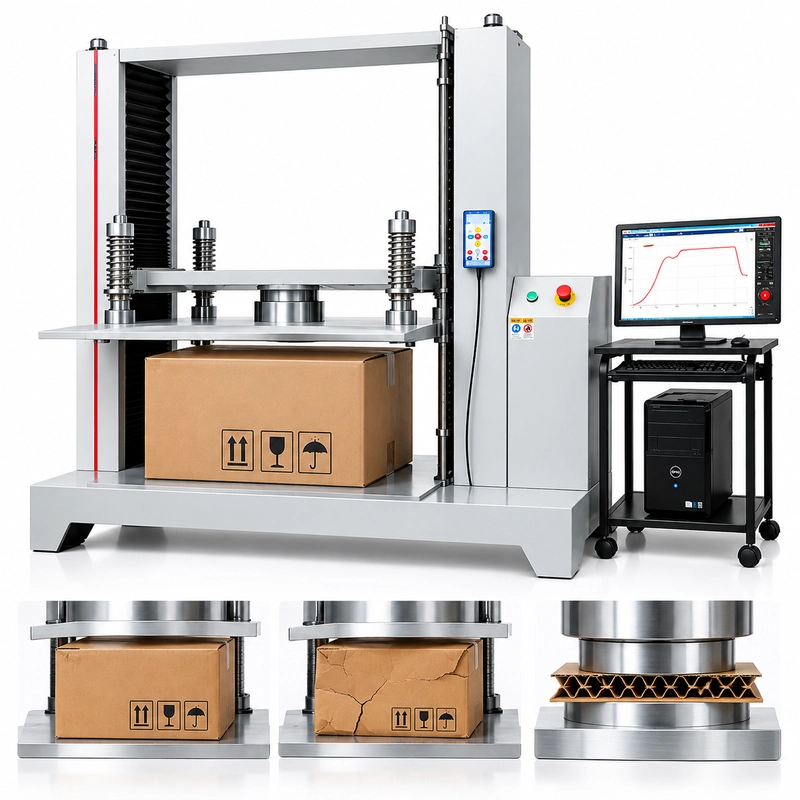
“Our largest package weighs 45 kg. Should we order a 10 kN or 20 kN compression tester?”
We see versions of this question regularly.
The missing information is not another package dimension. It is the force the test must apply and measure.
Package mass does not tell you the compression force at which a carton will buckle or collapse. Nor does choosing the largest available machine automatically give you the best configuration for lower-force tests.
A useful capacity decision separates four things:
Package mass
Required or expected compression force
Force measurement range
Maximum machine capacity
For a 10, 20 or 50 kN packaging compression tester, the selection should start with the test force—not the weight printed on the shipping document.
Package Weight Does Not Determine Tester Capacity
Take a filled package with a mass of:
40 kg
Its approximate gravitational force is:
40 × 9.81 ≈ 392 N = 0.392 kN
The calculation is correct.
The conclusion:
“Therefore the package needs less than 1 kN of compression capacity”
would not be.
A box compression test applies an external compressive load to the package structure. The load at which that structure deforms, buckles or collapses depends on how it carries force.
For a corrugated carton, that can be affected by board construction, flute combination, panel geometry, corners, seams and closures. Internal trays, partitions or the product itself can change the load path. Moisture and conditioning can change corrugated-board response. Test orientation matters too.
Two packages can therefore have the same filled mass and very different compression behavior.
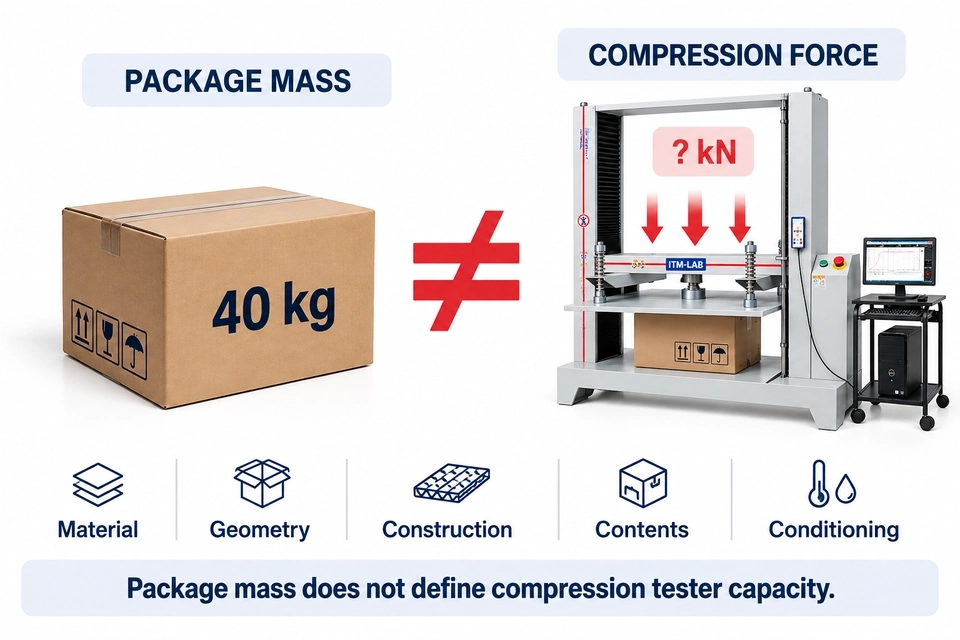
So when an RFQ says:
Package weight: 40 kg
Required tester: 20 kN
our next question is:
What led to the 20 kN requirement?
If the answer is simply “the package is heavy,” the force requirement still needs to be defined.
Start With the Force the Test Must Reach
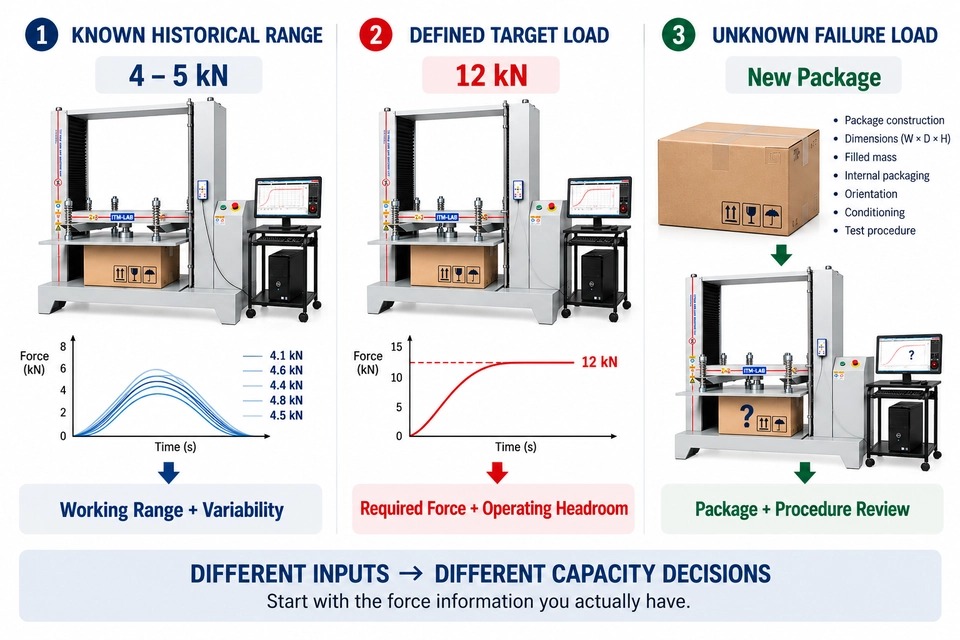
There are three common starting points.
Historical compression data
If the package has already been tested, previous results are usually more useful than a theoretical guess.
Suppose five representative peak loads were:
4.1 / 4.6 / 4.4 / 4.8 / 4.5 kN
Now there is evidence that the normal test region is around 4–5 kN.
Do not use only one convenient result. Look at a representative group and consider how much the package-to-package results vary.
A defined test requirement
Sometimes the procedure already tells you the force.
For example:
Apply 12 kN and maintain the load for the specified holding period.
Now 12 kN is a known equipment requirement.
Package mass is no longer the primary force-selection input.
Unknown failure force
This is common with a new packaging design.
Do not invent a number simply because the RFQ form has a blank marked “Capacity.”
Write:
Expected peak force: Unknown
Then provide the package construction, dimensions, filled mass, internal packaging, test orientation and procedure.
An unknown force is something to account for during configuration—not something to hide behind an arbitrary 20 or 50 kN selection.
Target Load and Failure Load Are Not the Same Thing
This distinction is easy to miss.
Consider these two requirements:
Test A: Apply 12 kN and hold.
and:
Test B: Compress the package until structural failure. Previous specimens failed around 12 kN.
Both mention 12 kN.
They do not describe the same test.
In Test A, 12 kN is a defined target load. The machine needs to reach and control the required load according to the procedure.
In Test B, 12 kN is an observed or estimated failure region. Another specimen may fail below it—or continue beyond it.
That difference matters when considering capacity above the expected force.
For a known target-load test, the required test point may be well defined.
For a destructive test, particularly on a new package, the upper force can contain more uncertainty.
Before discussing “safety margin,” establish which of these two numbers you actually have:
REQUIRED TARGET LOAD
or
EXPECTED FAILURE LOAD
They should not be treated interchangeably.
Capacity, Measurement Range and Working Range Are Different
Suppose your cartons normally produce peak forces around:
4–6 kN
You receive quotations for systems described as:
10 kN
20 kN
50 kN
Those numbers are important, but they do not answer every force-measurement question.
It helps to separate three concepts.
Machine capacity
The maximum rated force capability of the machine or proposed system configuration.
Force measurement range
The force range associated with the measurement configuration being proposed.
Do not assume from a frame-capacity number alone that you know every detail of the force-measurement configuration. Ask the supplier to identify what is actually being supplied and how its force specification applies.
Normal working range
The region where your real package tests normally occur.
If most tests are between 4 and 6 kN, this is the range you will use repeatedly—not merely a small number on the way to the machine's maximum capacity.
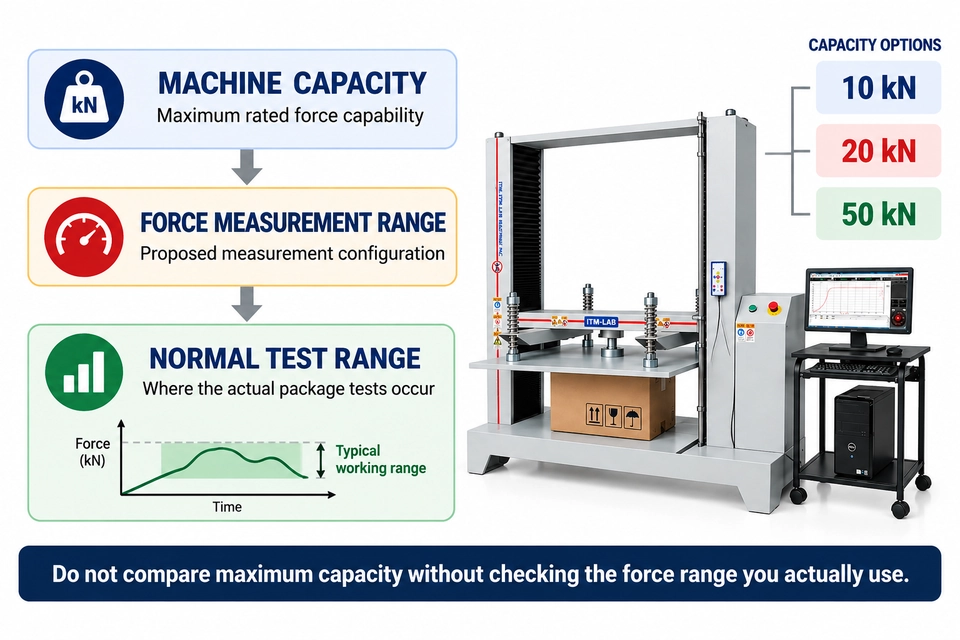
This changes the question you should ask a supplier.
Instead of only:
“What is the maximum capacity?”
ask:
“What force-measurement range is proposed, and how is accuracy specified over the range we actually use?”
That becomes especially important when accuracy is specified as a percentage of full scale.
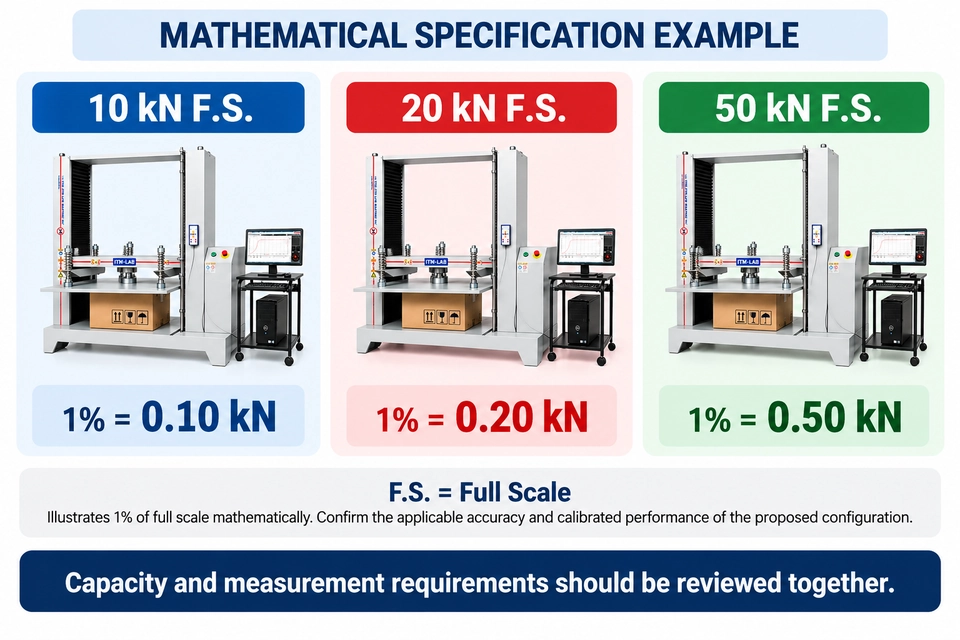
Why ±1% F.S. Matters When Comparing Capacity
The ITM-LAB RS-8401 specifies load accuracy as:
±1% F.S.
F.S. means full scale.
A full-scale specification should not be read as though it were a percentage-of-reading specification.
The arithmetic is simple.
| Full Scale | 1% of Full Scale |
|---|---|
| 10 kN | 0.10 kN |
| 20 kN | 0.20 kN |
| 50 kN | 0.50 kN |
For example:
10 kN × 1% = 0.10 kN
while:
50 kN × 1% = 0.50 kN
These figures are a mathematical illustration of the meaning of 1% of full scale.
They are not a calibration certificate, and they should not be interpreted as a statement that actual measurement error at every test point will necessarily equal those values.
The applicable system specification and calibrated configuration still need to be confirmed.
What does this mean when buying a tester?
Suppose most of your compression tests occur around 4 kN.
Do not compare a 10 kN and 50 kN proposal only by asking:
“Can both machines reach 4 kN?”
Maximum capacity answers that question.
It does not answer the measurement question.
Ask how force accuracy is specified for each proposed configuration over the range you actually intend to use.
This does not mean that the lowest-capacity machine is automatically the correct one.
It means:
More maximum capacity and better suitability for a particular working range are not the same claim.
10 kN vs 20 kN vs 50 kN: How Should You Compare Them?
There is no reliable universal rule such as:
10 kN = small cartons
20 kN = medium cartons
50 kN = large cartons
Carton size primarily affects the required test envelope. It does not directly determine package compression strength.
The same problem applies to:
10 kN = light packages
20 kN = medium packages
50 kN = heavy packages
Package mass alone cannot make that decision either.
A more useful comparison is:
| Configuration | Capacity Question |
|---|---|
| 10 kN | Does 10 kN cover the highest reasonably expected force for the current test program? |
| 20 kN | Is the additional force range required by current tests or a defined future requirement? |
| 50 kN | Is this higher force capability genuinely required, and how does the proposed measurement configuration fit the normal working forces? |
| All Options | Verify force specification, working range, test procedure and required operating headroom. |
Notice what is missing from the table:
“Suitable package weight.”
There is no honest universal value to put there.
The same is true for:
“Suitable carton size.”
A large but lightly constructed package can fail at a lower force than a smaller, heavily reinforced package.
Select the capacity from the force requirement. Select the test space from the package envelope.
How Much Extra Capacity Should You Leave Above the Expected Force?
There is no universal 20% rule for every packaging compression test.
Take a package with these recent peak results:
4.1 / 4.6 / 4.4 / 4.8 / 4.5 kN
Compare that with a new package for which the engineering team says:
“We think it will fail at about 5 kN, but we have never tested it.”
The nominal number may look similar.
The uncertainty is not.
Appropriate operating headroom can depend on:
- specimen-to-specimen variation;
- whether the force is measured, estimated or specified;
- target-load vs. destructive testing;
- the applicable procedure;
- system operating and overload limits;
- and defined future test requirements.
For this reason, avoid turning:
Expected Force × 1.2
into a universal equipment-selection formula unless a specific internal or external requirement establishes that margin.
A better question is:
What is the highest force this test could reasonably reach, including the uncertainty we actually have?
Then evaluate the system against that requirement.
What If the Peak Compression Force Is Unknown?
Do not automatically solve an unknown force by ordering the largest machine.
Start with the evidence available.
Previous test data?
Use the actual range and variability.
Defined customer load?
Use the required test point.
Reliable comparable-package data?
Use it as an estimate, while accounting for differences in construction and test condition.
Completely new design?
Keep the force marked as unknown and document the package.
For a new package, useful information includes:
Construction
W × D × H
Filled mass
Internal packaging
Empty / filled condition
Orientation
Conditioning
Standard / customer procedure
The objective is not to calculate an exact failure force from these inputs alone.
It is to make the uncertainty visible before the equipment is specified.
Three Capacity Decisions We Would Treat Differently
Real RFQs make the distinction clearer.
“Our cartons usually fail around 4–5 kN, but we want 50 kN for the future.”
The laboratory provides five recent results:
4.1, 4.6, 4.4, 4.8 and 4.5 kN.
This is useful information. The current working region is reasonably well documented.
The buyer also wants future flexibility.
That is a legitimate requirement—but “future” needs a little definition.
Are higher-force packages already planned? What force range is expected? Is there a customer program behind the requirement, or is 50 kN simply being chosen because it is the largest available number?
The current 4–5 kN requirement and the future requirement should both be documented.
Then the proposed configuration can be reviewed against both.
“Our customer requires 12 kN for the hold test.”
This one starts differently.
The customer procedure requires the package to reach 12 kN and remain under load for a specified period.
A configuration with a maximum rated capacity below 12 kN cannot perform that requirement.
That immediately eliminates insufficient capacity.
But the equipment review does not end there.
The supplier still needs to understand whether 12 kN is the highest force expected during the test, what control requirement applies during the hold and how the force specification applies around that test point.
The known target load solves part of the capacity question—not the entire system configuration.
New double-wall export carton. No previous BCT data.
The third project has:
65 kg filled mass
Double-wall corrugated construction
Compression to failure
No historical compression results
The 65 kg number does not provide the missing failure force.
Neither does the physical size of the carton.
The useful next step is to gather the package drawing, construction information, internal packaging, orientation, conditioning requirement and test procedure. Data from genuinely comparable packages can be considered if it exists.
If the peak remains unknown, that uncertainty becomes part of the capacity review.
It should not be disguised as:
“Let's choose 50 kN just to be safe.”
Should You Buy More Capacity for Future Packages?
Sometimes that makes good purchasing sense.
A laboratory may expect to use the machine for many years, while its current packaging program covers only part of the products it expects to test later.
Future capacity should therefore not be ignored.
Try to define it.
Instead of:
“We may need stronger packages someday.”
provide whatever is known:
“A new returnable-packaging program is expected next year, with test loads potentially above our current 5 kN range.”
Even an approximate future requirement gives the supplier more to work with than simply requesting the largest capacity.
There is a balance here.
Too little capability can restrict future work.
But an undefined future requirement should not erase the measurement needs of the products being tested today.
Future capacity is a valid purchasing consideration. It should be evaluated alongside the current working range—not instead of it.
Four Shortcuts That Can Lead to the Wrong Capacity
1. Package weight → tester capacity
A 50 kg package does not imply a particular kN machine.
Mass and structural compression strength are different quantities.
2. Carton size → tester capacity
Large dimensions may require a larger test space.
They do not automatically require greater force capacity.
3. “Buy the largest capacity to be safe”
Higher capacity provides greater upper-force capability.
It does not remove the need to evaluate the proposed force-measurement configuration and normal working range.
4. “Our old tester was 20 kN”
It may still be the right capacity.
But first check whether the packages, procedures and force ranges are still the same.
A replacement project is a good time to verify the requirement rather than copying the old machine's nameplate.
Capacity Is Only One Part of the Tester
Once the force range is understood, the complete machine still needs to match the package and procedure.
Force capacity does not tell you:
- whether the largest package fits between the platens;
- whether sufficient platen travel is available;
- whether the required compression speed can be reproduced;
- whether the procedure needs a constant-load hold;
- whether displacement must be measured;
- or what test data needs to be recorded.
So after force capacity, verify:
Test Space
Package Orientation
Compression Speed
Control Mode
Hold Requirement
Displacement
Force–Displacement Data
For the broader equipment-selection process, these factors belong in the complete Box Compression Tester Buying Guide rather than being used to redefine capacity.
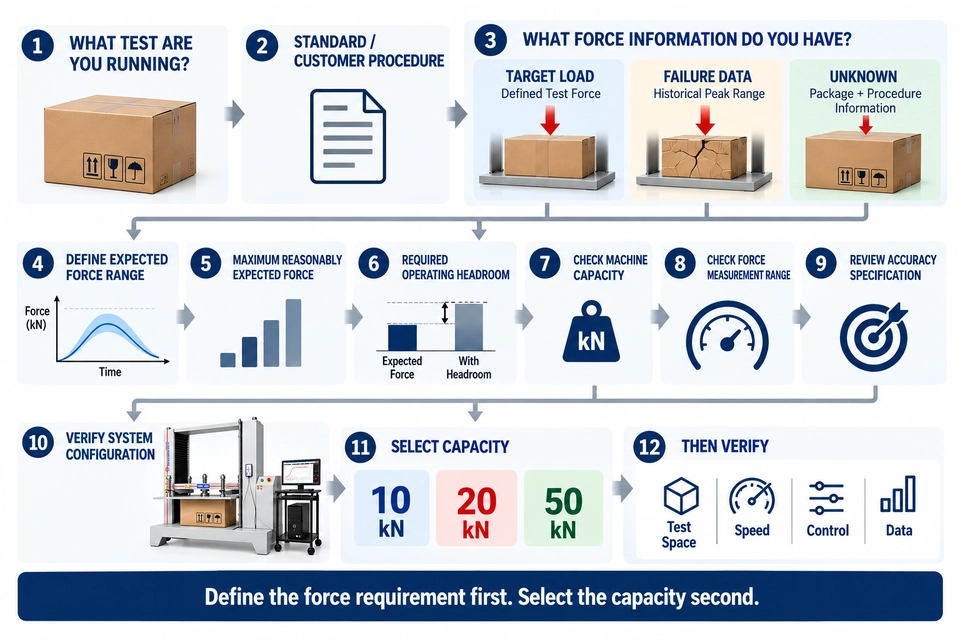
Packaging Compression Tester Capacity Selection Roadmap
The capacity decision can be reduced to a practical sequence.
Matching the Requirement to the RS-8401
The ITM-LAB RS-8401 Packaging Compression Tester is available with:
10 kN / 20 kN / 50 kN
capacity options.
The system is designed for compression and stacking testing of corrugated cartons, shipping boxes, plastic containers and complete transport packages.
| Parameter | RS-8401 Specification |
|---|---|
| Capacity Options | 10 / 20 / 50 kN |
| Load Accuracy | ±1% F.S. |
| Load Resolution | 1/250,000 |
| Test Speed | 0.001–200 mm/min |
| Displacement Resolution | 0.001 mm |
| Test Space | Up to 1500 × 1500 × 1500 mm |
| Drive System | AC servo motor |
| Control | Professional closed-loop control software |
We would not turn those three capacity options into three arbitrary package categories.
For capacity review, the more useful information is:
Normal working force
Maximum expected or required force
Target-load or failure test
Package dimensions
Test procedure
If previous compression data exists, include several representative results rather than only one maximum.
If the expected force is unknown, provide the package construction, dimensions, filled mass and test procedure.
That gives the configuration review a real engineering basis.
What Should You Put in the RFQ?
You do not need to design the tester before asking for a quotation.
You need to describe the test.
| Requirement | Information to Provide |
|---|---|
| Package | Carton / container / complete package |
| Dimensions | W × D × H |
| Filled Mass | kg |
| Construction | Material / board / internal support |
| Test Type | Compression / stacking / both |
| Load Type | Target load / failure load |
| Normal Working Force | kN, if known |
| Maximum Expected Force | kN, if known |
| Historical Results | Several representative values if available |
| Procedure | Standard / customer method |
| Conditioning | If applicable |
| Orientation | Test direction |
| Future Force Requirement | If genuinely expected |
If the force is unknown, write:
Unknown
and send the information you do have.
That is more useful than selecting 20 or 50 kN without knowing why.
FAQ
How do I choose between a 10 kN, 20 kN and 50 kN compression tester?
Start with the required or expected compression force. Then consider the maximum reasonably expected force, normal working range, uncertainty or variability, required operating headroom and the force specification of the proposed configuration. Package weight alone should not determine capacity.
Can I select compression tester capacity from package weight?
No direct conversion should be used. Package mass can be converted into gravitational force, but that does not tell you the structural compression force at which the package will deform or fail.
Can I use a 50 kN compression tester for a carton that normally reaches only 5 kN?
A 50 kN system has sufficient upper force capability to reach 5 kN, but maximum capacity alone does not establish whether it is the appropriate measurement configuration. Check the proposed force-measurement range and applicable accuracy specification against the forces you normally test.
What does ±1% F.S. mean on a compression tester?
F.S. means full scale. Mathematically, 1% of a 10 kN full scale is 0.10 kN, while 1% of a 50 kN full scale is 0.50 kN. These values illustrate how a full-scale specification is calculated; actual system performance should be evaluated using the applicable manufacturer specification and calibrated configuration.
What if I do not know the expected carton compression force?
Review historical results, defined customer loads and reliable comparable-package data first. For a new design with no useful force data, provide the package construction, dimensions, filled mass, orientation and test procedure so the unknown force can be considered during configuration.
Define the Force Requirement Before Choosing the Capacity
10 kN, 20 kN or 50 kN?
That is not the first question.
First establish what the test actually needs to apply and measure.
Keep these distinctions clear:
Package Mass ≠ Compression Force
Target Load ≠ Failure Load
Machine Capacity ≠ Force Measurement Range ≠ Normal Working Range
Once those are understood, the capacity options become much easier to evaluate.
For an RS-8401 configuration review, provide your normal working force, maximum expected or required force, package dimensions and test procedure.
If the force is not yet known, provide the package construction, filled mass and applicable procedure instead.
Define the force requirement first. Select the capacity second.
