
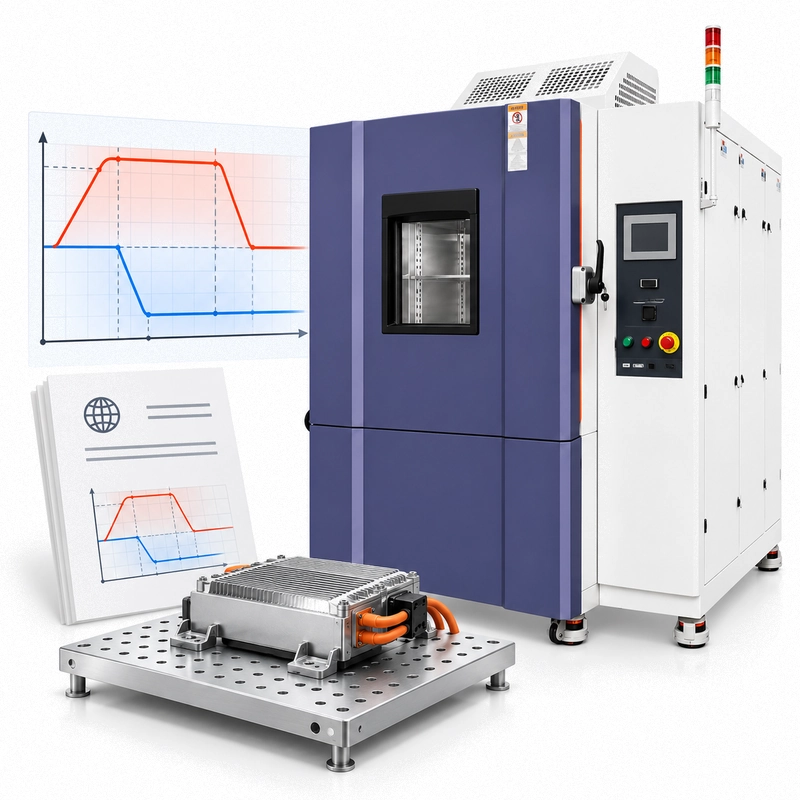
A chamber datasheet says 10°C/min.
Your test specification also says 10°C/min.
At first glance, the match looks perfect.
Then the chamber is loaded with a 30 kg electronic assembly, a 10 kg fixture, cables and monitoring hardware. The DUT remains powered during cooling and releases 600 W of heat. Part of the product also sits across the chamber's circulation path.
Now “10°C/min” needs a little more explanation.
Was the catalog rate measured with an empty chamber? Is 10°C/min an average over a specified temperature interval, or a linear rate? Does it apply to heating, cooling, or both? Is the measurement based on chamber air or DUT temperature?
Most importantly:
Was the 10°C/min performance specified under anything resembling your actual test load?
That is the difference between selecting a chamber by a headline specification and selecting one around the test.
In one sentence:
A no-load temperature change rate describes chamber performance under a defined unloaded condition; a loaded temperature ramp rate describes performance with a specified DUT, fixture and operating load inside the chamber.
For chamber buyers, the practical rule is simple:
“10°C/min” becomes a useful specification only after you know what was measured, over which temperature interval, and under what load.
What “10°C/min” Tells You—and What It Doesn't
Temperature change rate tells you how quickly a measured temperature changes over a defined period or interval.
That is useful.
But the number alone does not tell you enough to compare two chambers.
Suppose three quotations all say:
Temperature change rate: 10°C/min
One may refer to an average empty-chamber air-temperature rate.
Another may define a rate over a particular temperature interval.
A third may be based on a specified load.
All three can display the same headline number while describing different performance conditions.
Before treating 10°C/min as a comparable specification, ask five questions:
What was loaded into the chamber?
Over what temperature interval was the rate determined?
Was the rate average or linear?
Was temperature measured in the chamber air or at the DUT?
Does the figure apply to heating, cooling, or both?
If those conditions are unknown, the number is not necessarily wrong.
It is simply incomplete for equipment selection.
For a deeper comparison of nominal rate classes, see [ Anchor Text: 5°C/min vs 10°C/min vs 15°C/min Temperature Ramp Rate].
One Chamber Can Have Four Different Ramp Rates
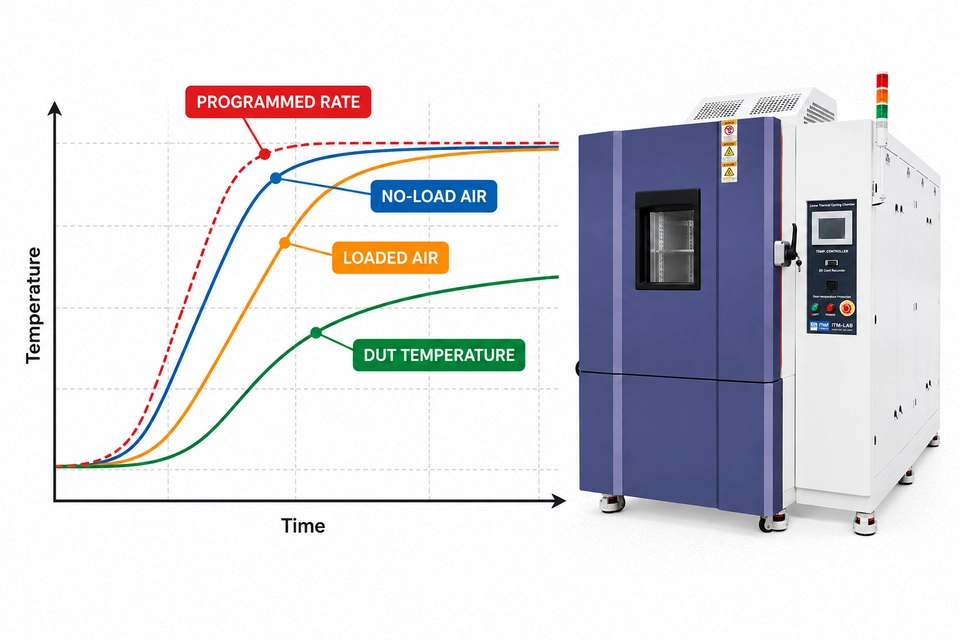
During a real test, “the ramp rate” may refer to several different things.
| Rate | What It Describes | Buyer Question |
|---|---|---|
| Programmed rate | What the controller is instructed to do | What rate does the test program request? |
| No-load chamber air rate | Chamber-air response under the stated unloaded condition | How was the catalog rate established? |
| Loaded chamber air rate | Air response with the DUT, fixture and other load installed | Can the chamber perform the transition with my load? |
| DUT temperature rate | How quickly the specimen itself changes temperature | Does my test evaluate air temperature or specimen temperature? |
Imagine a program calling for a transition toward +85°C at 10°C/min.
The controller commands the profile.
The empty chamber air responds.
Add a large DUT and fixture, and the chamber now has additional thermal mass to condition.
The DUT itself may respond more slowly still.
That gives us an important distinction:
Programmed rate ≠ No-load air rate ≠ Loaded air rate ≠ DUT rate
They may be close in some applications and quite different in others.
The test procedure determines which one actually matters.
What Changes When You Put the DUT Inside?
It is tempting to reduce chamber load to one number:
kilograms.
That is useful, but incomplete.
A chamber also “sees” the material being conditioned, the fixture, the geometry of the load, how the load interacts with airflow, and any heat generated while the DUT is operating.
A 40 kg load is not a complete thermal specification.
If DUT geometry, fixture clearance and usable chamber space are still being defined, see [How to Size an Environmental Test Chamber for Your DUT].
Thermal Mass Changes the Job
A simple energy relationship helps explain why:
Q = m × cp × ΔT
where:
Q = thermal energy
m = mass
cp = specific heat capacity
ΔT = temperature change
A heavier DUT—or one made from a material with different thermal properties—can require more energy to move through the same temperature interval.
This is useful for understanding why load matters.
It is not, by itself, a chamber-sizing equation.
Actual temperature-transition performance also depends on heat transfer, airflow, refrigeration and heating capacity, control strategy, temperature interval, operating conditions and the construction of the load itself.
The Fixture Is Part of the Load
An RFQ may say:
DUT mass: 30 kg
Then the test team installs the DUT on a 15 kg mounting plate.
The chamber does not condition only the DUT.
It conditions the fixture too.
In practical terms, the relevant load now includes:
30 kg DUT + 15 kg fixture
Racks, shelves, mounting plates and other substantial hardware can all contribute to the thermal demand.
This is why “DUT weight” and “total loaded mass” should not automatically be treated as the same number.
Live Heat Is Not the Same as Mass
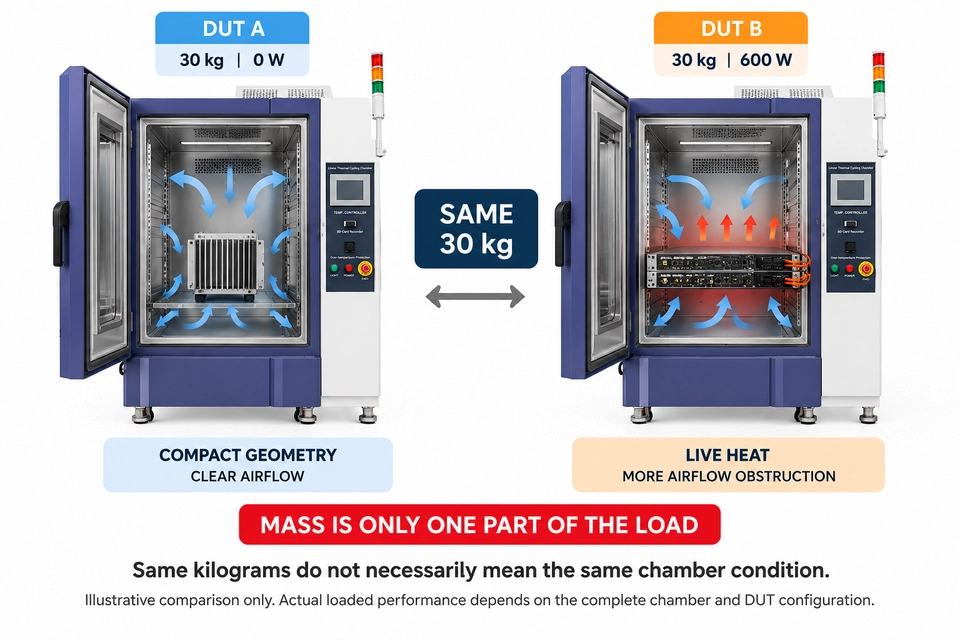
Now take two identical 30 kg electronic assemblies.
One is switched off during the transition:
30 kg / 0 W
The other operates continuously:
30 kg / 600 W
Their mass is the same.
Their cooling condition is not.
The powered product continues releasing heat while the refrigeration system is trying to drive the chamber and load toward a lower temperature.
A useful distinction is:
Mass tells you how much material has to change temperature. Watts tell you how much heat keeps entering the test environment.
For powered testing, both belong in the RFQ.
Same Kilograms Can Still Mean a Different Load
Here is the part that weight alone misses.
Consider two DUTs.
DUT A
30 kg
0 W
Compact metal assembly.
Mounted so that conditioned air can circulate around it.
DUT B
30 kg
600 W
Wide electronics assembly.
Its orientation obstructs a larger portion of the circulation path.
Both RFQs can say:
Load: 30 kg
But they do not present the chamber with the same job.
The second DUT introduces continuous heat and may also change the way conditioned air moves through the workspace.
That matters because environmental chambers depend on circulation to transfer heat between the conditioning system, chamber air and specimen.
A large flat product positioned across a supply or return path can behave differently from a compact DUT of the same weight.
So when loaded ramp performance matters:
Mass is only part of the load.
Geometry matters.
Orientation matters.
Airflow obstruction matters.
Live heat matters.
For more detail on specimen occupancy and circulation clearance, see [INTERNAL LINK — Anchor Text: How Much Chamber Space Should Your Test Specimen Occupy?].
Average vs Linear Temperature Change Rate
Load condition is only half of the comparison.
You also need to know how the °C/min figure is defined.
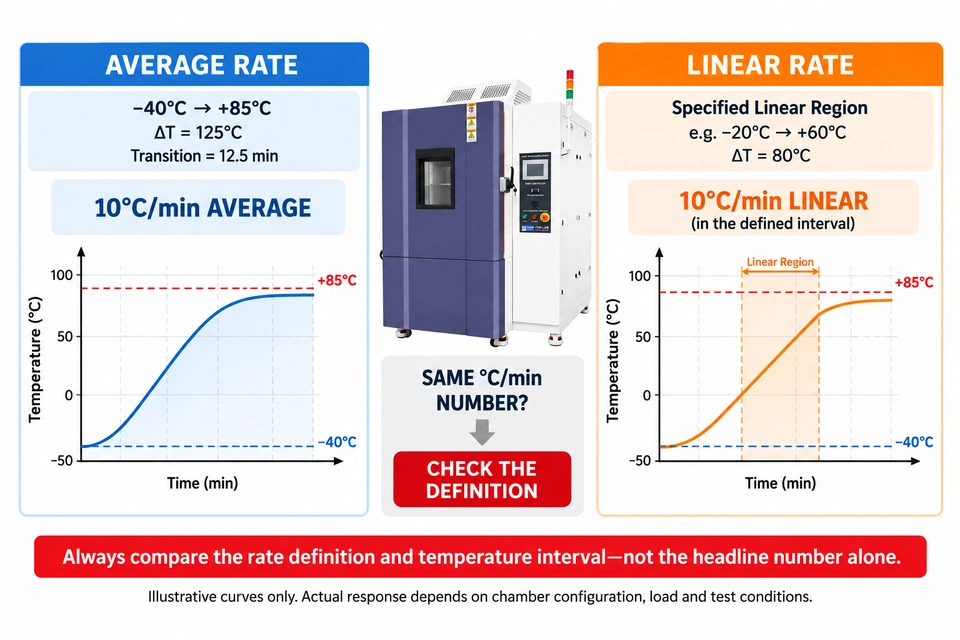
Suppose the required transition is:
−40°C → +85°C
The total temperature difference is:
125°C
If the transition takes 12.5 minutes:
125°C ÷ 12.5 min = 10°C/min
That is an average across the defined transition.
It does not prove that the measured temperature changes by exactly 10°C during every minute of those 12.5 minutes.
Real temperature curves do not necessarily maintain one identical slope from beginning to end.
This matters when one quotation states an average temperature change rate while another requirement calls for a defined linear rate through a specified temperature region.
Before comparing the numbers, compare their definitions.
The same applies to direction.
A specification saying only:
10°C/min
does not necessarily tell you whether that value applies to:
−40°C → +85°C heating
+85°C → −40°C cooling
or both.
Heating and cooling place different demands on the system. During cooling, a powered DUT can make the distinction especially important because its live heat must also be removed.
So the useful question is not merely:
How many °C/min?
It is:
How is the rate defined, over what interval, and in which direction?
For a dedicated comparison of rate classes and transition time, see [ 5°C/min vs 10°C/min vs 15°C/min: How to Choose the Right Temperature Change Rate].
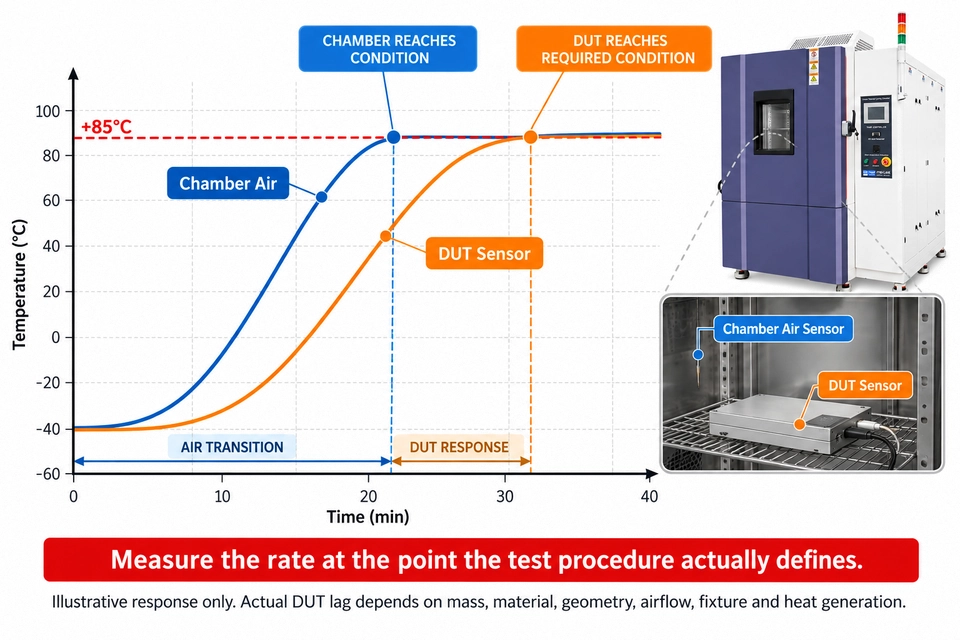
Chamber Air Rate vs DUT Temperature Rate
There is another reason two engineers can look at the same test and report different temperature-change behavior.
They may be measuring different things.
The chamber air responds to the conditioning system.
The DUT responds to the air—and then to heat transfer through its own materials and construction.
Consider a dense electronics enclosure.
The chamber air may already be moving toward the next temperature condition while the product enclosure lags behind. Internal components can lag further still.
A thin specimen exposed directly to circulation may respond much faster.
Neither situation is unusual.
The key is to identify what the test actually defines.
Does the requirement apply to:
chamber air temperature?
a sensor positioned near the specimen?
DUT surface temperature?
an internal DUT measurement point?
The answer changes what “10°C/min” means for the application.
A 10°C/min chamber-air transition does not automatically produce a 10°C/min DUT transition.
This is particularly important when a test also specifies stabilization before the dwell begins.
Reaching the chamber setpoint and reaching the required specimen condition may occur at different times.
The same distinction becomes important when selecting the chamber's low-temperature range. See [ −40°C vs −70°C Environmental Test Chamber: Which Temperature Range Do You Need?].
Two Chambers Both Say 10°C/min. Are They Really Equivalent?
Suppose you are comparing two quotations.
Both headline specifications say:
10°C/min
That makes them look directly comparable.
Now look at the information behind the number.
| Specification Question | Quote A | Quote B |
|---|---|---|
| Temperature interval defined? | No | Yes |
| No-load / loaded condition defined? | No | Yes |
| Average / linear definition stated? | No | Yes |
| Heating / cooling basis stated? | No | Yes |
| Measurement reference defined? | No | Yes |
| Test load defined? | No | Yes |
| Relevant operating conditions stated? | No | Yes |
This table does not tell us that Chamber B is necessarily faster or technically superior.
It tells us something more basic:
Quote B gives us enough information to understand what its 10°C/min figure means.
Quote A still needs clarification before a meaningful comparison can be made.
This is why buying by nominal ramp rate alone can be misleading.
10°C/min vs 10°C/min is not yet a performance comparison.
First make sure the two numbers describe comparable conditions.
Worked Example: A 10°C/min Requirement With a 40 kg Powered DUT
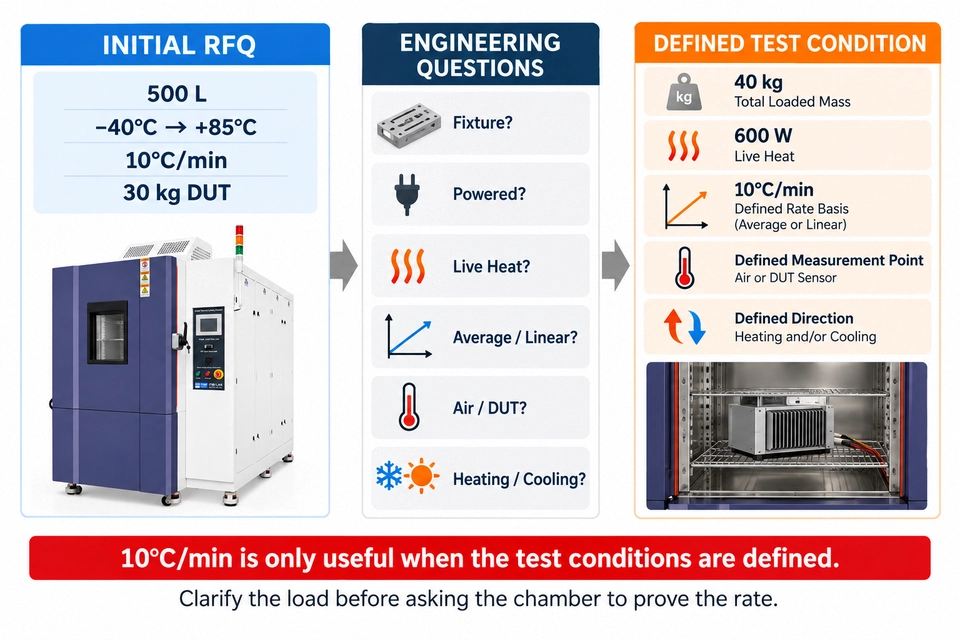
Here is a more realistic RFQ.
A customer initially sends:
500 L chamber
−40°C to +85°C
10°C/min
DUT weight: 30 kg
It looks fairly complete.
It isn't.
After a few engineering questions, the actual test becomes clearer:
DUT: 30 kg electronics assembly
Fixture: 10 kg
Total loaded mass: 40 kg
Powered during cooling: Yes
Maximum live heat: 600 W
Temperature transition: −40°C ↔ +85°C
Required rate: 10°C/min
Average or linear: Not yet defined
Measurement point: Not yet defined
Now we can see what is missing.
What must change at 10°C/min?
If the requirement refers to chamber air, the chamber is being evaluated on one basis.
If the product itself must follow 10°C/min, that is a different requirement and needs to be stated explicitly.
Average or linear?
If 10°C/min is an average across a defined transition, say so.
If a test standard or customer procedure requires a particular linear temperature change through a defined region, use that definition instead.
Does 600 W continue during cooling?
If yes, the chamber must remove heat generated by the DUT while simultaneously cooling the loaded system.
That is materially different from cooling the same 40 kg load with the DUT switched off.
Is 10°C/min required with the full 40 kg installed?
The fixture counts.
If the performance requirement applies to the complete installed test arrangement, the chamber should be evaluated accordingly.
The original RFQ was:
500 L / −40°C to +85°C / 10°C/min
After clarification, the engineering requirement might look more like:
500 L workspace. 30 kg DUT + 10 kg fixture. DUT powered during cooling with up to 600 W live heat. Required chamber-air temperature change rate: 10°C/min average over the specified transition, heating and cooling.
That is a specification a chamber manufacturer can actually evaluate.
Notice what did not change:
The headline still says 10°C/min.
What changed was the meaning behind it.
What to Send With Your Chamber RFQ
A useful RFQ does not have to be long.
It needs to contain the information that affects the test.
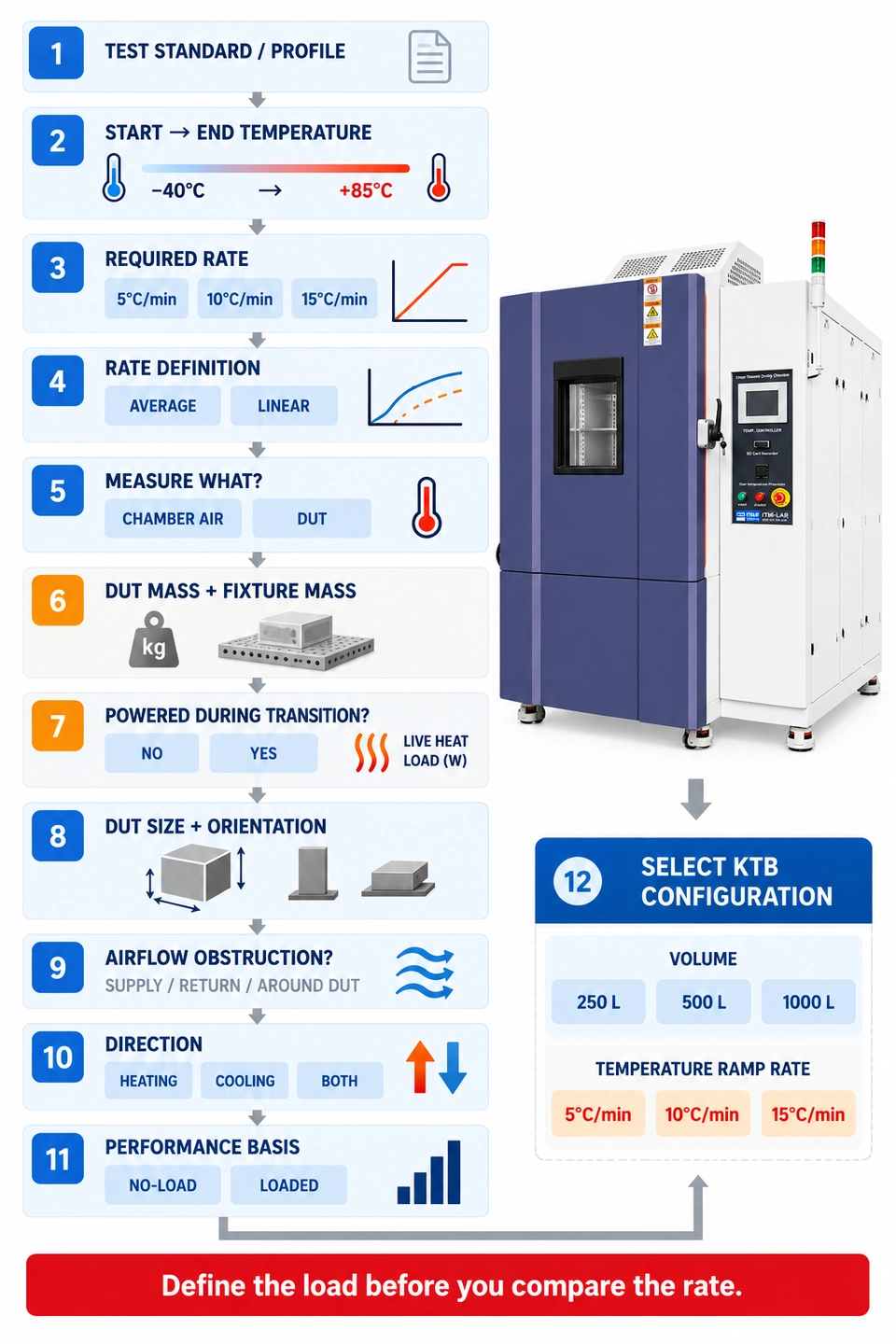
For a rapid temperature change application, provide:
- Temperature profile: start temperature, end temperature and cycling conditions.
- Required temperature change rate: 5°C/min, 10°C/min, 15°C/min or another requirement.
- Rate definition: average, linear or the definition in the applicable procedure.
- Measurement point: chamber air, DUT or another specified location.
- DUT dimensions and quantity.
- DUT mass.
- Fixture or rack mass.
- Whether the DUT is powered during transition.
- Maximum live heat in watts.
- DUT orientation and loading arrangement.
- Whether the required rate applies to heating, cooling or both.
- Dwell and stabilization requirements.
- Applicable standard or customer procedure.
- Relevant facility conditions where they affect performance.
For an unusual loading arrangement, add a photograph, CAD drawing or simple sketch.
That can answer questions a line saying “40 kg DUT” cannot.
Where KTB Fits Into the Selection
For applications where temperature transition rate is a primary requirement, ITM-LAB KTB rapid temperature change chamber configurations are available around nominal 5°C/min, 10°C/min and 15°C/min classes, with chamber capacities including 250 L, 500 L and 1000 L, depending on configuration.
Those numbers are a useful starting point.
They are not a substitute for the load definition.
A request such as:
500 L / 10°C/min
identifies a general performance class.
A request such as:
500 L / 10°C/min / 40 kg loaded mass / 600 W live heat during cooling
provides much more useful information for configuration review.
That distinction becomes increasingly important as DUT mass, fixture mass, live heat or airflow obstruction increases.
For combined temperature and humidity testing, the selection path is different. A GDJS temperature and humidity chamber should be evaluated against the required temperature/RH profile and applicable operating envelope rather than chosen from a rapid-temperature-change rate class alone.
In other words:
Choose the chamber family from the test. Then verify the performance under the conditions that matter.
For product specifications and configuration options, use [Rapid Temperature Change Test Chamber] to link to the KTB product page.
For applications where controlled humidity is required, use [Temperature and Humidity Test Chamber] to link to the GDJS product page.
FAQ
What is the difference between loaded and no-load temperature ramp rate?
A no-load temperature ramp rate describes chamber performance under a defined unloaded condition.
A loaded temperature ramp rate describes performance with a specified DUT, fixture and other relevant test load inside the chamber.
For meaningful comparison, the load condition and measurement basis should be stated.
Will a 10°C/min chamber still achieve 10°C/min when loaded?
Not necessarily under every load.
The result depends on the chamber configuration and factors such as DUT and fixture mass, materials, live heat, geometry, airflow, temperature interval, transition direction and measurement method.
If 10°C/min is required with the DUT installed, specify the loaded condition and verify performance against it.
Does DUT weight determine loaded ramp rate?
Weight matters, but it is not enough on its own.
Two 30 kg DUTs can present different thermal conditions if one generates substantial heat or obstructs more of the chamber airflow.
Material, fixture, geometry, orientation and live heat should also be considered.
Is chamber-air ramp rate the same as DUT ramp rate?
No, not necessarily.
The DUT has its own thermal response and may lag behind the chamber air. The amount of lag depends on the product, fixture, airflow, material, mass and heat generation.
Use the measurement point defined by the applicable test procedure.
Is a 15°C/min chamber better than a 10°C/min chamber?
A 15°C/min rate class provides greater nominal temperature-transition capability, but that does not automatically make it the appropriate choice for every test.
The chamber should be selected around the required test profile and verified under the relevant load conditions.
Define the Load Before You Compare the Rate
There is nothing wrong with a datasheet saying 10°C/min.
The problem begins when that number is treated as though it answers every performance question.
An empty chamber, a chamber carrying 40 kg of passive hardware, and a chamber carrying the same mass while the DUT generates 600 W are three different operating conditions.
Even kilograms are not the whole story.
A compact DUT with clear circulation and a wide DUT obstructing a return-air path can behave differently inside the same workspace.
Then there is the measurement itself.
Average or linear?
Heating or cooling?
Chamber air or DUT?
Those details determine what the °C/min figure actually represents.
So when comparing environmental chambers, do not stop at:
Supplier A: 10°C/min
Supplier B: 10°C/min
Ask what sits behind those numbers.
For an ITM-LAB KTB configuration, nominal 5°C/min, 10°C/min or 15°C/min classes provide the starting point. DUT mass, fixture mass, live heat, loading geometry and the required transition define the application that needs to be verified.
The number on the datasheet starts the conversation.
The test conditions finish it.
Define the load before you compare the rate.
