
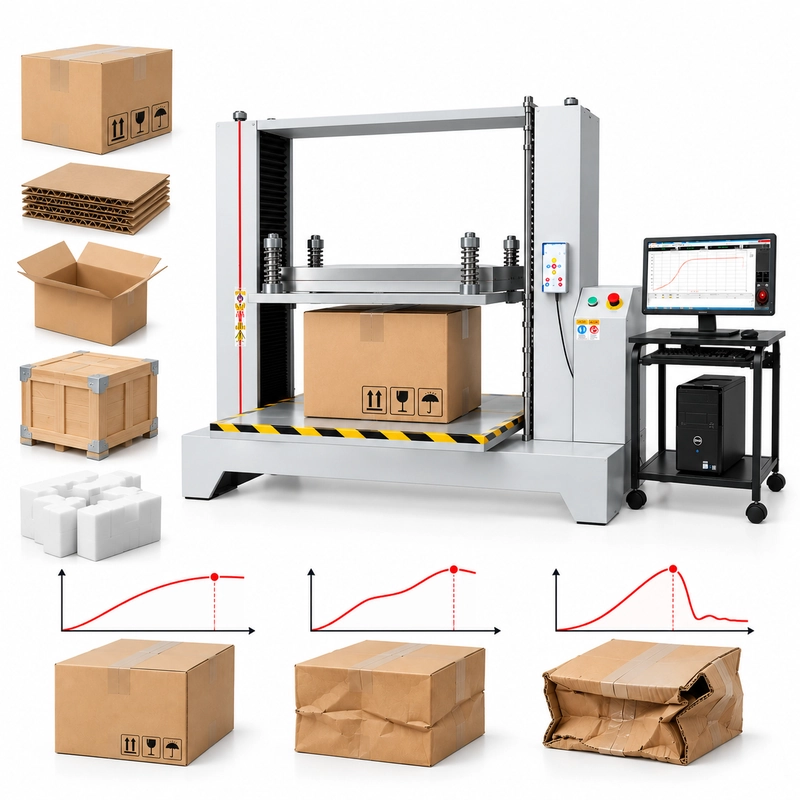
A box compression tester is easy to compare on paper. One machine is rated to 10 kN, another to 20 kN, and another to 50 kN. Test spaces, speed ranges, accuracy figures and software functions sit neatly in specification tables.
The harder question is whether those specifications match the package you actually need to test.
A 50 kN machine is not automatically a better choice than a 10 kN machine. A carton that fits within the published test space may still be awkward to load or leave too little room for platen travel. And package weight, by itself, tells you very little about the compression force the structure can withstand.
A better selection process starts with the package and the test method, then works toward the machine:
Package → Test Method → Expected Force → Working Range → Test Envelope → Control → Measurement → Configuration
This guide explains how to work through that process before requesting a quotation for a box compression tester.
What Does a Box Compression Tester Actually Measure?
A box compression tester applies a controlled compressive load to a carton, container or complete transport package between two platens.
During the test, two measurements matter most:
Force tells you how much compressive load is being applied.
Displacement tells you how the package changes dimension as that load increases or is maintained.
Depending on the procedure, the result may include:
-
peak compression force;
-
deformation at a specified load;
-
force at a specified deformation;
-
load–displacement behavior;
-
or deformation during a sustained-load period.
Typical test items include corrugated cartons, shipping boxes, plastic containers, honeycomb packaging, returnable containers and complete filled transport packages.
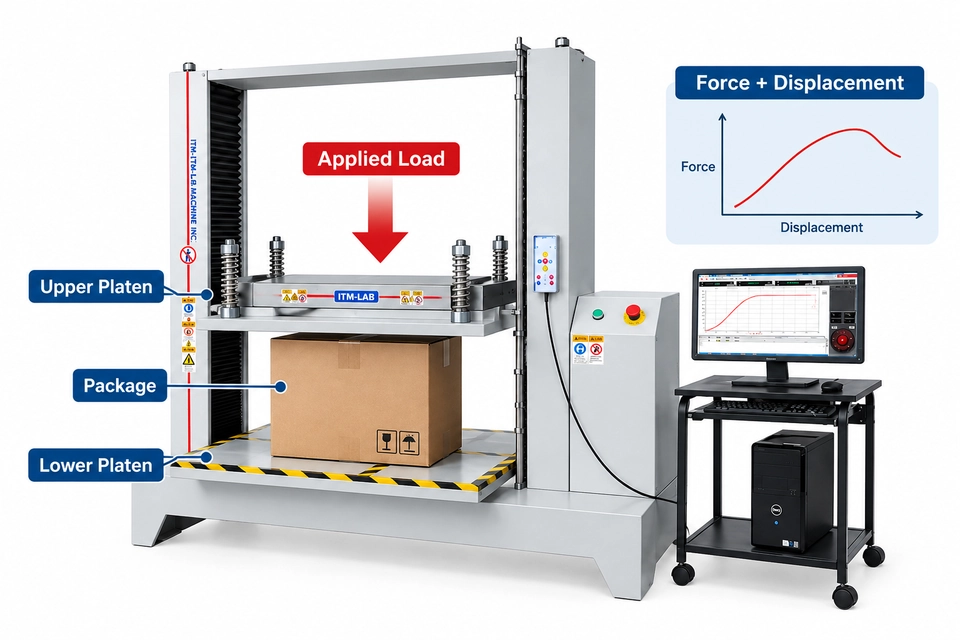
A useful compression test therefore gives you more than a maximum-force number. It records how the package responds while the load is being applied.
That distinction becomes important when comparing packaging designs or investigating a failure.
Start With the Package, Not the Machine
An inquiry that says:
“Please quote a 20 kN box compression tester.”
already contains a machine specification, but it does not yet contain enough information to confirm that specification.
Start with the DUT.
Package type
What are you testing?
A corrugated carton, plastic container, honeycomb package, returnable container or complete shipping package can behave very differently under compression.
Maximum dimensions
Record the actual:
Width × Depth × Height
in the orientation used during testing.
Do not rely only on a nominal carton size from a product catalog.
Filled mass
State whether the package will be tested empty or with the product and internal packaging installed.
For filled packages, provide the total test mass.
Construction
Board grade, wall construction, seams, internal partitions, trays and inserts can all affect the way compression loads travel through the package.
Two cartons can have nearly identical external dimensions and still produce very different compression curves.
Test orientation
If the package can be tested in more than one orientation, identify the required direction or directions before the test-space configuration is finalized.
Do not ignore conditioning
Corrugated packaging can respond differently as moisture content and environmental exposure change.
If your procedure specifies preconditioning or a controlled atmosphere, include that condition when defining the test and comparing results.
A compression result obtained from one conditioning state should not automatically be treated as equivalent to a result obtained under another.
Compression Test vs. Stacking Test
A common request is:
“We need to check whether our cartons can survive stacking.”
That still leaves an important question unanswered.
Are you trying to find the package's compression strength, or do you need to apply a defined load and maintain it for a specified period?
Those are different test objectives.
| Compression Test | Stacking Test | |
|---|---|---|
| Main Question | How does the package respond as compression increases? | What happens under a sustained load? |
| Loading | Controlled increasing compression | Defined applied load |
| Duration | To an endpoint or failure condition | Specified holding period |
| Typical Results | Peak force, deformation, load–displacement curve | Deformation and stability over time |
| Typical DUT | Carton, container or complete package | Complete transport package |
A compression-to-failure test needs controlled platen movement and reliable force measurement.
A stacking evaluation may require the machine to reach a specified load, maintain that condition and record what happens to the package over time.
So the equipment category alone does not define the test.
The procedure does.
How Much Box Compression Tester Capacity Do You Need?
This is one of the easiest specifications to get wrong.
Suppose a complete package weighs 30 kg.
That does not mean its compression strength is 30 kgf, and it does not tell you whether the correct machine capacity is 10, 20 or 50 kN.
Package mass and package compression strength describe different things.
A relatively light corrugated carton can carry substantial vertical compression through its corners, panels and internal structure. A heavier package may begin deforming at a lower force if its construction provides less vertical support.
Compression behavior may change with:
-
material and board grade;
-
flute and wall construction;
-
package geometry;
-
closures and seams;
-
internal supports;
-
empty or filled condition;
-
test orientation;
-
environmental conditioning;
-
and the test procedure itself.
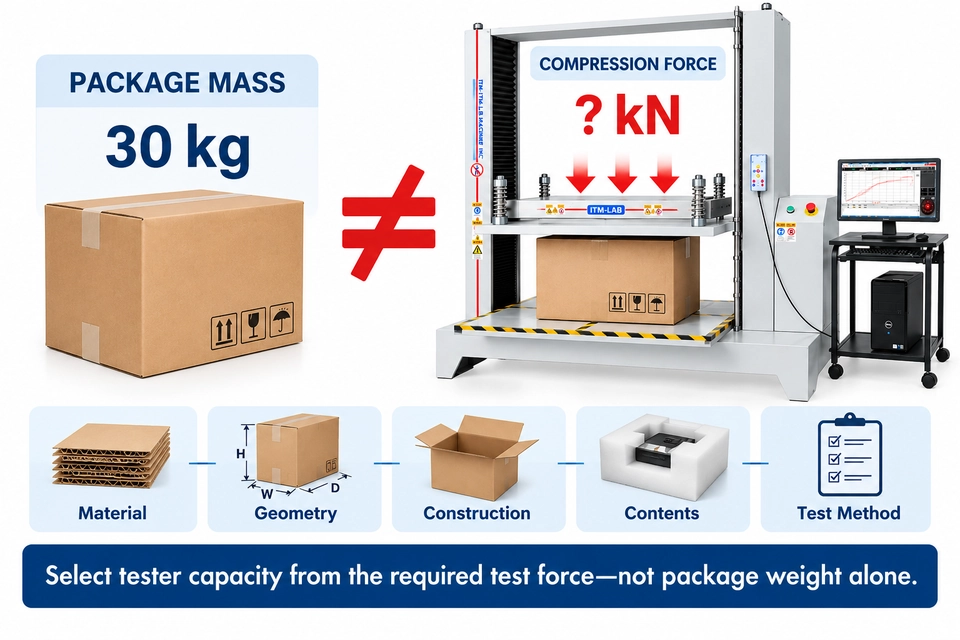
The number you need for capacity selection is the expected test force.
What if you do not know the expected force?
That is not unusual, particularly for a new packaging design.
If previous compression-test data exists, start there.
If a customer specification defines a required load, use that requirement.
If you are working to a published test method, review the actual procedure and loading conditions.
If none of those sources provides a reliable estimate, send the equipment supplier the package dimensions, filled mass, construction information and test procedure.
Writing “expected force unknown” in an RFQ is better than inventing a capacity from the package weight.
Why Bigger Capacity Is Not Automatically Better
Consider two laboratories.
One normally tests cartons that produce peak forces around 3–5 kN.
Another tests heavier packaging structures in the 28–35 kN region.
Both need enough capacity to complete their tests, but their normal measurement ranges are clearly different.
A machine's maximum capacity tells you its upper system limit. It does not automatically tell you how suitable that configuration is for the forces you measure every day.
When comparing 10, 20 and 50 kN systems, ask:
Can the machine cover the maximum required force?
and:
Where will our normal test forces fall within the proposed measurement range?
Both questions matter.
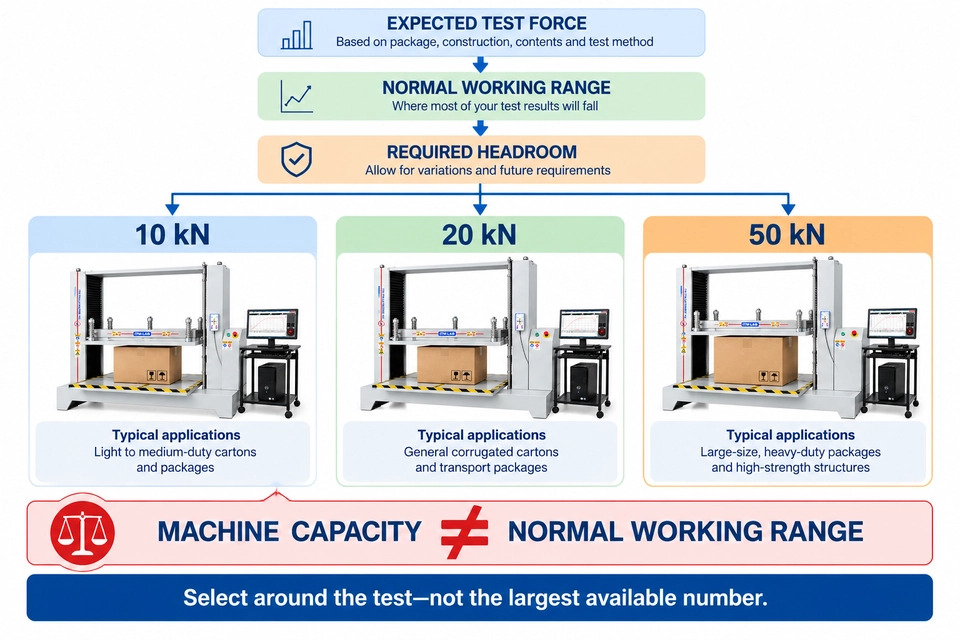
This point becomes especially important when comparing force specifications.
For example, the ITM-LAB RS-8401 specifies load accuracy as ±1% F.S.
A full-scale accuracy specification should not be interpreted in the same way as a percentage-of-reading specification.
When evaluating a proposed configuration, ask how the stated force accuracy applies across the range you expect to use.
A 50 kN frame gives you more maximum capacity. That fact alone does not mean it is the better configuration for a test that normally runs at only a few kilonewtons.
Will Your Package Actually Fit the Tester?
Force capacity usually gets more attention during purchasing.
Test space can stop the project just as quickly.
Imagine that your largest package measures:
980 × 850 × 1050 mm
and the tester lists a nominal space of:
1000 × 1000 × 1200 mm
On paper, it fits.
In the laboratory, you still need to load the package, position it correctly, move the platen through the required test travel and remove the specimen after the test.
Protruding handles, closures, fixtures or an alternative orientation may require additional room.
That is why we prefer to think in terms of a usable test envelope, not simply nominal carton dimensions.
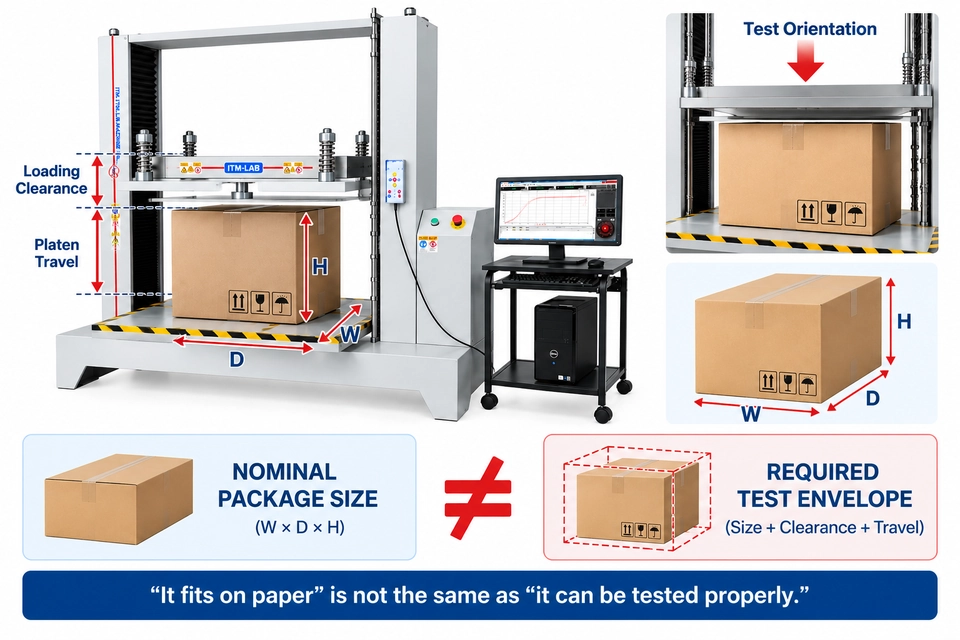
The RS-8401, for example, can be configured with test spaces including:
1000 × 1000 × 1200 mm
1200 × 1200 × 1200 mm
1500 × 1500 × 1500 mm
Choose the space around the largest package in its actual test orientation and leave enough working room for the test—not merely enough room for the carton to exist between the platens.
Speed and Control: Look Beyond the Maximum Number
Speed is easy to compare because it appears as a clean numerical range on a datasheet.
But the highest available speed is rarely the deciding factor in a package compression test.
The better question is:
Can the machine reproduce the loading sequence required by our procedure?
The RS-8401 provides a test-speed range of 0.001–200 mm/min using servo-controlled platen movement.
Depending on the test, you may need controlled compression, a target force, a defined deformation or a load-holding period.
For laboratories working with several customer procedures, control flexibility can matter more than the headline maximum speed.
Compare the required test sequence, not just the speed number.
Force Accuracy, Resolution and Displacement Are Different Specifications
These values often appear next to each other in a datasheet, which makes them easy to treat as interchangeable.
They are not.
Force accuracy
Accuracy describes how closely the indicated force agrees with the reference value under the stated specification conditions.
The RS-8401 specifies:
Load Accuracy: ±1% F.S.
Because this is a full-scale specification, the selected force range matters when evaluating the measurement requirement.
Force resolution
Resolution describes how finely the measurement system can distinguish changes in force.
The RS-8401 specifies:
Load Resolution: 1/250,000
A display with more digits is not automatically a more accurate measurement system.
Displacement
Displacement tells you how much the package changes dimension as load is applied.
The RS-8401 provides:
Displacement Resolution: 0.001 mm
Recording force and displacement together turns the test from a single maximum-load measurement into a record of the package's mechanical response.
What the Force–Displacement Curve Can Tell You
Suppose two cartons both reach approximately the same peak compression force.
Did they perform the same way?
Not necessarily.
One carton may build load steadily with relatively little deformation until it approaches the peak.
Another may begin buckling much earlier. Its stiffness changes, deformation increases, yet it eventually reaches a similar maximum force.
If you record only the peak value, much of that difference disappears.
The load–displacement curve preserves it.
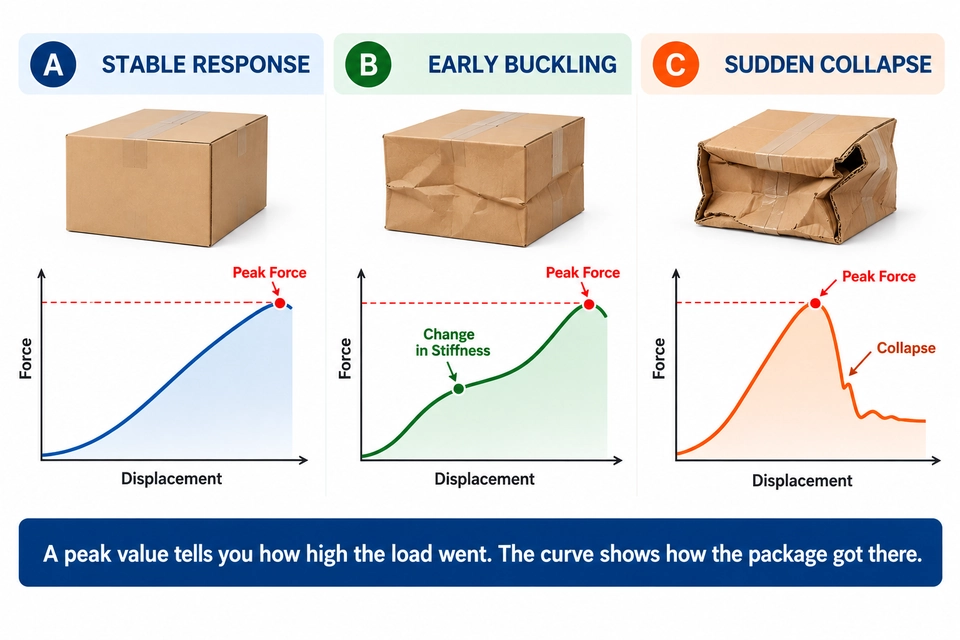
For packaging development, this can be especially useful.
Changes in board construction, geometry or internal support may change the shape of the compression response even when the final peak loads remain relatively close.
That gives the engineer more information than a simple “maximum force” result.
Empty Carton or Filled Package?
An empty carton and a complete filled transport package are not necessarily equivalent test specimens.
Contents can change the way the structure carries load.
Foam, trays, partitions and the product itself may support the outer package. In other cases, internal components can change where forces are transferred and where deformation begins.
Do not assume that an empty carton is automatically the conservative or “worst-case” condition.
The correct test configuration depends on what the procedure is intended to evaluate.
Your RFQ should therefore state clearly:
EMPTY PACKAGE
FILLED PACKAGE
or
BOTH
For filled-package testing, include the total mass and describe the internal packaging arrangement when it is relevant to the compression behavior.
Which Packaging Compression Test Standard Applies?
Identify the applicable standard or customer procedure before the tester configuration is finalized.
Common references include:
| Standard | Why It May Matter During Equipment Selection |
|---|---|
| ASTM D642 | Compression resistance testing of shipping containers, components and unit loads |
| ISO 12048 | Compression and stacking testing of complete, filled transport packages |
| ISO 2234 | Static-load stacking testing |
| ASTM D4577 | Constant-load compression testing of containers |
| ASTM D4169 | Compression may form part of a broader distribution-testing program |
Confirm the applicable edition and the actual procedure required by your laboratory, customer or internal specification.
Do not assume that sending a standard number answers every equipment question.
The package geometry, loading condition, required force, test duration and measurement outputs still need to be defined.
The standard belongs in the RFQ, but it does not replace the RFQ.
Six Buying Mistakes We See in Compression Tester RFQs
1. Selecting capacity from package weight
Package mass is useful application information. It is not the package's compression strength.
Start with the expected test force.
2. Choosing the highest capacity “just in case”
More capacity increases the upper limit. It does not automatically make the system better suited to the normal working force.
3. Checking carton dimensions but not the usable test envelope
Allow for loading, orientation and platen travel.
4. Writing only “compression test”
That does not tell the supplier whether the test runs to failure, to a target load, to a target deformation or through a sustained-load period.
5. Comparing only maximum force
Force measurement, displacement, control and test data can be just as important as maximum capacity.
6. Sending only the standard number
The actual package and procedure still have to be defined.
These look like small omissions in an RFQ. Any one of them can change the machine configuration.
A Better RFQ: Before and After
Consider this request:
“Need one box compression tester, 20 kN. Please quote.”
It tells the supplier the capacity the buyer has in mind.
It does not explain why 20 kN was selected.
Compare it with:
DUT: Filled corrugated shipping carton
Maximum size: 820 × 640 × 760 mm
Filled mass: 42 kg
Test: Compression to failure + constant-load hold
Expected peak force: Approximately 6–8 kN based on previous tests
Procedure: ASTM D642 plus customer procedure
Required results: Peak load, deformation and force–displacement curve
Now there is enough information to review the important parts of the configuration:
Force range
Test envelope
Control requirement
Measurement outputs
If the expected force is unknown, state that directly and provide the package construction and test procedure instead.
A good RFQ does not need to contain every machine specification.
It needs to describe the test well enough for the machine specification to be selected correctly.
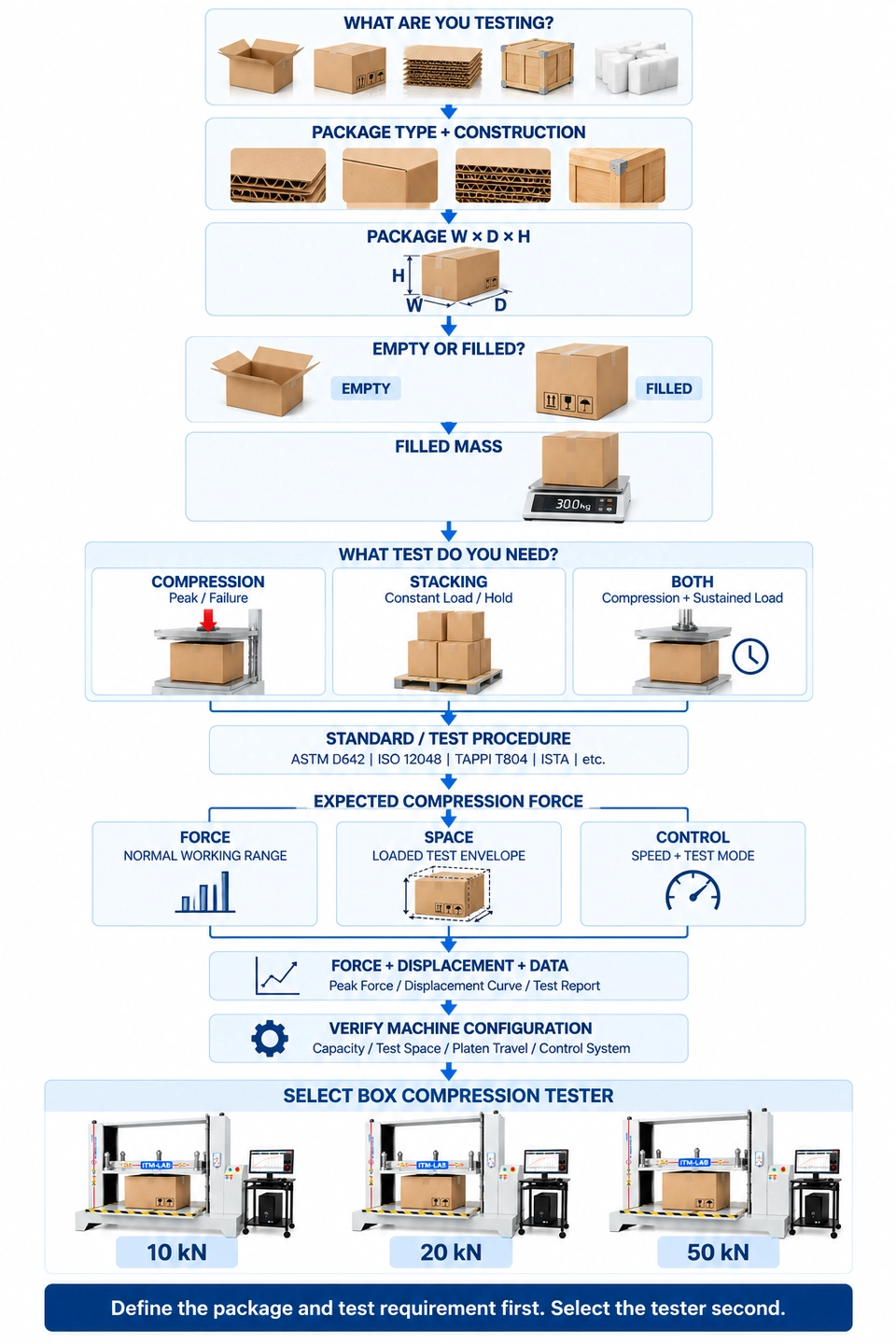
Box Compression Tester Selection Roadmap
The selection process can be reduced to one practical sequence.
Configuring the RS-8401 for Your Package
The ITM-LAB RS-8401 Packaging Compression Tester is designed for compression and stacking testing of cartons, corrugated boxes, plastic containers and complete transport packages.
Available force configurations are:
10 kN / 20 kN / 50 kN
Key system specifications include:
| Parameter | Specification |
|---|---|
| Capacity | 10 / 20 / 50 kN |
| Load Accuracy | ±1% F.S. |
| Load Resolution | 1/250,000 |
| Test Speed | 0.001–200 mm/min |
| Displacement Resolution | 0.001 mm |
| Test Space | Up to 1500 × 1500 × 1500 mm |
| Drive System | AC servo motor |
| Control Method | Professional closed-loop control software |
The system supports compression, constant-load, pressure-holding, constant-deformation and constant-time testing.
But the specification table should be the end of the selection process, not the beginning.
Before selecting an RS-8401 configuration, define:
Package W × D × H
Empty or filled condition
Filled mass
Compression / stacking / both
Expected test force
Standard or customer procedure
If the expected force is unknown, provide the package drawing or photos, construction information and test procedure for configuration review.
Box Compression Tester Buying Checklist
Before comparing quotations, make sure each proposed system is being evaluated against the same test requirement.
PACKAGE
Type + Construction + W × D × H + Filled Mass
↓
TEST
Compression / Stacking / Both
↓
PROCEDURE
Standard + Customer Requirement
↓
FORCE
Expected Peak + Normal Working Range
↓
SPACE
Usable Test Envelope
↓
CONTROL
Speed + Load / Deformation / Hold Requirement
↓
MEASUREMENT
Force + Displacement
↓
DATA
Results + Curve + Export
↓
MACHINE CONFIGURATION
Capacity + Test Space + Control System
A quotation that matches only the requested maximum force has not necessarily matched the test.
FAQ
What capacity box compression tester do I need?
Select capacity around the maximum required test force and the normal working range. Package weight alone should not be used to determine machine capacity. Package construction, test method and expected compression behavior also need to be considered.
Can I choose a box compression tester based on carton weight?
No direct conversion should be made between carton weight and compression-tester capacity. Two packages with similar mass can have very different compression strength because their materials, geometry, contents and load paths are different.
What is the difference between a box compression test and a stacking test?
A compression test generally evaluates package response as compressive load increases toward a specified endpoint or failure. A stacking test evaluates package behavior while a defined load is maintained for a specified period. The required control mode therefore depends on the procedure.
How much test space does a box compression tester need?
Start with the maximum package dimensions in the actual test orientation, then allow for loading clearance and required platen movement. The usable test envelope is more important than a simple comparison between nominal carton size and nominal machine dimensions.
What information should I provide when requesting a box compression tester quote?
Provide the package type, dimensions, filled mass, construction, test type, expected force if known, applicable standard or procedure, required hold duration and required test results. For unusual package geometry, include a drawing or photo.
Before You Request a Quote
Do not start the selection process with:
“Should we buy 10, 20 or 50 kN?”
Start with:
“What package are we testing, and what exactly must the test reproduce and measure?”
Once the package, procedure, expected force and usable test envelope are understood, the capacity decision becomes much easier.
For an RS-8401 configuration review, provide your package dimensions, filled mass, package construction, test method and expected compression force.
If the force is unknown, send the test procedure and package information instead.
Configure the tester around the package—not the other way around.
