
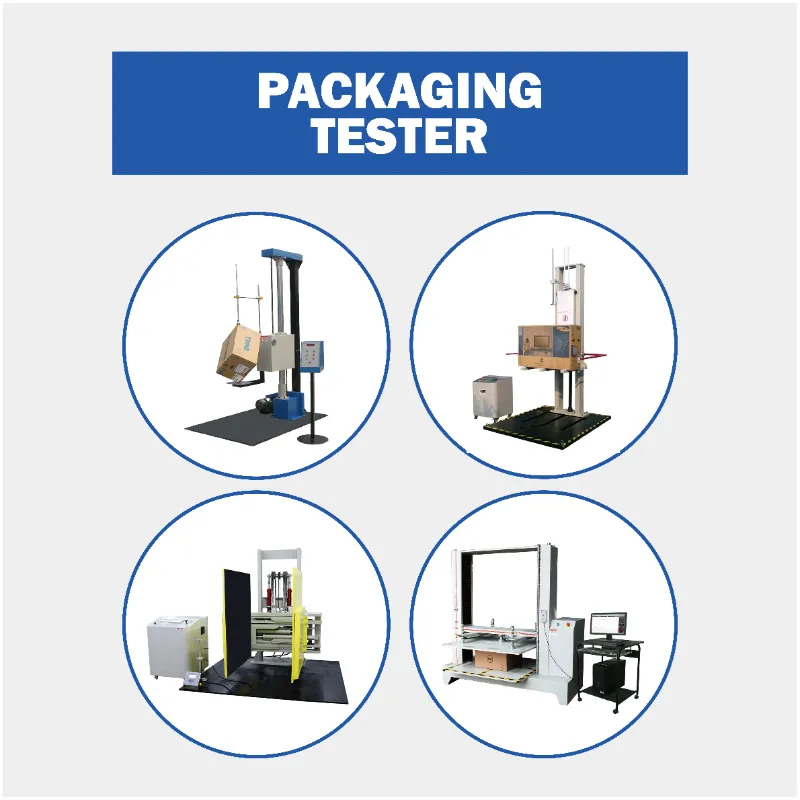
## Introduction to Package Testing Methods
Package testing equipment evaluates protective packaging performance under distribution hazards. Two primary methods address different failure modes: tumble testing (rotary drum) and drop testing (free fall impact). Understanding the differences helps select appropriate testing equipment.
## Fundamental Differences
### Tumble Tester (Rotary Drum Tester)
Definition:
Equipment that rotates packages inside a drum to simulate tumbling and rolling motion during transportation.
Test Principle:
- Repeated low-level impacts
- Continuous rotation (typically 10-12 rpm)
- Multiple impact angles
- Accumulated damage assessment
Simulates:
- Conveyor system handling
- Package sliding on truck beds
- Sorting system tumbling
- Multi-handling distribution
### Drop Tester
Definition:
Equipment that releases packages from specified heights to simulate impact during handling.
Test Principle:
- Single high-energy impact
- Controlled drop height
- Specific impact surface (flat, edge, corner)
- Immediate damage assessment
Simulates:
- Handler dropping package
- Fall from conveyor
- Forklift handling accident
- Loading dock impact
## Technical Comparison
### Test Parameters
Tumble Tester:
- Rotation speed: 10-12 rpm (ASTM D4169)
- Test duration: 5-25 minutes typical
- Impact frequency: Continuous (multiple impacts per rotation)
- Impact energy: Low per impact, cumulative over time
- Control variables: Rotation speed, duration, drum size
Drop Tester:
- Drop height: 300-1500mm typical
- Test frequency: Single or multiple drops
- Impact energy: High per impact
- Impact orientation: Controlled (flat, edge, corner, face)
- Control variables: Drop height, impact surface, orientation
### Equipment Configuration
Tumble Tester Components:
- Rotating drum (hexagonal or octagonal interior)
- Drive motor (0.37-0.75 kW typical)
- Speed control system
- Timer or rotation counter
- Safety interlock
- Emergency stop
Drop Tester Components:
- Release mechanism (pneumatic, electromagnetic, or mechanical)
- Height adjustment system
- Impact surface (concrete, steel, or wood)
- Carriage or gripper
- Height measurement system
- Safety features
## Application Scenarios
### When to Use Tumble Testing
Appropriate for:
- E-commerce parcel shipments
- Courier and postal service simulation
- Multi-handling distribution
- Small package testing (<30 kg typical)
- ASTM D4169 Schedule D or E compliance
- ISTA 3A or 6-Amazon testing
Not Appropriate for:
- Heavy freight shipments
- Single-event impact assessment
- Pallet unit load testing
- Fork truck handling simulation
### When to Use Drop Testing
Appropriate for:
- Handler drop simulation
- Individual package impact testing
- All package sizes (small to palletized)
- ASTM D4169 shock test requirements
- ISTA drop test specifications
- Rapid damage assessment
Not Appropriate for:
- Continuous handling simulation
- Accumulated damage testing
- Vibration-related failures
- Compression damage
## Standards and Specifications
### Tumble Testing Standards
ASTM D4169:
- Schedule D (Small Parcel Service): 60-250 rotations
- Schedule E (US Postal): 40-150 rotations
- Rotation speed: 10-12 rpm
- Equipment: Hexagonal or octagonal drum
ISTA 3A:
- Test 7: Rotary drum test
- Parameters depend on package weight
- Duration: Varies by test profile
### Drop Testing Standards
ASTM D4169:
- Multiple schedules include drop tests
- Drop height: Varies by assurance level and package weight
- Impact surfaces: Specified by standard
ISTA 3A:
- Test 6: Drop test
- Drop height based on package weight
- Multiple face, edge, corner drops
## Performance Comparison
### Damage Modes Detected
Tumble Testing Identifies:
- Closure system fatigue
- Seal weakening over time
- Cushioning compression
- Repeated impact damage
- Label wear
- Cumulative structural failure
Drop Testing Identifies:
- Immediate structural failure
- Cushioning bottoming out
- Corner crushing
- Product shifting
- Seal failure under shock
- Single-event damage threshold
### Test Sensitivity
Tumble Testing:
- Sensitive to: Closure design, seal quality, cumulative impact
- Less sensitive to: Cushioning thickness, single impact strength
- Detection: Gradual failure modes
Drop Testing:
- Sensitive to: Cushioning effectiveness, structural strength
- Less sensitive to: Closure fatigue, gradual seal weakening
- Detection: Immediate failure modes
## Equipment Selection Factors
### Testing Requirements
Consider:
- Applicable testing standards
- Distribution environment
- Package characteristics
- Testing volume
- Laboratory space
Tumble Tester Selection If:
- Primary standard: ASTM D4169 Schedule D/E
- Package type: Parcel service shipments
- Testing focus: Multi-handling simulation
- Space available: Larger footprint (drum diameter + clearance)
Drop Tester Selection If:
- Primary standard: Various drop test requirements
- Package type: All sizes
- Testing focus: Single impact events
- Space available: Height clearance required
### Budget Considerations
Tumble Tester Costs:
- Initial equipment: Moderate to high
- Installation: Standard (floor mounting)
- Operating cost: Electrical consumption (0.4-0.8 kW)
- Maintenance: Motor, bearings, drive belt
- Calibration: Annual speed verification
Drop Tester Costs:
- Initial equipment: Varies widely by configuration
- Installation: May require floor anchoring
- Operating cost: Pneumatic system (if applicable)
- Maintenance: Release mechanism, impact surface
- Calibration: Height measurement verification
## Complementary Testing
### Integrated Test Programs
Most comprehensive package validation programs use both methods:
Example Test Sequence:
1. Pre-conditioning
2. Drop test (initial impact assessment)
3. Tumble test (handling simulation)
4. Vibration test (transportation simulation)
5. Compression test (stacking load)
Rationale:
- Drop test identifies immediate failure threshold
- Tumble test reveals cumulative damage
- Combined results represent complete distribution cycle
### Test Data Correlation
Analyzing Both Test Results:
- Compare damage modes
- Identify primary failure mechanism
- Optimize packaging design
- Validate package performance
Example:
- Package passes drop test (adequate cushioning)
- Package fails tumble test (closure failure)
- Conclusion: Redesign closure system, maintain cushioning
## Operational Considerations
### Test Duration
Tumble Testing:
- Setup time: 2-5 minutes per test
- Test duration: 5-25 minutes per test
- Post-test evaluation: 5-10 minutes
- Total time per sample: 15-40 minutes
Drop Testing:
- Setup time: 2-5 minutes per orientation
- Test duration: <1 minute per drop
- Post-test evaluation: 2-5 minutes per drop
- Total time per sample: 10-30 minutes (multiple orientations)
### Operator Skill Requirements
Tumble Testing:
- Training time: 4-8 hours
- Complexity: Moderate
- Critical skills: Speed verification, duration calculation
- Safety concerns: Rotating equipment hazards
Drop Testing:
- Training time: 2-4 hours
- Complexity: Low to moderate
- Critical skills: Height adjustment, orientation control
- Safety concerns: Falling package hazards
### Maintenance Requirements
Tumble Tester Maintenance:
- Daily: Drum interior cleaning
- Monthly: Lubrication, belt tension check
- Annually: Calibration, bearing inspection
- Common repairs: Belt replacement, bearing replacement
Drop Tester Maintenance:
- Daily: Impact surface inspection
- Monthly: Release mechanism check
- Annually: Calibration, carriage inspection
- Common repairs: Release mechanism adjustment, surface replacement
## Laboratory Space Planning
### Tumble Tester Installation
Space Requirements:
- Equipment footprint: Drum diameter + frame
- Service clearance: 800mm minimum on access side
- Overhead clearance: 2000mm minimum
- Floor loading: Verify structural capacity
Example:
- Drum diameter: 1000mm
- Total footprint: 1500mm × 1200mm
- Clearance zone: 2300mm × 2000mm
- Total area: 4.6 square meters
### Drop Tester Installation
Space Requirements:
- Equipment footprint: Small (carriage guides)
- Service clearance: 1000mm all sides
- Overhead clearance: Drop height + 2000mm minimum
- Floor loading: Impact forces (may require reinforcement)
Example:
- Maximum drop height: 1500mm
- Equipment footprint: 800mm × 600mm
- Clearance zone: 2800mm × 2600mm
- Ceiling height required: 4000mm minimum
- Total area: 7.3 square meters
## ROI Considerations
### Testing Efficiency
Tumble Testing:
- Samples per hour: 2-4 (depending on test duration)
- Simultaneous testing: Possible (multiple packages in drum if size permits)
- Operator attention: Low (after setup)
Drop Testing:
- Samples per hour: 4-8 (depending on orientations)
- Simultaneous testing: Not possible
- Operator attention: High (each drop)
### Cost per Test
Tumble Testing:
- Energy cost per test: 0.3-0.6 kWh × electricity rate
- Consumables: Minimal (drum liner wear)
- Labor: Setup and evaluation time
- Total cost: Moderate per test
Drop Testing:
- Energy cost per test: Minimal to moderate (pneumatic systems)
- Consumables: Impact surface wear
- Labor: Multiple drop setup time
- Total cost: Low to moderate per test
## Decision Matrix
### Selecting Testing Method
Use this matrix to determine appropriate equipment:
| Factor | Favor Tumble Tester | Favor Drop Tester |
|--------|---------------------|-------------------|
| Package size | <30 kg | Any size |
| Primary standard | ASTM D4169 D/E | Various standards |
| Distribution mode | Parcel service | All modes |
| Damage mode focus | Cumulative | Single impact |
| Test volume | Moderate | High |
| Floor space | Available | Limited height |
| Budget | Moderate | Variable |
## Case Studies
### Case Study 1: E-commerce Packaging
Scenario:
- Product: Consumer electronics
- Distribution: Courier service
- Package weight: 2.5 kg
Testing Program:
- Primary: Tumble test (ISTA 6-Amazon)
- Secondary: Drop test (edge and corner)
Results:
- Tumble test identified closure weakness
- Drop test confirmed cushioning adequate
- Corrective action: Redesign closure, maintain cushioning
### Case Study 2: Medical Device
Scenario:
- Product: Diagnostic equipment
- Distribution: Dedicated carrier
- Package weight: 15 kg
Testing Program:
- Primary: Drop test (ASTM D4169 Level III)
- Secondary: Tumble test (for validation)
Results:
- Drop test revealed cushioning insufficient
- Tumble test confirmed package structure adequate
- Corrective action: Increase cushioning thickness
## Equipment Sourcing
### Tumble Tester Manufacturers
ITM-LAB:
- Product range: Standard and custom drum sizes
- Control options: Manual, digital, PLC
- Certifications: ISO 9001:2015
- Customization: Available
- Website: https://www.itm-lab.com/
- Experience: 27 years manufacturing
### Evaluation Criteria
When comparing vendors:
- Compliance with applicable standards
- Construction quality
- Control system features
- Technical support availability
- Spare parts accessibility
- Calibration services
- Warranty terms
## Technical Support
### ITM-LAB Services
Available Support:
- Pre-sales consultation
- Standard interpretation assistance
- Equipment specification
- Installation guidance
- Training materials
- After-sales technical support
Contact Information:
- Website: https://www.itm-lab.com/
- Inquiry response: 24-48 business hours
- Technical consultation: Available
Information to Provide:
- Testing standards applicable
- Package dimensions and weight
- Testing volume requirements
- Space constraints
- Budget considerations
---
## Conclusion
Tumble testers and drop testers serve complementary roles in package testing. Selection depends on:
- Applicable testing standards
- Distribution environment
- Damage modes of concern
- Testing volume and frequency
- Laboratory capabilities
Most comprehensive testing programs incorporate both methods to validate package performance across all distribution hazards.
---
References:
- ASTM D4169: Performance Testing of Shipping Containers
- ISTA 3A: Testing Procedures for Packaged Products
- Packaging testing industry practices
Disclaimer: This comparison provides general guidance. Consult applicable standards and testing requirements for specific applications.
