
MAIN ARTICLE CONTENT
tensile testing machine: Technical Overview and Applications
What is a Tensile Testing Machine
A tensile testing machine applies controlled tension to material specimens until failure, measuring force and deformation throughout the test process. These instruments determine mechanical properties including tensile strength, yield strength, elongation, and modulus of elasticity.
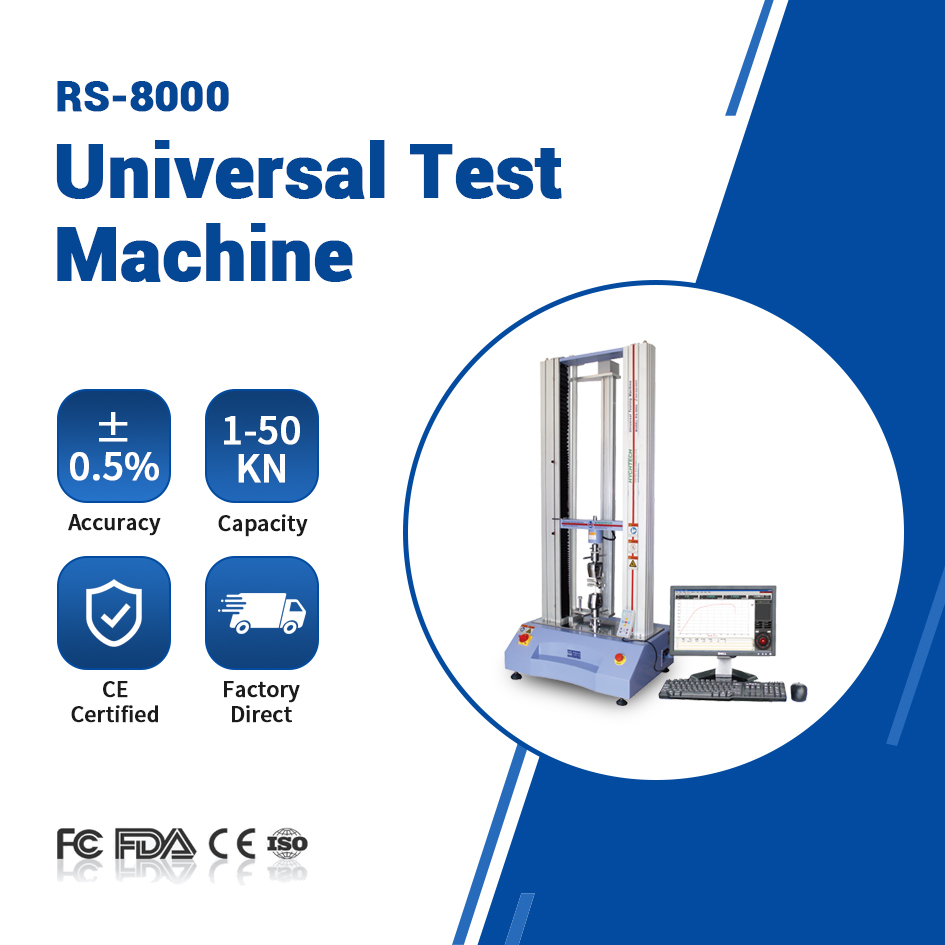
Universal testing machines (UTM) perform both tension and compression tests using interchangeable fixtures. The basic configuration includes a load frame, crosshead, grips, load cell, and extensometer.
Technical Specifications Comparison
| Specification | Standard UTM | High-Capacity UTM | Precision UTM |
|-------------------------|-----------------|-------------------|------------------|
| Load Capacity | 50 kN | 100-600 kN | 5-10 kN |
| Test Speed Range | 0.01-500 mm/min | 0.01-500 mm/min | 0.001-500 mm/min |
| Load Accuracy | ±0.5% | ±0.5% | ±0.2% |
| Displacement Resolution | 0.01 mm | 0.01 mm | 0.001 mm |
| Column Spacing | 400-500 mm | 600-800 mm | 400 mm |
| Power Requirement | 220V/50Hz | 380V/50Hz | 220V/50Hz |
Core Components
Load Frame: Provides structural rigidity to maintain alignment during testing. Single-column frames suit loads up to 5 kN; dual-column frames handle 5-600 kN.
Drive System: Ball screw mechanisms deliver precise crosshead positioning. Servo motors enable speed control from 0.01 to 500 mm/min.
Load Cell: Strain gauge transducers measure applied force. Accuracy class 0.5 or 1 per ISO 7500-1 standard.
Grips and Fixtures: Wedge grips for flat specimens, roller grips for thin materials, threaded grips for round specimens. Selection depends on specimen geometry and test standard.
Control Software: Records force-displacement data, calculates mechanical properties, generates test reports per ASTM, ISO, GB, DIN, JIS standards.
Applications by Industry
Metals and Alloys: Tensile tests per ASTM E8 for steel, aluminum, copper. Determines yield strength, ultimate tensile strength, elongation at break.
Plastics and Polymers: ASTM D638 testing for injection molded parts, films, sheets. Evaluates stress-strain behavior, modulus measurement.
Composites: ASTM D3039 for fiber-reinforced plastics. Assesses laminate strength, fiber-matrix bonding.
Textiles: ISO 13934 for fabric strength, ISO 2062 for yarn testing. Measures breaking force and elongation.
Rubber and Elastomers: ISO 37 dumbbell specimen testing. Characterizes stress at specific elongations, tensile strength.
Medical Devices: ASTM F2516 for braided stents, ASTM F2129 for suture materials. Validates product specifications.
Construction Materials: Rebar testing per ASTM A370, geotextile testing per ASTM D4595.
Test Standards and Compliance
ITM-LAB machines support testing per:
- ASTM E4, E8, D638, D3039, D790
- ISO 6892, ISO 527, ISO 37, ISO 7500-1
- GB/T 228.1, GB/T 1040, GB/T 16491
- EN 10002, EN ISO 6892
- JIS Z2241
Calibration per ISO 7500-1 standard ensures measurement traceability to national metrology institutes.
Maintenance Procedures
Daily Operations:
- Inspect grips for wear or damage
- Verify zero load reading before testing
- Clean specimen debris from test area
- Check emergency stop function
Weekly Maintenance:
- Lubricate ball screw with lithium-based grease
- Inspect guide rails for contamination
- Verify crosshead movement smoothness
- Check cable connections
Monthly Tasks:
- Calibrate load cell using certified weights or force transducers
- Inspect hydraulic grips for oil leaks (if applicable)
- Verify extensometer accuracy with calibration block
- Update software if patches available
Annual Service:
- Complete system calibration by certified technician
- Replace worn grips and fixtures
- Inspect electrical components
- Document calibration results per ISO 17025
Selection Criteria
Load Capacity: Choose capacity 2-3 times expected maximum test force. Accuracy degrades below 10% of rated capacity.
Test Space: Verify stroke length accommodates specimen elongation plus grip height.
Testing Speed: Materials testing requires 0.01-50 mm/min; impact simulation needs higher speeds.
Environment: Temperature 23±2°C, humidity 50±5% RH per ASTM D618 for plastics testing.
Data Output: Ensure compatibility with laboratory information management systems (LIMS).
ITM-LAB Manufacturing Capabilities
ITM-LAB produces testing machines since 1998 with the following capabilities:
- Load range: 5 kN to 600 kN
- Compliance with ISO 7500-1 Class 0.5 and Class 1
- Customized fixtures for specialized applications
- Multi-language software supporting 15+ test standards
- On-site installation and operator training
- Annual calibration service with certified references
Factory certifications include ISO 9001:2015 quality management and ISO 17025 testing laboratory accreditation.
Technical Support
Installation: On-site setup, alignment verification, initial calibration.
Training: 2-day operator course covering specimen preparation, test procedures, software operation, routine maintenance.
Calibration: Annual calibration service with ISO 17025 accredited certificate. Turnaround time 3-5 business days.
Spare Parts: Load cells, grips, extensometers, software licenses. Standard parts ship within 48 hours.
Remote Support: Technical assistance via phone, email, remote desktop during business hours UTC+8.
Warranty: 24-month coverage on electrical components, 12-month on mechanical parts. Extended service contracts available.
Cost Considerations
Price factors include:
- Load capacity (higher capacity increases cost)
- Control system (digital vs. computer-controlled)
- Fixtures and accessories quantity
- Software features (basic vs. advanced analytics)
- Calibration certification requirements
Return on investment depends on testing volume, labor costs, and quality control requirements. Typical payback period ranges 2-4 years for production quality control applications.
Common Testing Challenges
Specimen Slippage: Use knurled grips or emery cloth for metals. Reduce grip pressure for soft materials.
Premature Failure: Verify specimen machining quality. Check for stress concentrations at grip interface.
Data Scatter: Control test speed strictly. Condition specimens per material standard. Verify calibration status.
Alignment Issues: Check specimen straightness. Ensure grip faces parallel. Perform regular alignment verification.
Future Developments
Current industry trends include:
- Integration with automated specimen handling systems
- Real-time data transmission to cloud platforms
- AI-assisted anomaly detection in test curves
- Multi-axis testing for complex loading scenarios
- Non-contact strain measurement using digital image correlation
ITM-LAB develops testing solutions aligned with Industry 4.0 requirements while maintaining measurement accuracy and standards compliance.
Contact us for price list and customized testing solutions.
