Introduction
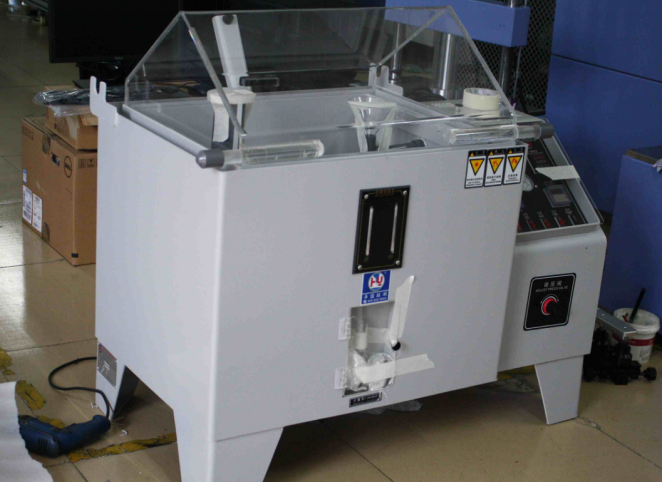
Salt Spray Testing Principles
Corrosion Mechanism
Salt spray testing accelerates electrochemical corrosion through continuous exposure to atomized sodium chloride solution. The test creates conditions favoring:
- Anodic dissolution of base metal at coating defects
- Cathodic oxygen reduction at coating surface
- Electrolyte concentration at metal-coating interface
- Accelerated pit propagation through coating thickness
Test severity exceeds natural atmospheric exposure through continuous salt deposition (1.0-2.0 mL/80cm²/hour), elevated chamber temperature (35°C ±2°C), and saturated humidity conditions (>95% RH). This compressed timescale enables comparative coating evaluation within practical test periods.
Solution Chemistry
ASTM B117 specifies 5% sodium chloride solution (50 g NaCl per liter of distilled or deionized water) at pH 6.5-7.2. Solution preparation requires:
- Reagent grade NaCl (99.5% minimum purity)
- Water meeting ASTM D1193 Type IV specifications (conductivity <5 μS/cm)
- pH verification before atomization
- Weekly solution replacement (minimum)
Solution aging affects test reproducibility. Chloride ion concentration increases through evaporation while pH drifts from CO₂ absorption. ITM-LAB chambers incorporate automatic solution replacement systems maintaining fresh chemistry throughout extended test cycles.
ASTM B117 Standard Requirements
Chamber Design Specifications / Test space configuration per ASTM B117:
Volume: Minimum 0.4m³ (400L) for standard testing
Temperature: 35°C ±2°C throughout test zone
Humidity: Continuous condensation on chamber surfaces (>95% RH)
Solution Collection: 1.0-2.0 mL/80cm²/hour averaged over 16 hours
Atomization: Compressed air at 10-25 PSI (69-172 kPa), oil-free
Air Saturation: Atomizing air pre-humidified at 35°C before nozzle
Chamber materials must resist corrosion without contaminating test atmosphere. ITM-LAB constructs chambers using:
- Interior: PP (polypropylene) or PVC welded construction
- Heating: Glass or PVC-coated immersion heaters
- Atomizing tower: Borosilicate glass or inert plastic
- Covers: Transparent acrylic or polycarbonate for visibility
Specimen Positioning
Test specimens require:
- 15-30° inclination from vertical (optimizes solution drainage)
- Minimum 100mm separation between specimens
- Supports constructed from glass, plastic, or coated materials
- No drip contamination from upper specimens to lower specimens
- Free air circulation around all specimen surfaces
Salt Spray Chamber ASTM B117 Test Paramete
| Parameter | ASTM B117 Requirement | Typical Chamber Range |
|---|---|---|
| Chamber Volume | 0.4m³ minimum | 0.4m³ - 1.5m³ |
| Temperature | 35°C ±2°C | 35°C ±1°C (precision models) |
| Solution Concentration | 5% NaCl, pH 6.5-7.2 | Automatic mixing and pH control |
| Collection Rate | 1.0-2.0 mL/80cm²/16h | 1.5 mL/80cm²/16h typical |
| Atomizing Pressure | 10-25 PSI (oil-free) | 15 PSI ±2 PSI |
| Air Saturation Temp | 35°C ±3°C (before atomization) | 35°C ±1°C |
| Test Duration | Specification dependent | 24h - 3000h programmable |
| Chamber Material | Corrosion resistant, non-contaminating | PP/PVC welded construction |
Note: Specifications represent ASTM B117 minimum requirements. Chamber design variations exist for accelerated testing per ASTM G85 protocols.
Accelerated Corrosion Test Methods
Neutral Salt Spray (NSS) - ASTM B117
Standard test for general corrosion resistance:
- Solution: 5% NaCl, pH 6.5-7.2
- Temperature: 35°C
- Duration: 24h to 3000h depending on application
- Applications: Zinc plating, nickel-chrome, paint systems, anodized aluminum
NSS testing represents coastal atmospheric exposure with continuous salt deposition. Results correlate to marine environments but show limited correlation to industrial or urban atmospheres containing sulfur compounds.
Acetic Acid Salt Spray (AASS) - ASTM G85-A2
Acidified test for chromate conversion coatings:
- Solution: 5% NaCl + glacial acetic acid to pH 3.0-3.1
- Temperature: 35°C
- Duration: 24h to 240h typical
- Applications: Chromate, phosphate conversion coatings on steel/aluminum
AASS accelerates corrosion at coating defects through acidic attack. Test severity exceeds NSS by factor of 3-5×. Primarily used for fasteners, military hardware, and aerospace components requiring MIL-DTL-5541 chromate coatings.
Copper-Accelerated Acetic Acid Salt Spray (CASS) - ASTM B368
Highly accelerated test for anodized aluminum and decorative coatings:
- Solution: 5% NaCl + glacial acetic acid + 0.26g/L CuCl₂, pH 3.0-3.1
- Temperature: 50°C
- Duration: 8h to 96h typical
- Applications: Anodized aluminum, decorative electroplating, architectural hardware
CASS testing compresses months of field exposure into hours through copper ion catalysis. Eight hours CASS approximates 240 hours NSS for many coating systems. Used extensively for ANSI/BHMA A156.18 architectural hardware certification.
Cyclic Corrosion Testing - SAE J2334, GMW 14872
Automotive industry cyclic protocols combining salt spray with humidity and dry-off phases:
GMW 14872 Cycle (General Motors):
- 0.5h: Salt spray (5% NaCl at 35°C)
- 2.5h: Humidity (50°C, 100% RH)
- 3.0h: Air dry (60°C, 50% RH)
- Repeat: 24-120 cycles depending on component
VDA 621-415 Cycle (German automotive):
- Salt spray phase (35°C)
- Climate change phase (-20°C to +50°C)
- Humidity phase (40°C, 100% RH)
- Dry phase (50°C, <30% RH)
Cyclic testing replicates real-world wet/dry cycling, improving field correlation vs. continuous salt spray. Results show better correlation to winter road salt exposure and coastal/industrial combined environments.
Chamber Configuration Options
Standard Salt Spray Chambers / Benchtop configuration for laboratory testing:
Internal Volume: 0.4m³ to 1.0m³
Test Space: 900mm W × 600mm D × 600mm H typical
Specimen Capacity: 20-40 panels (150mm × 100mm)
Construction: PP/PVC tank with acrylic cover
Temperature Control: PID controller, ±0.5°C
Solution Delivery: Peristaltic pump with level control
Atomizer: Borosilicate glass tower, adjustable nozzle
Standard chambers accommodate flat panel testing per ASTM B117. Chamber size selection depends on specimen quantity and panel dimensions. ITM-LAB chambers feature side-access doors for specimen loading without disturbing chamber environment.
Cyclic Corrosion Chambers
Combined salt spray, humidity, and temperature cycling:
Volume: 0.8m³ to 1.5m³
Temperature Range: -20°C to +70°C (cyclic testing)
Humidity Range: 30% RH to 98% RH
Transition Rate: 1°C/min typical (heating), 0.5°C/min (cooling)
Programmable Cycles: 100 steps, repeatable segments
Data Logging: Temperature, RH, solution level, alarm conditions
Cyclic chambers integrate refrigeration systems for low-temperature phases and dehumidification for dry cycles. Controllers execute complex automotive test sequences automatically with minimal operator intervention.
Industry Applications
Automotive Components / Salt spray testing validates:
- Underbody components: 720h NSS or 30 GMW cycles minimum
- Exhaust systems: 240h NSS for aluminized steel, 480h for stainless
- Fasteners: Grade 5/8 require 500h NSS per SAE J429
- Wheels: 480h CASS for decorative coatings per SAE J2334
Automotive specifications reference both continuous salt spray and cyclic protocols. OEM-specific standards (GMW, WSS, PV, ES) often exceed ASTM requirements. Test pass/fail criteria include red rust area limits (typically <5% at rating 8 per ASTM D610) and perforation limits for structural components.
Aerospace and Defense
Military specifications require:
- MIL-DTL-5541 chromate coatings: 336h AASS
- MIL-DTL-81706 chemical agent resistant coating: 500h salt fog
- AMS 2700 passivation: 24h salt spray, no corrosion
- Anodized aluminum (MIL-A-8625): 336h CASS minimum
Aerospace testing emphasizes coating adhesion, blistering resistance, and corrosion product type. White corrosion (zinc oxide) on sacrificial coatings indicates proper function, while red rust (iron oxide) on steel indicates coating failure.
Coatings and Surface Finishing
Industrial coating evaluation:
- Powder coatings: 1000h NSS per ASTM D1654
- Zinc plating: 96-720h NSS depending on thickness
- Zinc-nickel alloy: 500h NSS minimum
- Galvanized steel: 96h NSS for coating weight verification
Salt spray duration correlates to coating thickness and substrate protection requirement. Testing establishes quality baselines during coating development and verifies process control during production. Results supplement electrochemical impedance spectroscopy (EIS) data for coating evaluation.
Metal Products and Hardware
Architectural hardware testing per ANSI/BHMA:
- Grade 1 (commercial): 96h CASS
- Grade 2 (light commercial): 26h CASS
- Grade 3 (residential): 8h CASS
Marine hardware follows ASTM F1538, B117 for stainless steel components with pass/fail at 1000h exposure. Testing validates material selection, welding procedures, and passivation effectiveness.
Electronics and Telecommunications
Connector and enclosure testing:
- IP67/IP68 rated enclosures: 96h salt spray per IEC 60529
- Telecommunications equipment: GR-63-CORE salt fog exposure
- Military electronics: MIL-STD-810 Method 509 salt fog
Electronic component testing emphasizes contact resistance stability, seal integrity, and conformal coating performance under corrosive conditions.
Selection Criteria
Determining Chamber Size / Calculate required volume using:
- Panel dimensions: Standard automotive panels 300mm × 150mm
- Specimen quantity per test cycle
- Rack configuration: 15-30° angle requires vertical clearance
- Support structures: Minimum 100mm spacing between specimens
Example sizing calculation:
Testing requirement: 30 panels (150mm × 100mm) per cycle
Rack spacing: 120mm between panels (center to center)
Required chamber width: 30 panels × 120mm spacing ÷ 2 rows = 1800mm minimum
Add 300mm access clearance = 2100mm internal width required
Specification Compliance Requirements
Select chamber based on test standards:
ASTM B117 only: Standard salt spray chamber
ASTM B117 + ASTM G85 (AASS/CASS): Chamber with temperature control to 50°C
SAE J2334/GMW cyclic: Full environmental chamber with refrigeration
ISO 9227 + VDA 621-415: Cyclic chamber with -20°C capability
Chamber validation documentation requirements vary by industry:
- Automotive: PPAP, temperature uniformity survey, solution verification
- Pharmaceutical: IQ/OQ protocols per 21 CFR Part 11
- Aerospace: AS9100 traceability, NADCAP certification for test facility
Test Volume and Production Scale
Laboratory R&D applications:
- Chamber size: 0.4-0.6m³
- Specimen capacity: 15-25 panels
- Single test protocol capability sufficient
Production quality control:
- Chamber size: 1.0-1.5m³
- Multiple test protocols (NSS, AASS, CASS)
- High-volume specimen processing
Multi-chamber installations enable parallel testing of different coating systems, component sizes, or test durations. ITM-LAB provides chamber banks with shared air compressor and solution preparation systems for facility-scale testing operations.
Maintenance and Calibration
Weekly Operations / Solution management:
- Verify salt solution concentration (specific gravity 1.029-1.036 at 25°C)
- Check pH (6.5-7.2 for NSS, 3.0-3.1 for AASS/CASS)
- Confirm solution level in reservoir
- Drain and replace solution (minimum weekly)
Chamber inspection:
- Clean collection funnels and drains
- Verify atomizer nozzle spray pattern
- Check temperature controller setpoint and actual temperature
- Inspect door seals for salt buildup
Monthly Maintenance
Deep cleaning procedures:
- Remove salt deposits from chamber walls (warm water rinse)
- Clean atomizing tower and nozzle (ultrasonic cleaning or vinegar soak)
- Flush solution supply lines
- Inspect and clean air saturation bottle
System verification:
- Calibrate temperature sensors against reference RTD (±0.5°C accuracy)
- Verify air pressure regulator setting (10-25 PSI range)
- Test safety interlocks (over-temperature cutoff, low solution alarm)
- Check data logger functionality
Annual Calibration
Temperature uniformity survey per ASTM B117:
- Minimum 5-point temperature mapping
- Reference standard: Calibrated RTD sensor (±0.2°C accuracy)
- Acceptance: All points within 35°C ±2°C during 24h test
- Documentation: Temperature vs. time plot, sensor locations
Solution collection rate verification:
- Position collectors (80cm² area) in test zone
- Run 16-hour test cycle
- Measure collected volume: 1.0-2.0 mL per collector
- Adjust atomizer pressure or solution flow if out of specification
Chamber qualification following major repairs or modifications requires full IQ/OQ protocol including temperature uniformity, solution verification, and test reproducibility using standard reference specimens.
ITM-LAB provides annual calibration service with certificates traceable to national standards (NIST/CNAS). On-site calibration available for chambers in continuous production use.
Test Procedure and Results Evaluation
Specimen Preparation / Surface preparation requirements per ASTM B117:
- Cleaning: Solvent degrease (acetone, isopropyl alcohol)
- Handling: Gloves required, avoid skin oils on test surface
- Scribing: 1mm wide scribe to substrate (coating evaluation only)
- Edge protection: Mask edges with wax or vinyl tape
- Identification: Permanent marker on non-test surface
Panel positioning:
- Angle: 15-30° from vertical
- Orientation: Coated surface upward (solution drainage away from panel)
- Supports: Glass or plastic racks (non-metallic contact)
Test Execution
Chamber operation sequence:
1. Load specimens into pre-heated chamber (35°C stabilized)
2. Verify solution concentration and pH
3. Start atomization (observe fog density and distribution)
4. Record start date/time, test specification, specimen identification
5. Conduct daily chamber checks (temperature, solution level, atomization)
6. Remove specimens at specified test duration
Continuous vs. intermittent exposure:
- ASTM B117: Continuous spray except for brief inspection (<30 minutes/day)
- ASTM G85: Some protocols require 1h spray, 1h dry cycles
- Cyclic testing: Programmed spray/humidity/dry sequences
Post-Test Evaluation
Immediate post-test procedures:
- Gently rinse specimens with clean water (remove salt deposits)
- Dry at room temperature or with compressed air
- Evaluate within 1 hour (corrosion product formation continues if delayed)
Rating methods per ASTM D610 (rusting) and ASTM D714 (blistering):
- Rating 10: No rust or blistering
- Rating 9: <0.01% area affected
- Rating 8: 0.01-0.03% area affected
- Rating 7: 0.03-0.1% area affected
- Rating 6: 0.1-0.3% area affected (minimum pass for many specifications)
Coating performance criteria:
- Creepage from scribe: Measure maximum blister distance from scribe line
- Adhesion loss: Cross-cut tape test per ASTM D3359 in corroded area
- Substrate corrosion: Red rust area on steel, white corrosion on zinc
- Pitting: Count and measure pit depth (micrometer or optical microscopy)
Photography and documentation:
- Pre-test: Capture specimen condition before testing
- Post-test: Standardized lighting and background for consistent imaging
- Detailed views: Close-up of scribe creepage, blistering, corrosion products
Troubleshooting Common Issues
Insufficient Corrosion (False Pass) / Possible causes:
- Salt solution concentration too low (verify specific gravity)
- Chamber temperature below 35°C (check temperature uniformity)
- Inadequate solution collection rate (verify 1.0-2.0 mL/80cm²/16h)
- Solution pH drift (CO₂ absorption in aged solution)
- Air pressure too low (weak atomization)
Verify chamber operation against ASTM B117 requirements using reference specimens with known performance.
Excessive Corrosion (False Fail)
Possible causes:
- Contaminated solution (metal ions from prior tests)
- Temperature above 37°C (accelerated beyond standard conditions)
- Excessive solution collection (>2.0 mL/80cm²/16h)
- Acidic pH (<6.5 due to solution aging or CO₂)
- Specimen contact with corroded support structures
Fresh solution and cleaned chamber typically resolves excessive corrosion issues. Contaminated chambers may require acid wash followed by extensive water rinsing.
Non-Uniform Results
Possible causes:
- Temperature gradients in chamber (inadequate circulation)
- Uneven salt deposition (atomizer positioning, air flow blockage)
- Drip contamination from upper specimens
- Condensate dripping on specimens
Conduct empty chamber temperature survey to identify hot/cold zones. Reposition atomizer or add baffles to improve fog distribution.
Cost of Ownership Analysis
Initial Investment
Salt spray chamber costs vary by specifications (pricing not provided per client requirements):
Factors affecting capital cost:
- Chamber volume (0.4m³ benchtop vs. 1.5m³ production units)
- Test capabilities (NSS-only vs. full cyclic testing)
- Automation level (manual solution change vs. automatic systems)
- Material quality (PVC vs. PP construction, glass vs. plastic atomizers)
- Data logging and compliance documentation features
Operating Costs
Consumables:
- Salt solution: 5% NaCl (~50g/L), fresh solution weekly
- Reagent grade NaCl cost: -40 per 25kg (500-1000 test solutions)
- Deionized water: 20-50 liters/week depending on chamber size
- Compressed air: Oil-free air at 10-25 PSI continuous operation
Energy consumption:
- Heating: 1-2 kW for temperature maintenance at 35°C
- Refrigeration (cyclic chambers): 3-5 kW during cooling cycles
- Annual electricity: Chamber size and utilization dependent
Maintenance materials:
- Atomizer nozzle replacement: Annually (erosion from salt spray)
- Temperature sensors: 3-5 year replacement cycle
- Seals and gaskets: Inspect annually, replace as needed
Lifecycle Costs (10-year period)
Total cost of ownership includes:
- Initial equipment purchase
- Installation and commissioning
- Consumables (salt, water, replacement parts)
- Energy costs (typically 20-30% of purchase price over 10 years)
- Annual calibration service
- Potential downtime costs (lost test capacity)
Chamber longevity depends on maintenance quality and test volume. Well-maintained chambers operate 15-20 years with periodic component replacement. Corrosive test environment requires more frequent maintenance vs. temperature-only chambers.
Conclusion
Salt spray chambers provide accelerated corrosion testing for coating evaluation, material selection, and quality control across automotive, aerospace, metal finishing, and architectural hardware industries. Chamber selection requires analysis of applicable test standards (ASTM B117, ISO 9227, ASTM G85, SAE J2334), specimen size and quantity, and required test protocols (continuous spray vs. cyclic exposure).
Test method selection balances test severity with field correlation. Neutral salt spray (NSS) represents general atmospheric corrosion. Acetic acid salt spray (AASS) accelerates testing for conversion coatings. CASS provides highly accelerated testing for decorative finishes. Cyclic protocols improve real-world correlation through wet/dry cycling that replicates environmental conditions.
Proper chamber operation, solution chemistry control, and specimen preparation ensure reproducible results supporting coating development, production quality verification, and failure investigation. Regular calibration and maintenance preserve test accuracy throughout chamber lifecycle.
ITM-LAB manufactures salt spray test chambers compliant with ASTM B117, ISO 9227, and automotive cyclic test standards with 27 years of experience serving coating manufacturers, automotive suppliers, aerospace contractors, and testing laboratories worldwide.
For salt spray chamber specifications tailored to specific test standards and production requirements, contact ITM-LAB technical team with applicable test protocols, specimen dimensions, and throughput requirements.
Contact us
Contact us for price list and customized testing solutions.
