
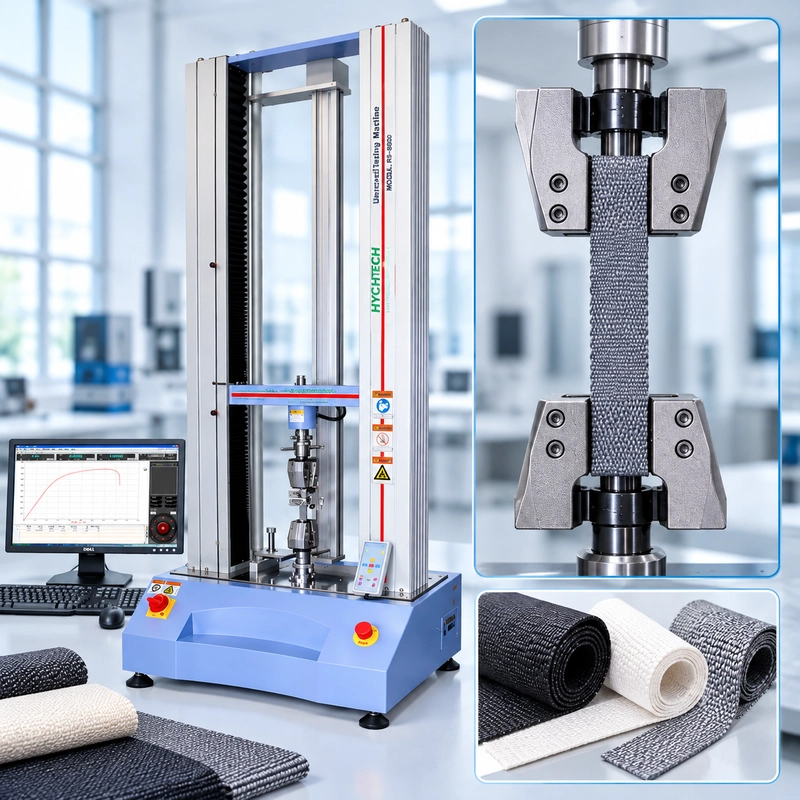
A customer asks for a 50 kN tensile testing machine for an industrial fabric.
The only test information supplied is:
Breaking force: approximately 18 kN.
Our first question would not be whether 50 kN is enough.
We would ask to see the specimen.
A 50 mm coated strip, a narrow reinforcement textile, and a wide technical-fabric specimen can all produce an 18 kN result. They do not necessarily need the same grips, gauge length, travel, or even the same test method.
That distinction matters because industrial textile is a material category, not a tensile test method.
Before choosing the frame, we need to know what product the textile becomes, which specification governs the test, what specimen that specification requires, and what the laboratory actually needs to measure.
For higher-force textile applications, the frame may turn out to be the easiest part of the specification.
Industrial Textile Is a Material Category, Not a Test Method
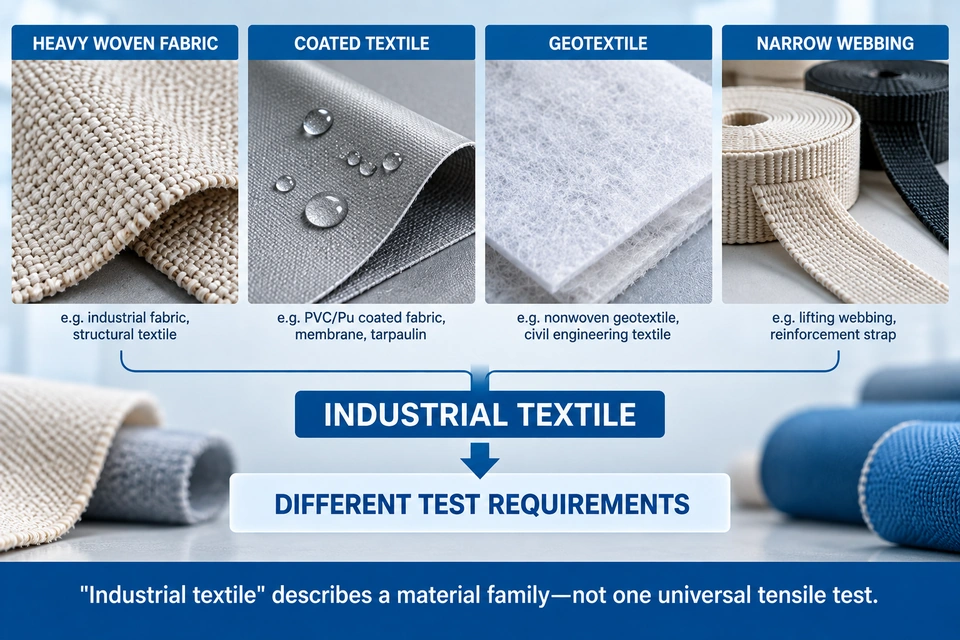
"Industrial textile" covers a surprisingly wide range of engineered materials.
A laboratory may be dealing with a heavy woven fabric today, a coated technical textile tomorrow, and a narrow reinforcement product next week.
All three can be tensile tested.
That does not make them the same test.
| Material / Product | What May Change in the Test |
|---|---|
| Heavy woven fabric | Direction, specimen width, edge preparation, grip behavior |
| Coated textile | Surface interaction with the jaws, substrate/coating response |
| Geotextile | Product-specific specimen geometry and test procedure |
| Narrow fabric / webbing | Concentrated load path and grip arrangement |
| Reinforcement textile | Higher force and alignment sensitivity |
| Filter / technical fabric | Construction-dependent deformation and failure |
Even the word strength needs context.
Are we reporting total breaking force? A result normalized according to a product-specific method? Maximum force in one product direction? A force-extension response?
The governing test requirement answers those questions.
The machine does not.
Start With the Product Requirement
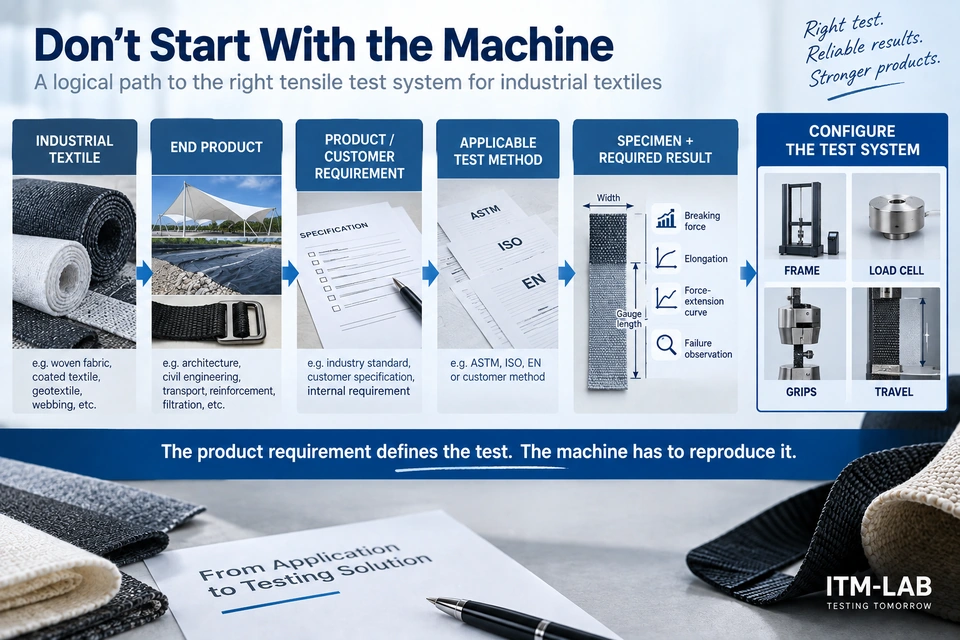
Before quoting a machine, we want four things established:
What is the finished product?
Which standard or customer specification controls the test?
What specimen does that requirement call for?
What result has to be reported?
This is more useful than beginning with machine capacity.
A product requirement may define the specimen width, free length, direction, conditioning procedure, test rate, gripping arrangement, and result calculation. Some requirements also define how particular failure locations should be treated.
A sensible test-system specification therefore develops in this direction:
END PRODUCT
↓
PRODUCT / CUSTOMER REQUIREMENT
↓
APPLICABLE TEST METHOD
↓
SPECIMEN
↓
REQUIRED RESULT
↓
TEST SYSTEM
Not the other way around.
This is particularly important when a customer already has an internal specification. A generic textile method should not automatically replace a product-specific requirement simply because the equipment supplier is more familiar with it.
18 kN Is Useful. It Still Isn't Enough.
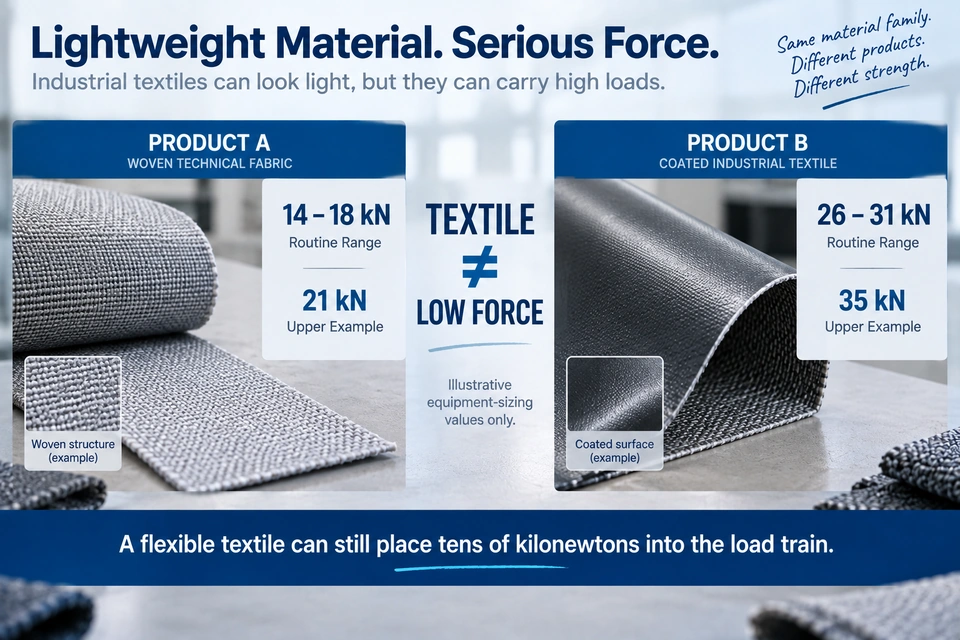
Suppose a laboratory sends us two sets of historical data.
Product A
Routine breaking force:
14–18 kN
Upper observed result:
21 kN
Product B
Routine breaking force:
26–31 kN
Upper observed result:
35 kN
These are illustrative equipment-sizing examples, not acceptance values from a particular textile standard.
Both immediately tell us something important:
This is no longer a low-force fabric application.
A textile can be thin, flexible, and easy to lift by hand while still putting tens of kilonewtons through a tensile machine.
But even 35 kN is not enough information to finish the specification.
We still need to know the specimen width.
We need to know how it is held.
We need to know how far it extends.
And we need to know whether 35 kN represents routine testing or an occasional upper result.
That is why we distinguish between maximum expected force and normal working force.
Where Does the Lab Actually Work?
Imagine this test program:
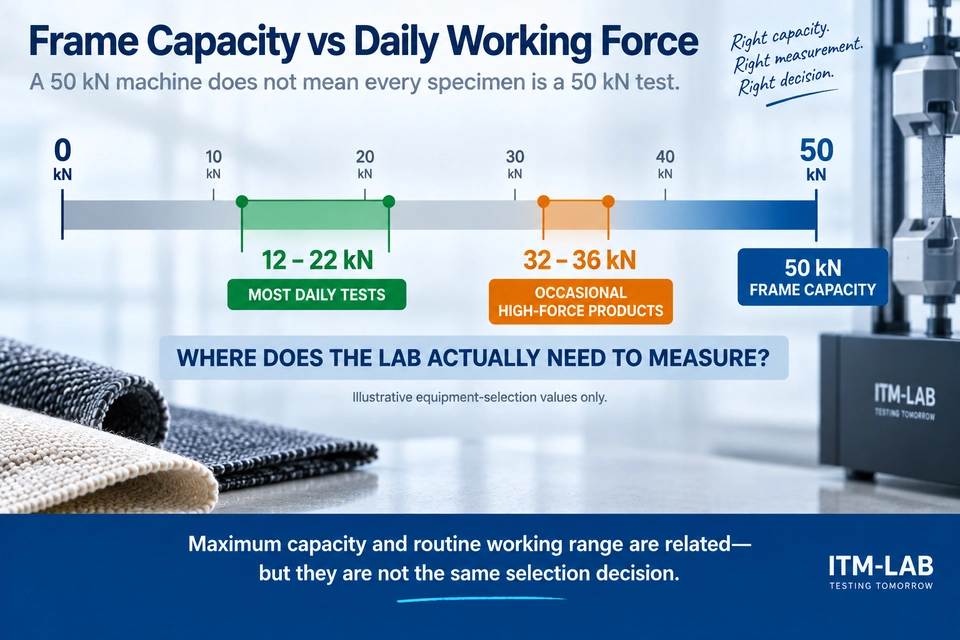
Most daily tests: 12–22 kN
Occasional high-force products: 32–36 kN
Machine under consideration: 50 kN
The 50 kN frame answers one question:
Can the machine accommodate the required force?
It does not answer another:
Where does the laboratory need useful force-measurement performance every day?
Most of this laboratory's testing takes place between 12 and 22 kN.
That matters when the load-measurement configuration is selected.
The occasional 36 kN specimen matters too, because the complete system still needs sufficient capacity for it.
This is why frame capacity and normal working range should be discussed separately.
A 50 kN machine does not mean every specimen is a "50 kN test."
When Does a Low-Force Textile Tester Stop Being the Right Platform?
There is no universal force number where a "textile tester" suddenly becomes the wrong machine and a higher-capacity universal testing machine becomes the right one.
The transition is application-specific.
A higher-capacity platform becomes worth evaluating when the expected force approaches or exceeds the usable capability of the existing system.
But force is not the only reason.
Industrial specimens may also require:
- physically larger grips;
- higher grip load capacity;
- wider jaw faces;
- more vertical test space;
- greater crosshead travel;
- heavier adapters or fixtures;
- additional capacity for future product families.
For lower-force fabric testing, a platform such as the ITM-LAB RS-8010A may be appropriate depending on the method and configuration.
Once the application moves into substantially higher breaking forces, the RS-8000 10–50 kN platform becomes one system worth evaluating.
The boundary should be determined from the test.
Not from the words fabric or industrial textile.
If your application is specifically an ASTM D5035 strip breaking-force and elongation test, use our dedicated ASTM D5035 guide for specimen preparation, raveled versus cut strips, fabric direction, specimen width, and lower-force system configuration.
The Grip Often Becomes the Hard Part
If a specimen is expected to break at 20 kN but starts sliding through the jaws at 12 kN, increasing frame capacity does nothing useful.
The machine can pull harder.
The specimen cannot receive that force correctly.
This is where higher-force textile testing becomes an application problem rather than a simple machine-capacity problem.
Before configuring the grips, we want to know:
| What We Need to Know | Why It Matters |
|---|---|
| Specimen width | Determines required gripping width and load distribution |
| Thickness | Affects jaw opening and restraint |
| Surface | Smooth, rough, and coated materials behave differently in contact |
| Construction | Woven, coated, and reinforced structures respond differently |
| Expected force | Grip and adapter capacity must support the load |
| Expected elongation | The specimen/grip interface must remain stable during extension |
| Existing failure location | Helps identify whether the current setup is influencing the result |
A photo of the actual specimen is often more useful here than another page of machine specifications.
Slip
Obvious pull-out is easy to identify.
Progressive slip is less obvious.
The specimen may move gradually relative to the jaw while the machine continues loading. If extension is being evaluated, that movement can be especially troublesome because not all recorded displacement necessarily represents deformation of the intended test region.
The answer is not always "clamp harder."
Jaw-Edge Break
Go too far in the opposite direction and the material may repeatedly fail at the edge of the grip.
That can indicate local damage or stress concentration introduced by the gripping arrangement.
Again, simply increasing clamping pressure is not a universal solution.
The aim is stable load transfer without creating a new dominant failure location.
Uneven Load Entry
Wide textile specimens introduce another problem.
If one side becomes taut before the other, the specimen does not begin the test under a clean, uniform axial load.
By the time the final peak appears on screen, the specimen may already have experienced asymmetric loading.
For this reason, centering and repeatable specimen installation matter more than they sometimes appear to.
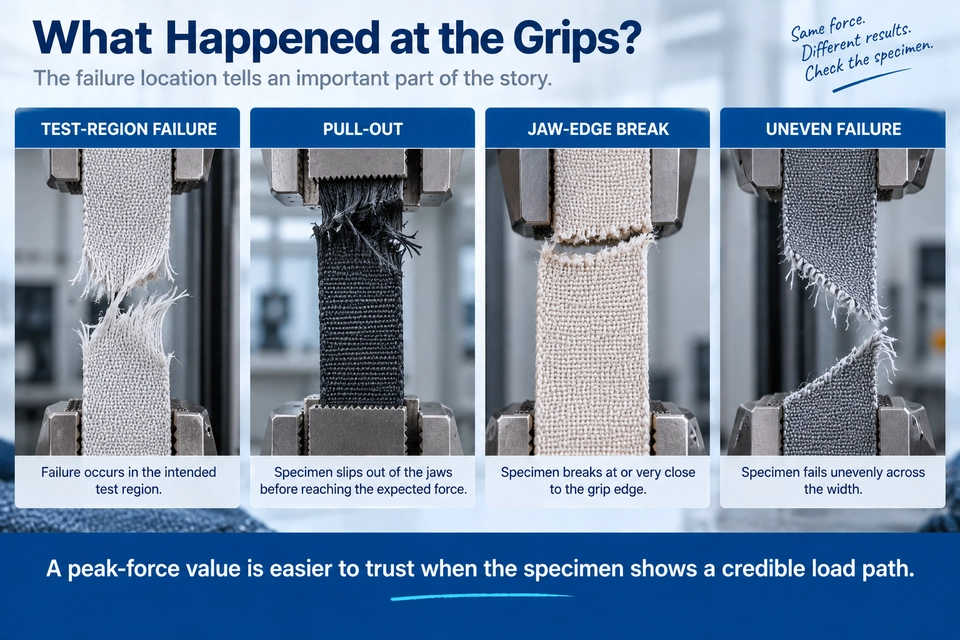
What Happened at the Grips?
When a result looks unusual, don't stop at the force value.
Take the specimen out and look at it.
A credible failure in the intended test region tells a different story from a strip that has been pulled out of the jaws.
A specimen that repeatedly breaks immediately beside the grip deserves investigation.
So does one that tears from one edge long before the opposite edge.
| Observation | What We Would Check |
|---|---|
| Failure in the intended test region | Consistency with the applicable test method |
| Visible pull-out | Grip suitability and restraint |
| Break immediately at jaw edge | Local stress concentration or grip damage |
| One-sided / asymmetric failure | Alignment, specimen preparation, and load entry |
| Coating separates from substrate | Material construction and method suitability |
| Unexpectedly large apparent extension | Specimen deformation versus possible grip movement |
These are troubleshooting clues, not universal pass/fail rules.
The applicable product or test standard decides how a particular failure should be interpreted.
But the broken specimen is still valuable evidence.
A peak-force value is easier to trust when the specimen shows a credible load path.
Same 25 kN. Completely Different Specimens.
Consider two tensile tests.
The first specimen is:
25 mm wide
Maximum force:
25 kN
The second specimen is:
200 mm wide
Maximum force:
25 kN
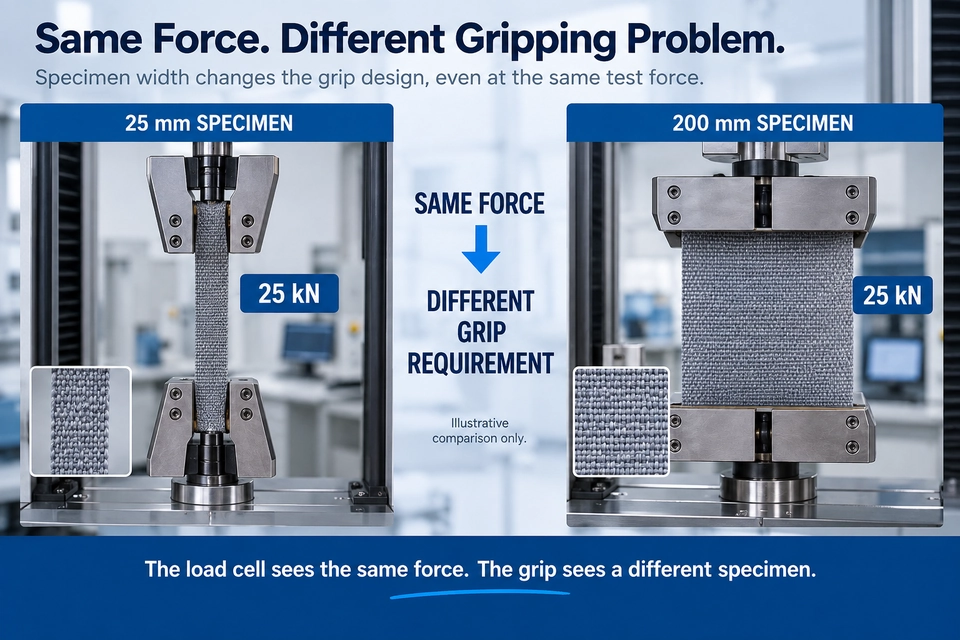
The load cell sees 25 kN in both cases.
The grip does not.
Holding 25 kN through a narrow specimen and introducing the same total force through a much wider textile are different fixture problems.
Width affects the required jaw geometry, contact area, load distribution, centering, and fixture dimensions.
This is why:
Maximum force: 25 kN
is not enough for us to select the grip.
Add:
Specimen width: 50 mm
and the inquiry becomes much more useful.
Force Determines Capacity. Extension Determines Space.
Force is only one physical dimension of the test.
Suppose the required free test length is:
200 mm
and the specimen may extend by approximately:
80 mm
before rupture.
The test region does not remain 200 mm long.
The machine needs enough usable movement and vertical space to accommodate the extension.
And the specimen is not the only thing occupying the test space.
Upper and lower grips, adapters, and load-train components all consume room.
This becomes particularly important when the material combines:
high breaking force + high elongation
A 30 kN specimen with limited extension and a 30 kN specimen with substantial extension may fit the same force-capacity envelope while requiring quite different physical test configurations.
So we normally ask for both:
Expected maximum force
and
Expected elongation
One helps size the load system.
The other helps determine whether the specimen can physically complete the test.
Don't Borrow the Test Speed From Another Fabric
"What test speed should I use?" sounds like a machine-setting question.
Usually it is a test-method question.
Industrial textiles do not share one universal crosshead speed. The applicable product or test specification may define the rate directly or establish the loading procedure another way.
That means a speed used successfully for one woven fabric should not automatically be copied to a coated textile or reinforcement product.
The better sequence is:
Confirm method → confirm specimen → confirm rate → program machine
The equipment needs to reproduce the required procedure.
It should not invent it.
What Do You Actually Need From the Test?
For some production checks, the key output may be straightforward:
Breaking Force
For another program, the customer may need:
Breaking Force + Elongation
A development laboratory may also want:
Force-Extension Curve + Failure Observation
These are not interchangeable requirements.
Two specimens can reach the same peak force and behave quite differently on the way there.
One may build force smoothly before rupture.
Another may show progressive structural movement, grip interaction, or a very different extension response before reaching a similar peak.
If the laboratory needs to understand that behavior, storing only the final maximum-force number leaves useful information behind.
Define the required outputs before the measurement configuration is finalized.
A Real Selection Example
Consider a customer testing a high-strength woven industrial textile.
The inquiry looks like this:
End Product: Industrial reinforcement component
Applicable Requirement: Customer-specific tensile procedure
Specimen Width: 50 mm
Typical Breaking Force: 16–24 kN
Upper Expected Force: 32 kN
Required Output: Peak force + force-extension curve
Daily Volume: Approximately 60 tests
Now we can start making useful equipment decisions.
Frame
A 5 kN platform clearly does not cover the expected load.
With an upper expected force around 32 kN, a 50 kN RS-8000 configuration is a reasonable platform to evaluate.
That does not mean the selection is finished.
Load Measurement
Most daily specimens are expected between 16 and 24 kN.
The 32 kN value matters for upper capacity.
The 16–24 kN range tells us where most routine measurement occurs.
We want both pieces of information before finalizing the load-measurement configuration.
Grip
Now we need to see the material.
A 50 mm rough woven specimen and a 50 mm smooth coated specimen can require different approaches even when their breaking forces are similar.
We would want the thickness, surface condition, and a specimen photo.
If the customer already has a problem—slip at 18 kN, for example—that should be mentioned before the fixture is selected.
Test Space
We still need the gauge length and expected elongation.
Those values help determine required travel and usable test space after the grips are installed.
Data
The laboratory needs both peak force and the force-extension curve.
So the reporting and measurement setup has to support that requirement.
At this point we are no longer choosing a generic "50 kN tensile machine."
We are configuring a test system for a specific specimen.
Why RS-8000 Enters the Discussion
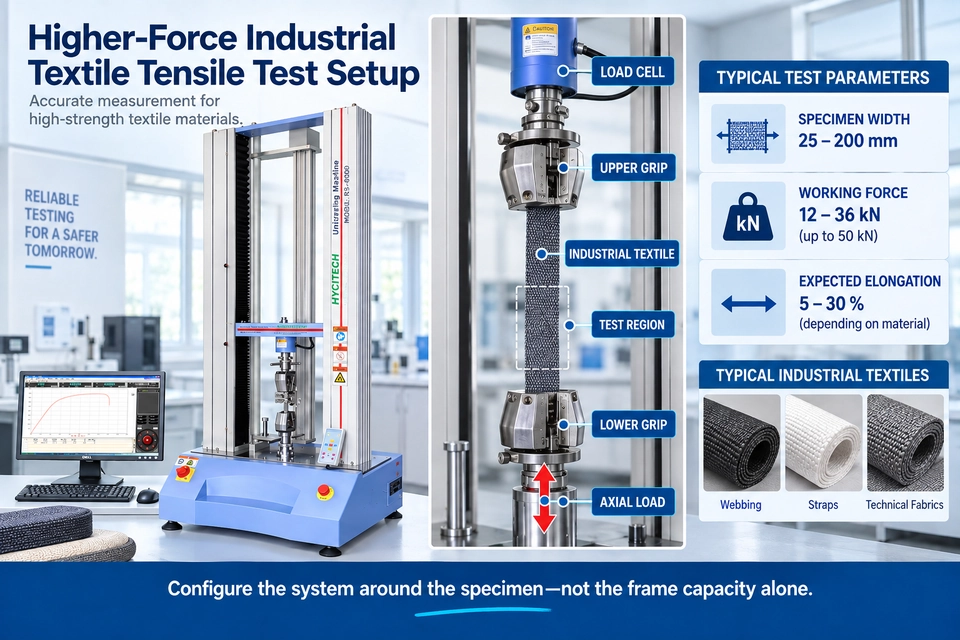
The ITM-LAB RS-8000 Universal Testing Machine covers force capacities from 10 to 50 kN.
For this application, that matters because some high-strength industrial textile tests move beyond the practical range of lower-force fabric testing systems.
But capacity is only the starting point.
A useful RS-8000 configuration still needs to be built around:
Normal working force
Maximum expected force
Specimen width and surface
Grip requirement
Gauge length
Expected elongation
Required results
We would not recommend a 50 kN configuration simply because a customer's strongest specimen reaches 30 kN.
The load cell and grips still need to make sense for the actual specimen.
Daily Volume Changes the Fixture Conversation
A fixture can work technically and still make life difficult for a production laboratory.
Consider the customer in our example:
60 specimens per day
Each specimen has to be positioned, centered, clamped, tested, and removed.
If changeover takes several minutes because the material is difficult to align, the grip becomes a throughput issue as well as a mechanical one.
This matters even more when a laboratory alternates between several product widths.
For routine QC, we therefore ask:
How many specimens do you test per day?
and:
How often do you change specimen types?
Those questions do not change the material's breaking force.
They can change what makes a practical test station.
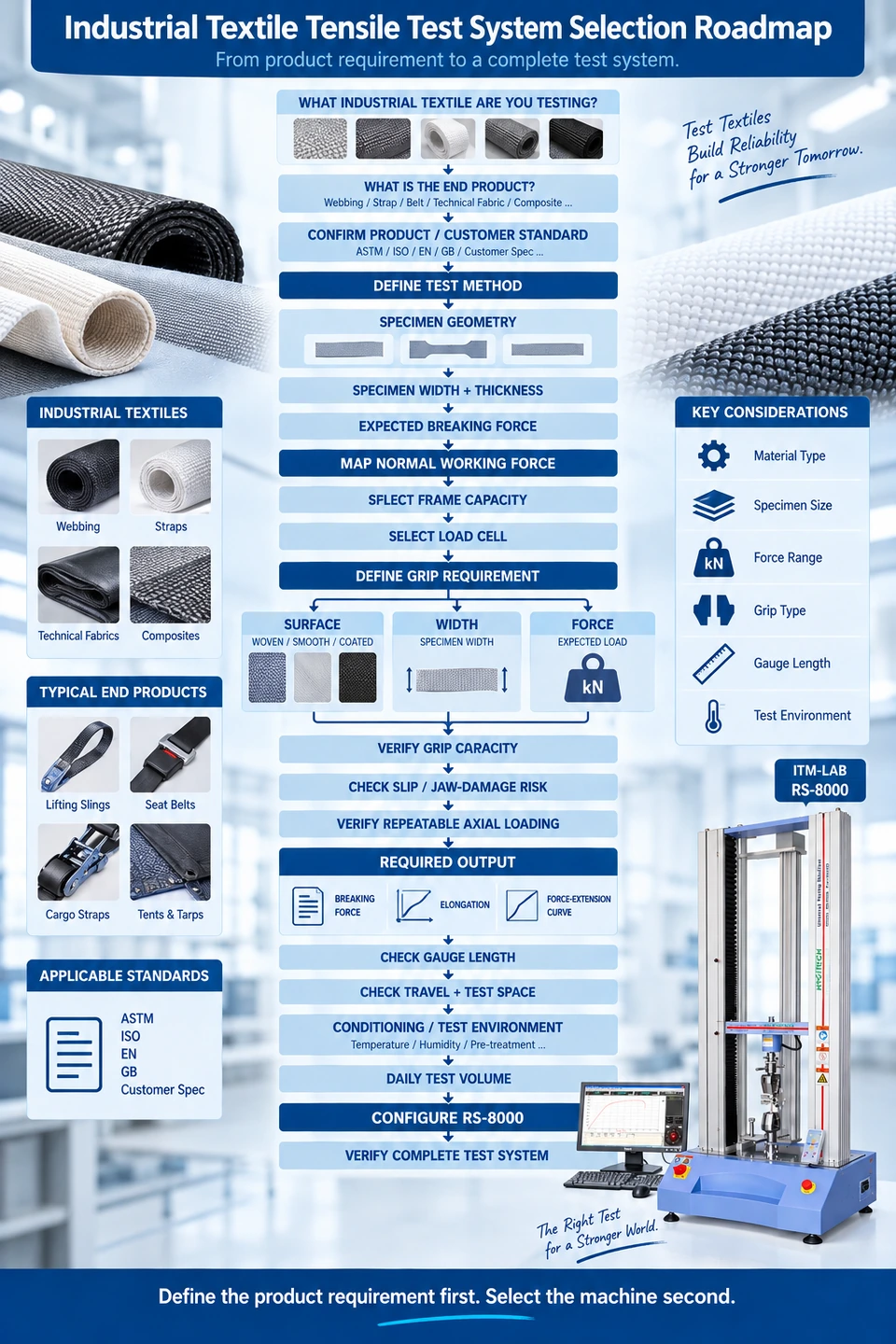
Industrial Textile Tensile Test System Selection Roadmap
Send Us These 8 Details
If you want us to evaluate an industrial textile tensile application, you do not need to prepare a complete machine specification first.
Send:
- Material / end product
- Applicable standard or customer specification
- Specimen width × thickness
- Gauge length
- Typical + maximum breaking force
- Expected elongation
- Required results
- Specimen photo or drawing
A photo is particularly useful when gripping is likely to be difficult.
Don't Know the Breaking Force Yet?
Send the applicable standard, material information, and specimen drawing first.
If you already have test data from another machine, include that too.
And if the current problem is:
The specimen slips.
or:
It always breaks at the grip.
tell us.
That information can be more useful for fixture selection than the machine capacity you originally planned to purchase.
FAQ
What tensile testing machine is suitable for industrial textiles?
There is no single machine capacity for all industrial textiles.
Start with the applicable product requirement, specimen geometry, expected breaking force, and normal working-force range. Then evaluate grip capacity, elongation, travel, and required results.
For higher-force applications within the appropriate range, an ITM-LAB RS-8000 10–50 kN Universal Testing Machine can be evaluated.
Is ASTM D5035 suitable for all industrial textiles?
No.
ASTM D5035 covers strip-method breaking force and elongation testing for fabrics within its scope. "Industrial textile" covers a much wider range of products.
A geotextile, reinforcement material, coated industrial product, or narrow textile may be governed by a different product or customer requirement.
Use the requirement that actually applies to the finished product rather than assigning ASTM D5035 simply because the specimen is textile.
When do I need a higher-capacity textile tensile tester?
Consider a higher-capacity platform when the expected test force approaches or exceeds the usable capability of the existing system.
Also consider grip size and capacity, specimen width, travel, test space, and future product requirements.
The decision should not be based on force alone.
Why does industrial fabric slip in tensile grips?
Possible causes include the specimen surface, insufficient restraint, unsuitable jaw geometry, grip width, or an inappropriate fixture for the required load.
Increasing clamping pressure is not always the correct solution because excessive local pressure can introduce jaw-area damage or premature failure.
The aim is stable load transfer without creating a new failure mechanism.
Is a 50 kN machine enough for a 30 kN textile test?
The frame has nominal capacity above the expected 30 kN force, but that alone does not confirm the complete system.
The load cell, grips, adapters, specimen width, expected elongation, travel, and usable test space also need to be checked against the applicable test requirement.
For high-force textile testing, the entire load train matters.
One Last Check Before You Specify the Machine
If an inquiry says only:
Industrial textile. 50 kN machine required.
we still do not have enough information to configure the test.
Send us the specimen width, applicable test method, and expected force range.
A photo of the actual material is even better.
From there, we can determine whether the RS-8000 is the right platform—and, just as importantly, what needs to be installed between the load cell and the specimen for the result to be useful.
