
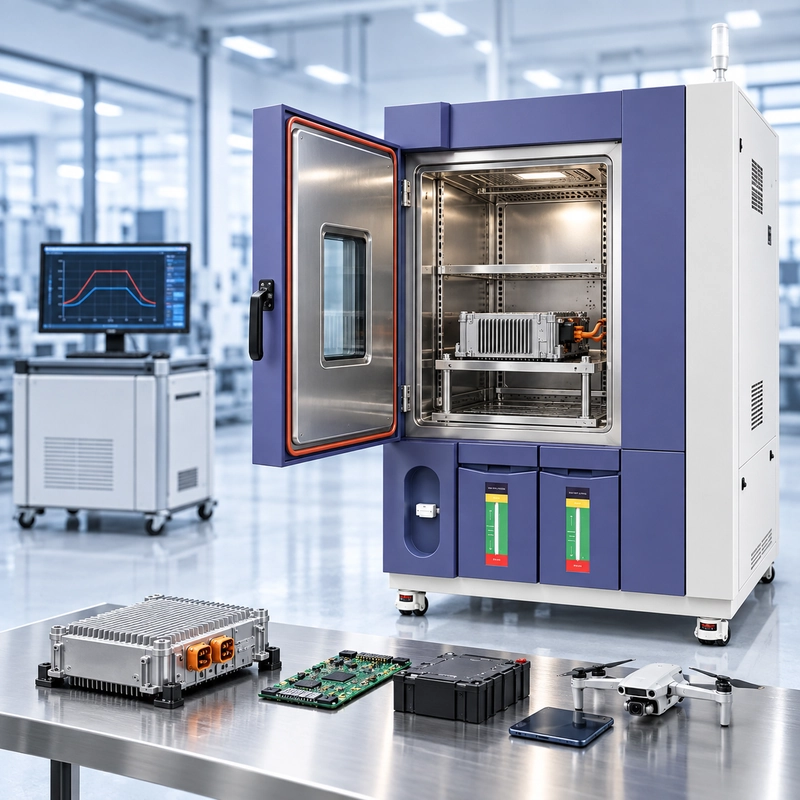
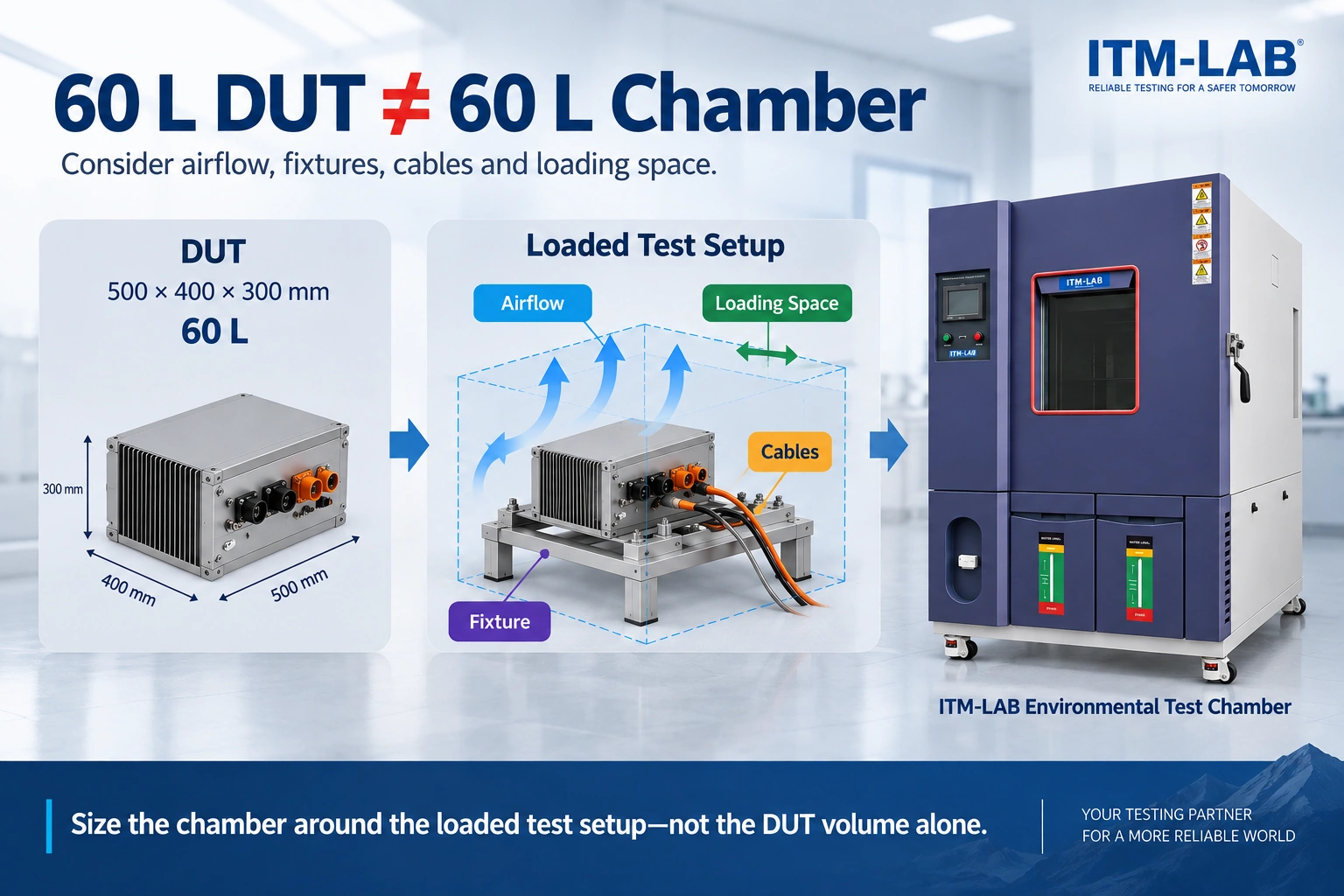
Your DUT measures 500 × 400 × 300 mm. Its external volume is 60 L.
So, is a 100 L environmental chamber large enough?
Maybe. Maybe not.
The DUT may fit through the door and still be too large for the chamber in practical use. It may sit too close to the walls, restrict the circulation path, leave no usable space for wiring or fixtures, or introduce more thermal load than the chamber can handle at the required test condition.
The opposite mistake happens too. Buyers sometimes jump from a 60 L DUT to a 300 L or 500 L chamber simply to "leave enough room." That can add cost, floor-space requirements and utility demand without improving the test.
A better approach is to size the chamber around the loaded test setup:
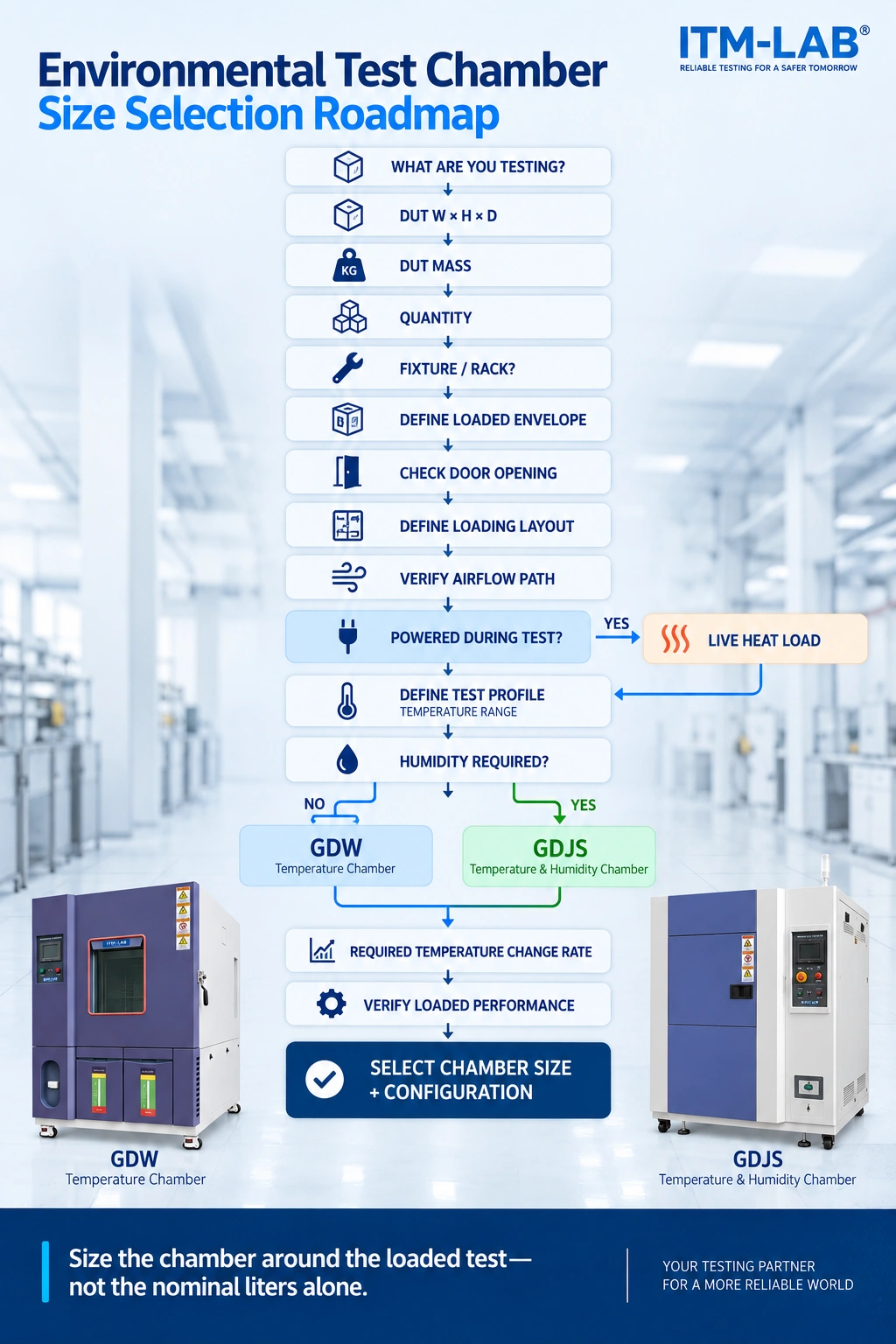
DUT geometry → loading arrangement → airflow → thermal load → test profile
Nominal chamber volume is only one part of that decision.
Start With the Loaded Test Setup
Before comparing 100 L, 225 L, 408 L or 800 L chambers, define what will actually go through the door.
The DUT is only the starting point.
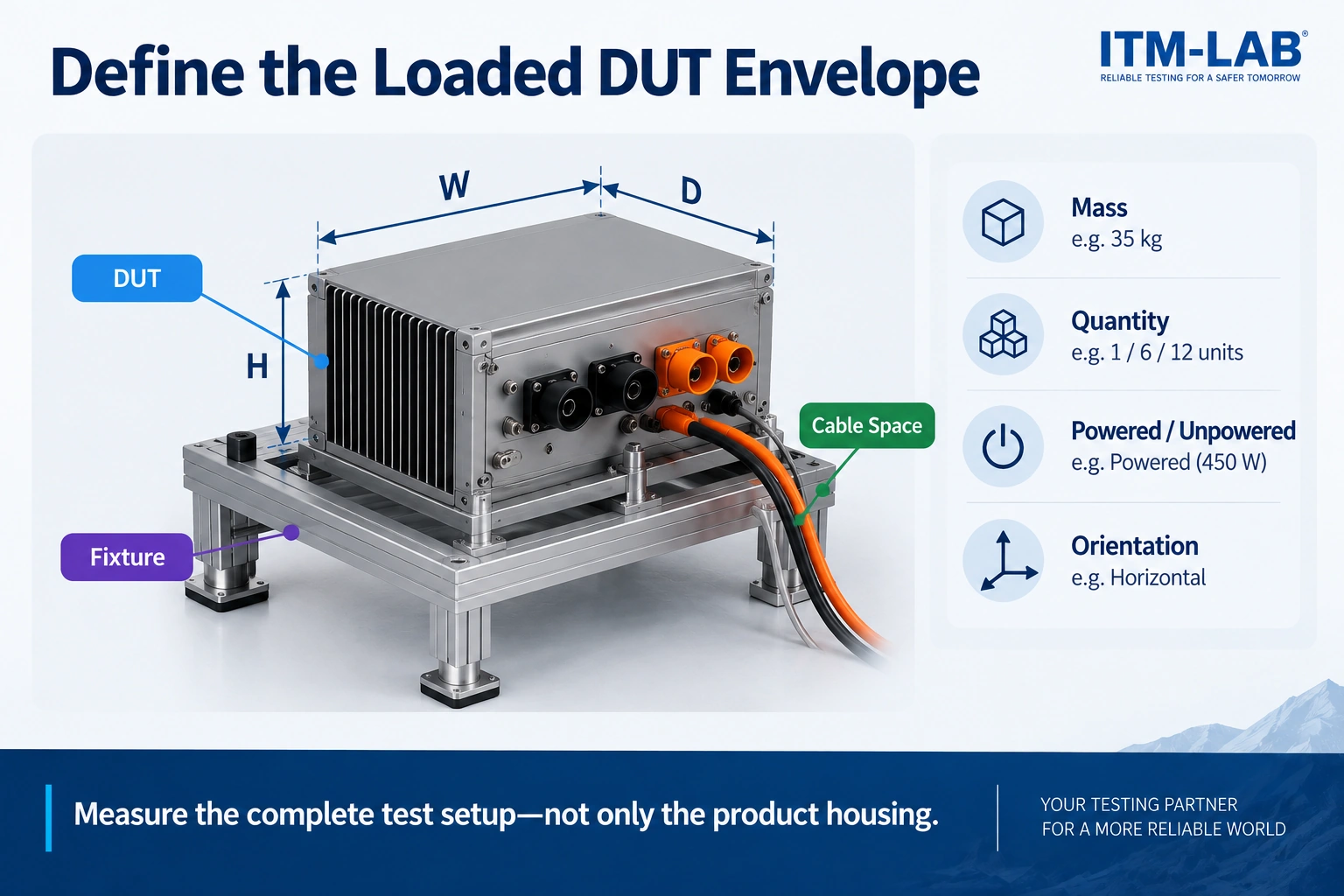
For a useful chamber recommendation, collect these parameters first:
| Input | What to Define |
|---|---|
| DUT dimensions | Width × height × depth |
| DUT mass | kg |
| Quantity | Units tested at the same time |
| Orientation | Horizontal, vertical or fixed |
| Fixture | Dimensions and mass |
| Powered during test | Yes / No |
| Heat dissipation | W, if powered |
| Connections | Power, signal, sensors, communication |
| Temperature range | Minimum and maximum |
| Humidity | Required / Not required |
| Temperature change rate | If specified |
Two test setups can use exactly the same product and still need different chambers.
A single unpowered ECU placed on a shelf is one load.
Six powered ECUs mounted in a rack, wired through a side port and dissipating heat throughout the test are another.
Same DUT. Different chamber requirement.
First Question: Will It Actually Fit?
Start with the simplest check: physical fit.
For a rectangular DUT:
DUT Volume = Width × Height × Depth
For example:
500 mm × 400 mm × 300 mm
becomes:
0.5 m × 0.4 m × 0.3 m = 0.06 m³
or:
60 L
That number is useful, but only as an initial reference.
What matters next is the actual envelope.
A chamber should therefore be checked against:
Internal width × internal height × internal depth
—not just nominal liters.
Don't Forget the Door
There is an even more basic problem that occasionally gets missed during specification.
The DUT has to get into the chamber.
A chamber may have sufficient internal workspace but a smaller clear door opening. This becomes relevant with large battery modules, wide electronic assemblies, preassembled racks and bulky fixtures.
For a large DUT, check both:
Workspace W × H × D
and
Clear door opening W × H
before approving the configuration.
A 500 L chamber is not useful if the fixture cannot pass through the door.
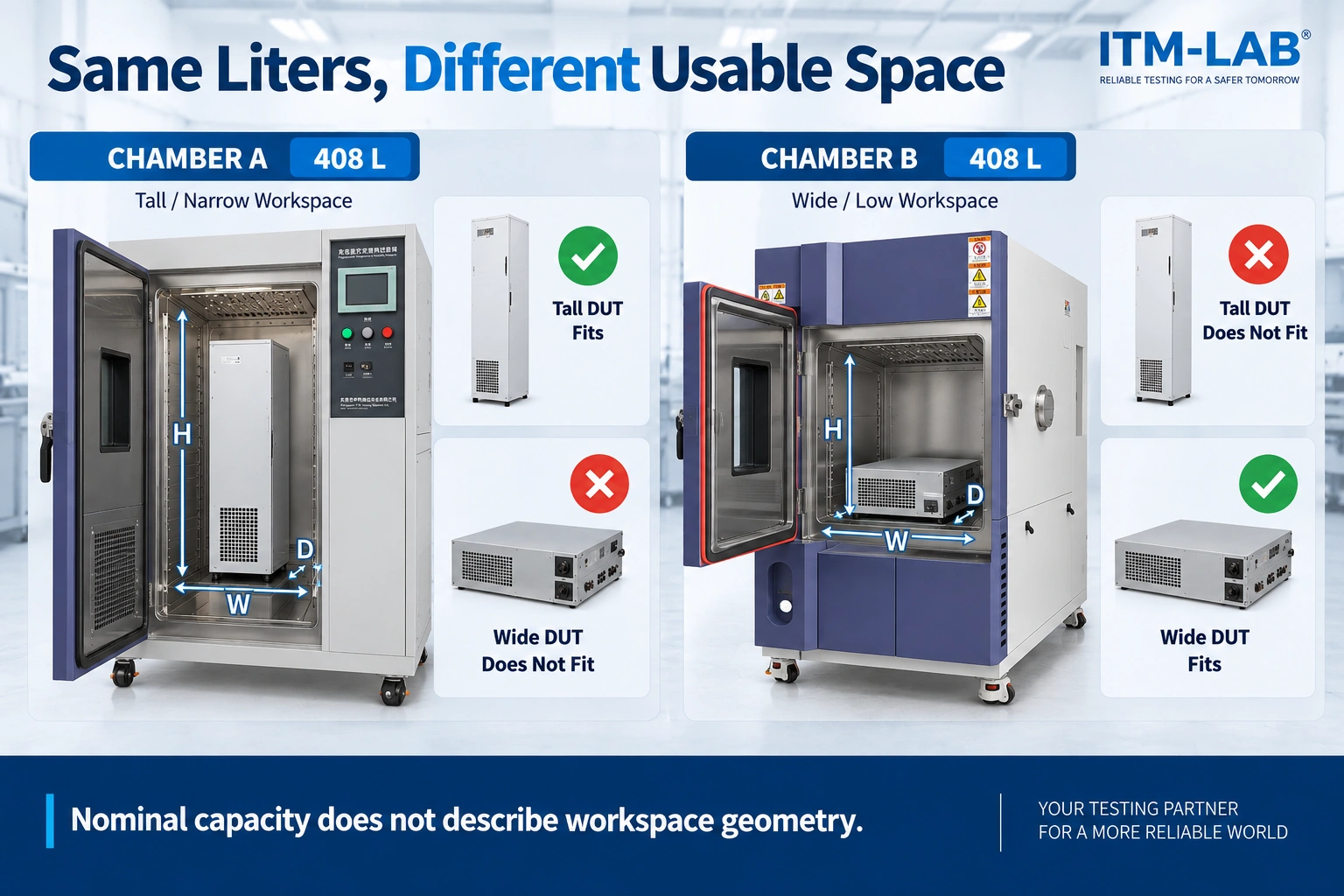
Liters Hide Geometry
This is one of the easiest mistakes to make when comparing environmental chamber datasheets.
Suppose two chambers have similar nominal volumes:
| Chamber A | Chamber B | |
|---|---|---|
| Internal Width | 600 mm | 800 mm |
| Internal Height | 850 mm | 700 mm |
| Internal Depth | 800 mm | 700 mm |
Their total workspace volumes may be similar.
Their usable geometry is not.
A tall DUT may fit Chamber A and fail to fit Chamber B. A wide assembly may produce exactly the opposite result.
The problem becomes even more obvious with long components, vertically mounted products and custom fixtures.
So after using liters to identify a general chamber class, stop comparing liters.
Compare:
W × H × D
against the actual loaded DUT envelope.
Liters tell you how much space exists. Internal dimensions tell you whether that space is useful.
What About the 1:3 DUT-to-Chamber Rule?
You may come across a rule of thumb suggesting that the DUT should occupy roughly one-third of the chamber workspace.
As an early screening tool, that can be useful.
As a chamber-sizing formula, it is not.
Take the 60 L DUT from the opening example.
A simple 1:3 calculation would give:
60 L × 3 = 180 L
It would be easy to conclude that a chamber around 180–225 L is the answer.
Now consider three different 60 L loads.
Load A — Open-Frame Electronics
Large gaps allow air to circulate through the assembly.
Load B — Dense Metal Enclosure
The same external volume contains substantially more thermal mass.
Load C — Powered Electronics
The DUT occupies the same approximate volume but dissipates 1,000 W while operating.
All three may occupy approximately 60 L.
They will not behave the same way inside a chamber.
Geometry, density, airflow obstruction, thermal mass and active heat generation all change the test condition.
The one-third guideline is therefore best treated as a first-pass sanity check, not a purchasing specification.
Do not write an RFQ that says only:
DUT volume: 60 L
Required chamber: ≥180 L
Send the actual DUT dimensions and test conditions instead.
Airflow Is Where Sizing Gets Tricky
An environmental chamber does more than surround the DUT with hot or cold air.
It has to move conditioned air through the workspace.
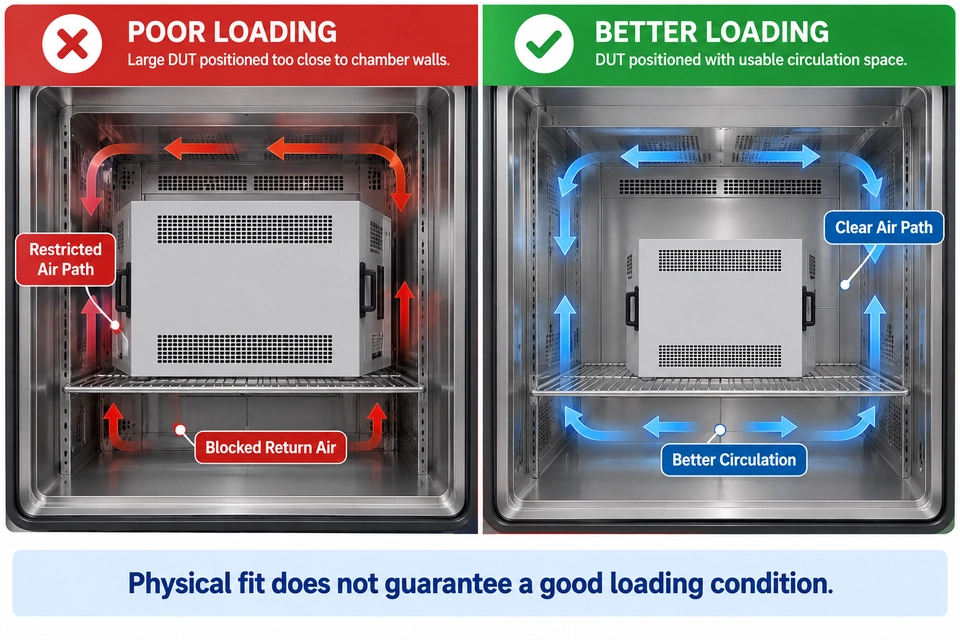
If the DUT sits too close to a wall, blocks a supply path or restricts return airflow, the usable chamber volume can become much smaller than the nominal volume suggests.
Poor loading can lead to:
- slow product stabilization;
- uneven conditions around the load;
- local hot or cold regions;
- longer recovery after transitions;
- different thermal responses between DUTs.
There is no single clearance dimension that works for every chamber and every DUT. Airflow direction, chamber construction and DUT geometry all matter.
That is why a blanket statement such as:
"Always leave 100 mm around the product"
is not a reliable sizing method.
The more useful question is:
Can the chamber's designed airflow circulate around and through the actual load without major obstruction?
A flat battery pack, for example, may block a large section of the circulation path even if its total volume is relatively small.
An open-frame PCB rack may occupy more geometric space while allowing air to move through it much more easily.
Two DUTs Can Be the Same Size and Still Be Very Different Loads
Dimensions tell us how much space a DUT occupies.
They do not tell us how difficult it is to heat or cool.
Consider two products with the same external dimensions:
500 × 400 × 300 mm
DUT A
Open-frame electronic assembly
Mass: 8 kg
DUT B
Dense aluminum assembly
Mass: 42 kg
They occupy the same geometric envelope.
But DUT B contains much more material that must absorb or release heat as chamber temperature changes.
Its thermal response will therefore be very different.
This is why DUT mass and material should accompany dimensions when a test involves cycling, rapid transitions or tight stabilization requirements.
Chamber sizing is partly a space problem.
It is also a thermal problem.
Multiple DUTs: Layout Changes Everything
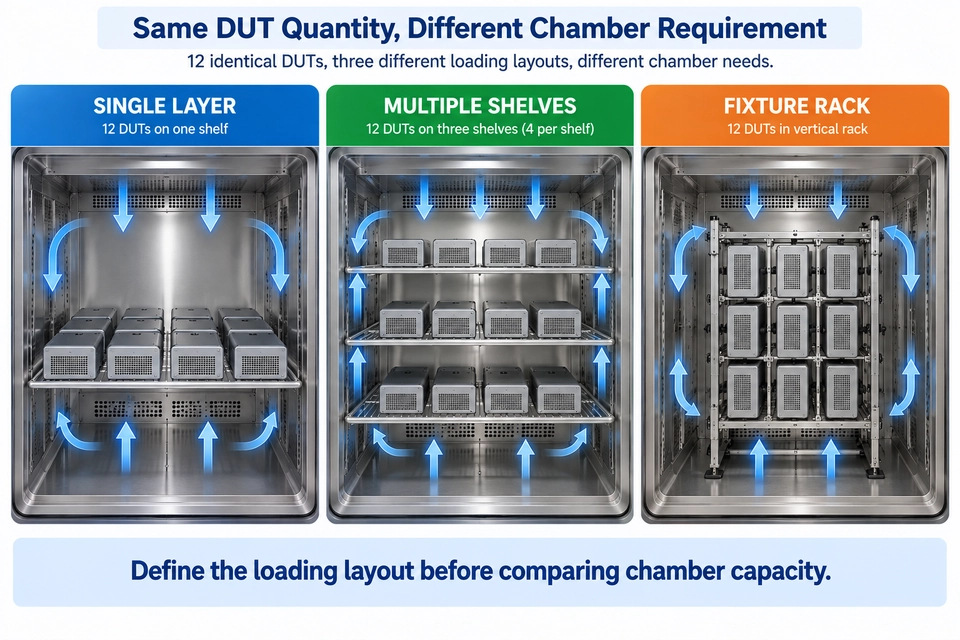
Now suppose the test calls for 12 identical products.
Multiplying one DUT volume by 12 gives the total physical product volume. It does not tell you what chamber geometry is required.
The products could be arranged in several ways.
Single Layer
All 12 DUTs are placed across one level.
This can require substantial workspace width and depth.
Multiple Shelves
The same DUTs are divided across several levels.
The footprint becomes smaller, but the required chamber height increases. Space between shelves also has to support the intended airflow.
Fixture Rack
The products are mounted in a dedicated rack.
Now the rack—not the individual DUT—is the envelope that should be compared with chamber dimensions.
There is another practical consideration: DUT-to-DUT spacing.
Packing twelve products tightly together may look efficient on paper but create a very different airflow condition for units in the middle of the load.
For multi-DUT testing, sketch the loading arrangement before choosing the chamber.
A simple front and side view with dimensions can be more useful than a calculated total volume.
Fixtures, Wiring and Ports Still Take Space
Fixtures count.
So does the wiring.
A 450 mm-high DUT mounted on a 120 mm fixture is not a 450 mm-high test load. For chamber sizing purposes, it is at least a 570 mm assembly before any additional clearance is considered.
Powered and monitored DUTs may also require:
- power cables;
- thermocouples;
- voltage or current measurement;
- signal wiring;
- CAN communication;
- external data acquisition.
Cable routing can influence both the loading arrangement and test-port position.
For a simple unpowered specimen this may be negligible.
For a rack of powered electronics, it may determine the entire chamber layout.
Don't Compare Chamber Size From Datasheets Alone
A datasheet may tell you:
Capacity: 408 L
That is useful.
But it does not answer all the questions needed for a loaded test.
Before comparing two candidate chambers, check:
- internal W × H × D;
- clear door opening;
- airflow arrangement;
- shelf configuration;
- allowable loading;
- temperature performance conditions;
- whether quoted heating/cooling rates are unloaded or based on a specified load.
This last point matters.
An empty chamber can change air temperature faster than the same chamber containing a large metal fixture, several battery modules or powered electronics.
A capacity number describes geometric volume.
It does not, by itself, describe loaded performance.
Size Is Only Half the Problem
Suppose a DUT fits comfortably inside the chamber.
There is enough airflow space.
The fixture fits.
The door closes.
That still does not prove the chamber is suitable.
Now the thermal questions begin.
Two load characteristics are particularly important:
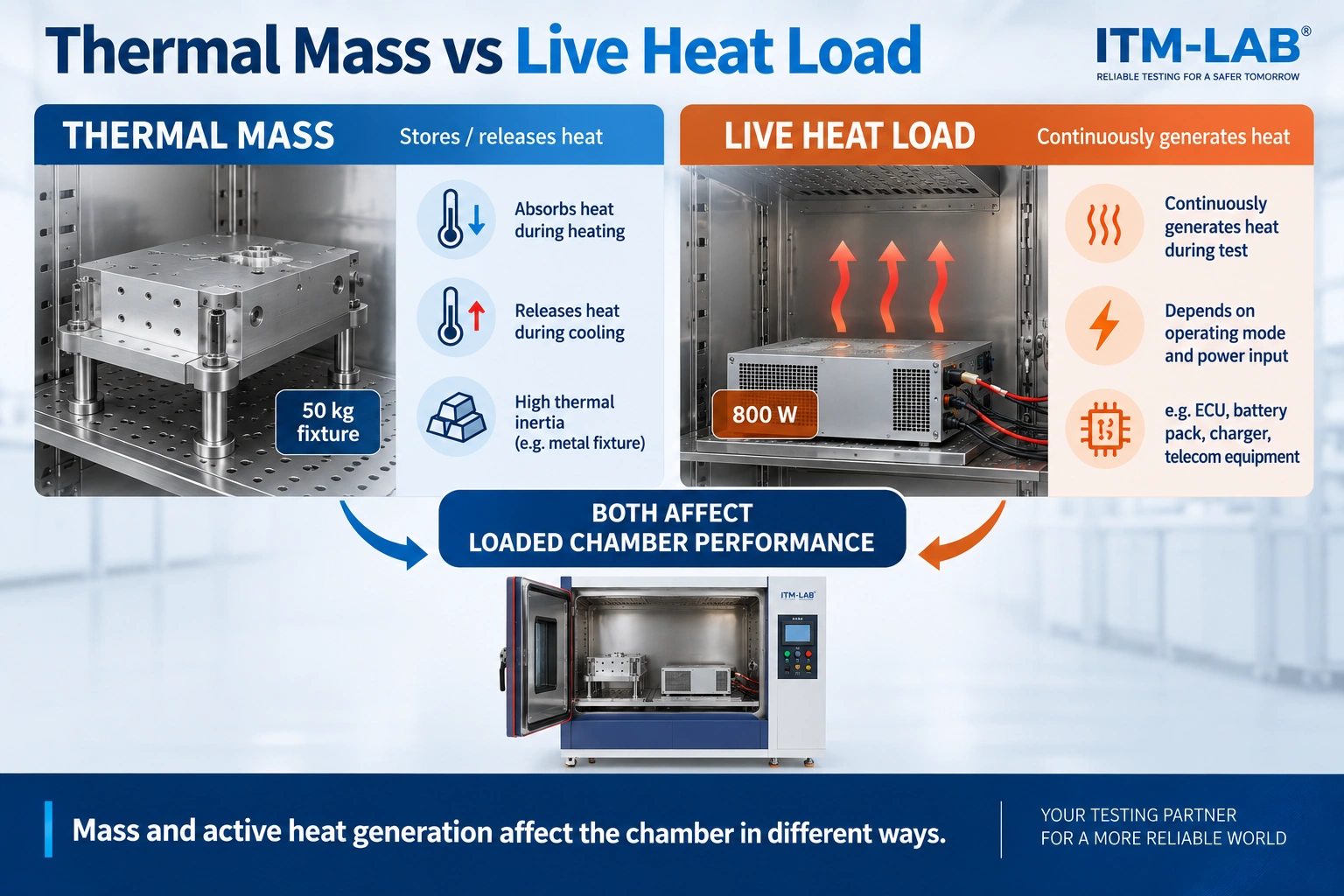
thermal mass
and
live heat load.
They are not the same thing.
Thermal Mass vs Live Heat Load
Thermal Mass
A DUT does not need to be powered to affect chamber performance.
A large metal fixture or dense mechanical assembly absorbs energy as it heats and releases energy as it cools.
The greater the thermal mass, the more work the chamber must do during temperature transitions.
For example:
50 kg aluminum fixture
may generate virtually no heat of its own, but it can still significantly affect transition and stabilization time.
Live Heat Load
A powered DUT adds heat continuously.
Consider an electronic system dissipating:
800 W
during a low-temperature test.
The refrigeration system has to remove that heat while also maintaining the required chamber condition.
With several powered DUTs, the combined live load can become substantial.
This leads to an important purchasing point:
A chamber can be physically large enough and still be thermally undersized.
A larger workspace is not automatically the solution.
Depending on the test, the correct answer may be:
- greater refrigeration capacity;
- a different chamber configuration;
- a different airflow arrangement;
- fewer powered DUTs per batch;
- a different chamber class.
This is why DUT heat dissipation should be included in the RFQ whenever products remain powered during testing.
What If You Need 5, 10 or 15°C/min?
A demanding temperature change rate makes loaded performance even more important.
Consider the same DUT under two test profiles.
Profile A
+85°C to -40°C
No specified rapid transition rate.
Profile B
+85°C to -40°C
Required rate:
10°C/min
The workspace requirement may be identical.
The chamber requirement is not.
For Profile B, the manufacturer needs enough information about the load to determine whether the required rate can be achieved under the intended test condition.
Useful information includes:
- DUT mass;
- DUT material;
- quantity;
- fixture mass;
- live heat load;
- target temperature range;
- required rate;
- how the rate is defined in the test specification.
Do not assume that a catalog heating or cooling rate automatically applies to your fully loaded chamber.
For demanding temperature transitions, a rapid temperature change chamber may be more appropriate than a conventional high/low temperature chamber.
Worked Example: Why 72 L × 3 Is Not a Chamber Specification
Consider this test setup.
DUT
600 × 400 × 300 mm
DUT Volume
0.6 × 0.4 × 0.3 = 0.072 m³
or:
72 L
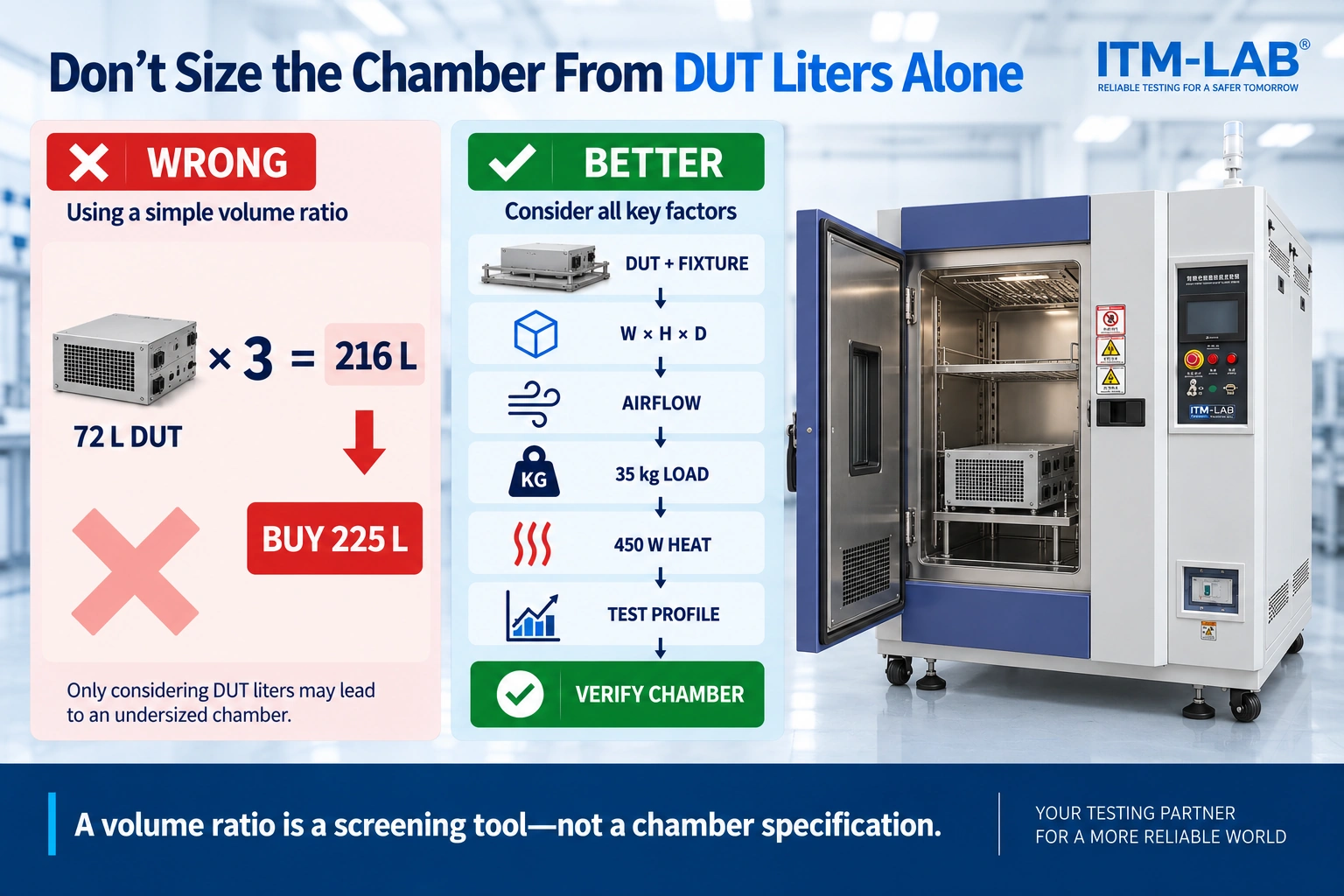
Suppose someone applies the one-third rule:
72 L × 3 = 216 L
The obvious conclusion would be:
Choose a chamber around 225 L.
That is not enough information to make the decision.
Now add the actual test conditions:
| Parameter | Requirement |
|---|---|
| DUT dimensions | 600 × 400 × 300 mm |
| DUT mass | 35 kg |
| Fixture height | 80 mm |
| Powered | Yes |
| Heat dissipation | 450 W |
| Cable exit | Right side |
| Temperature | -40°C to +85°C |
| Humidity | Required |
The effective physical load is already larger than the 72 L product envelope because of the fixture and wiring.
Next, the 35 kg load has to be thermally conditioned.
Then the chamber has to remove up to 450 W of live heat while controlling the required environment.
The selection process should therefore be:
1. Build the Loaded Envelope
DUT + fixture + cable routing.
2. Compare W × H × D
Confirm workspace geometry and door opening.
3. Check the Airflow Path
Make sure the installed load does not obstruct the chamber's circulation design.
4. Evaluate the Thermal Load
35 kg DUT + fixture + 450 W active heat.
5. Confirm the Test Profile
-40°C to +85°C with humidity control.
Only then should a candidate chamber capacity be selected and its loaded performance verified.
Wrong Approach
72 L × 3 = 216 L → Buy 225 L
Better Approach
Loaded geometry + airflow + mass + heat load + test profile → evaluate candidate chamber
The first method produces a number.
The second produces a chamber specification.
One Large Chamber or Two Smaller Chambers?
More capacity does not always have to come from one larger chamber.
Suppose a laboratory needs to test 20 relatively small DUTs.
One option is to select a chamber large enough for all 20.
Another is to divide the load between two smaller chambers.
Two chambers may make sense when the laboratory needs:
- parallel test profiles;
- different temperature conditions at the same time;
- more flexible scheduling;
- smaller batch sizes;
- less disruption if one test has to stop.
A single larger chamber may make more sense when all DUTs must run under the same profile and throughput is the main priority.
This is not purely a chamber-size question.
It is a laboratory workflow question.
Before moving from a 408 L class to a much larger chamber simply because test quantity has increased, consider whether one large batch is actually how the equipment will be used.
Should You Leave Room for Future DUTs?
Yes—but with a defined reason.
If the current DUT is 450 mm wide and the next product generation is expected to be 520–550 mm wide, selecting a chamber with additional usable width may avoid an early equipment replacement.
The same logic applies if test quantity is expected to increase.
What does not work well is unlimited oversizing based on:
"We might test something bigger in the future."
An unnecessarily large chamber may bring:
- higher purchase cost;
- more laboratory floor space;
- greater utility requirements;
- higher operating cost.
Future capacity should be based on a realistic product roadmap or test-volume forecast.
Buy enough flexibility to cover a known requirement—not unused liters for their own sake.
Six Sizing Mistakes We See Repeatedly
1. Selecting From Liters Alone
Nominal capacity hides workspace geometry.
Check internal W × H × D.
2. Treating the 1:3 Rule as a Formula
A volume ratio can help with initial screening, but it cannot account for geometry, airflow, mass or live heat.
3. Packing the Chamber Too Tightly
More DUTs per batch may look efficient until the loading arrangement restricts airflow and creates inconsistent conditioning.
4. Forgetting the Fixture
The chamber must fit the complete test assembly, not the bare product.
5. Ignoring Powered Heat Load
A DUT that fits easily may still exceed the chamber's thermal capability under a demanding low-temperature or rapid-change test.
6. Oversizing Without a Test Reason
Larger is not automatically safer or better.
The goal is usable capacity matched to the test.
Temperature Only or Temperature + Humidity?
Once the required workspace is reasonably defined, the test condition determines the chamber type.
Temperature Only
For high-temperature, low-temperature and temperature cycling tests without controlled humidity, an ITM-LAB GDW Series High/Low Temperature Test Chamber can be configured around the required workspace and temperature range.
Temperature + Humidity
When relative humidity is part of the test profile, an ITM-LAB GDJS Series Temperature & Humidity Test Chamber should be considered.
Rapid Temperature Change
If the specification calls for a defined rapid transition such as 5°C/min, 10°C/min or 15°C/min, chamber selection must include loaded heating/cooling performance rather than workspace volume alone.
In practice, the sequence is:
Workspace → Temperature → Humidity → Ramp Rate → Loaded Performance
What to Put in Your RFQ
If you want the manufacturer to recommend an environmental chamber size, avoid sending only:
"Please quote a 500 L environmental chamber."
Send the test setup instead.
DUT Information
- Product type
- Width × height × depth
- Mass
- Quantity per test
- Material, where relevant
- Photo or drawing
Loading Information
- DUT orientation
- Fixture dimensions and mass
- Shelf arrangement
- Required access
- Cable routing
Test Profile
- Minimum temperature
- Maximum temperature
- Humidity range
- Dwell time
- Required temperature change rate
- Applicable standard or internal specification
Powered Testing
- Powered during test: Yes / No
- Power consumption
- Estimated heat dissipation
- Number of powered DUTs
Connections
- Power cables
- Thermocouples
- Signal cables
- Communication
- Test-port quantity and diameter
With those inputs, the manufacturer can evaluate the actual workspace and thermal requirement instead of guessing from nominal liters.
Environmental Chamber Sizing FAQ
What size environmental chamber do I need?
Start with the complete loaded envelope: DUT dimensions, quantity, fixture, orientation and cable space. Compare that envelope with the chamber's internal W × H × D and clear door opening. Airflow, DUT mass, heat dissipation and the required test profile should then be checked before the final chamber size and configuration are confirmed.
How much of the chamber can the DUT occupy?
There is no universal percentage that applies to every test. A one-third DUT-to-workspace ratio is sometimes used as an initial rule of thumb, but it should not replace an airflow and load evaluation. DUT shape, density, quantity, heat generation and chamber airflow design can all change the usable workspace.
Is a larger environmental chamber always better?
No. A larger chamber may provide more loading flexibility, but it can also increase purchase cost, floor-space requirements and utility demand. The better choice is a chamber with enough usable workspace and thermal capability for the current test plus realistic near-term requirements.
Does DUT heat load affect chamber size?
It affects chamber selection, but the solution is not necessarily a larger workspace. A powered DUT adds live heat that the chamber must remove. Depending on the load and test profile, the solution may involve greater refrigeration capacity, a different chamber configuration, reduced batch quantity or a different chamber class.
Select the Chamber Around the Test
There is no single liters-per-DUT formula that can reliably size every environmental test chamber.
Start with the physical questions:
What is the loaded W × H × D?
Will it pass through the door?
Can air circulate around the installed load?
Then move to the thermal questions:
How much mass is being conditioned?
Does the DUT generate heat?
How quickly must temperature change?
Finally, match those requirements to the chamber.
For temperature-only testing, the ITM-LAB GDW Series High/Low Temperature Test Chamber can be configured for different workspace and temperature requirements.
For combined temperature and humidity testing, the ITM-LAB GDJS Series Temperature & Humidity Test Chamber provides multiple configurations for different DUT and environmental requirements.
When requesting a chamber recommendation, send the DUT dimensions, mass, quantity, fixture information, test profile and powered heat load where applicable.
Don't start with "How many liters should I buy?"
Start with:
"What will actually be inside the chamber, and what does the test require it to do?"
