
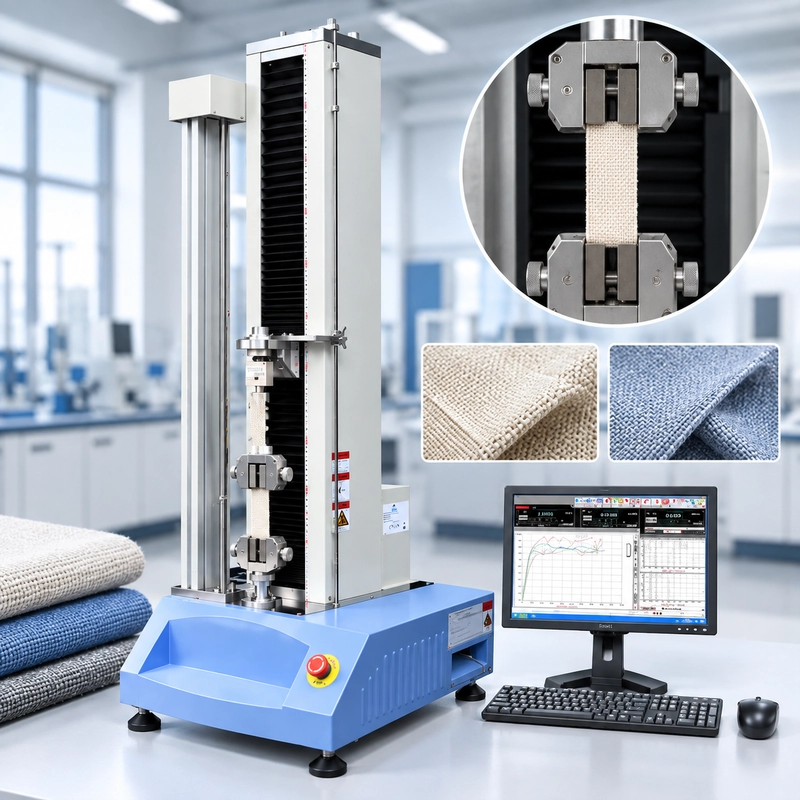
A woven fabric breaks at 420 N.
The next specimen reaches 487 N.
The third fails beside the upper jaw at 391 N.
Is the fabric inconsistent?
Maybe. But before blaming the material, look at the test setup.
One specimen may have slipped. Another may have entered the grips slightly off-axis. The third may have been damaged where the jaw contacted the fabric. And if the laboratory changed from a 25 mm raveled strip to a 50 mm strip somewhere along the way, the specimens are not directly equivalent.
That is what makes fabric tensile testing more interesting than the final force number suggests.
The current ASTM D5035-11(2024) covers raveled-strip and cut-strip procedures for determining the breaking force and elongation of most textile fabrics. The raveled-strip procedure applies to woven fabrics, while the cut-strip procedure covers materials such as nonwoven, felted, dipped, and coated fabrics. The method also provides for wet testing.
But the standard number alone does not tell you how to configure the test system.
You still need to answer a more practical set of questions:
What fabric construction are you testing? In which direction? How should the strip be prepared? Where will the specimen actually break in force terms? How will you hold it without slip or jaw damage? And how much extension needs to occur before rupture?
Those questions should come before machine capacity.
What ASTM D5035 Actually Measures
You'll often see ASTM D5035 described online as a fabric tensile strength test.
That's understandable search language, but it can blur an important distinction.
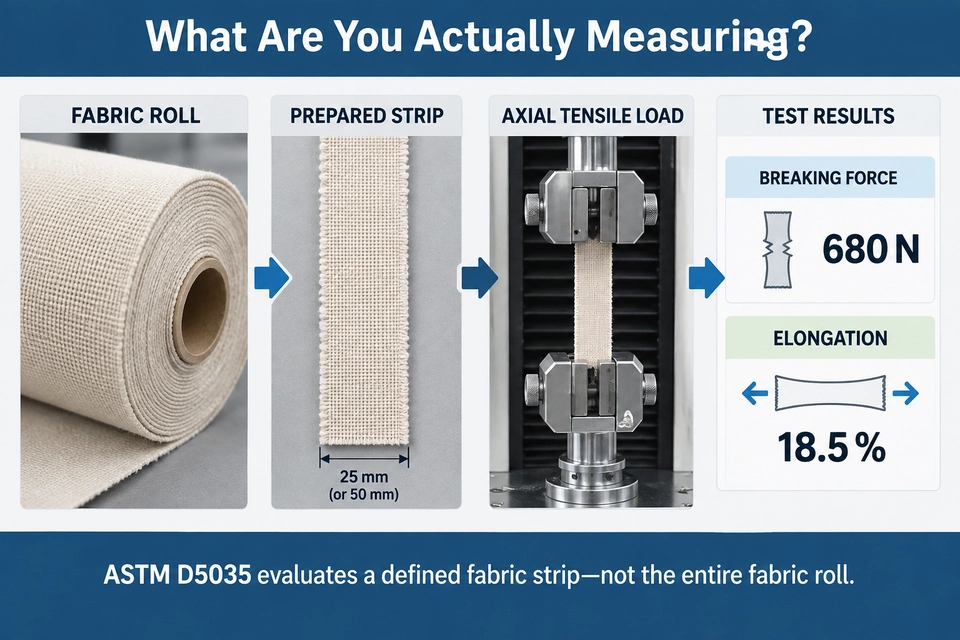
ASTM D5035 is specifically concerned with breaking force and elongation using a strip specimen.
Suppose the test gives:
Breaking Force = 680 N
That result describes the force carried by the defined fabric strip under the test conditions.
It is not automatically a material tensile stress in MPa.
That distinction is easy to miss if you are used to testing metals or plastics, where force is commonly divided by the original specimen cross-sectional area to calculate tensile stress.
Fabric is different. It is a structural assembly of yarns, fibers, coatings, or bonded material. Its construction is part of the mechanical response.
For a woven fabric, the test is not simply asking how strong the fiber material is. It is loading a defined population of yarns while those yarns interact within the fabric construction.
ASTM notes that raveled-strip results can be useful for comparing the effective strength of yarns within the woven fabric with the combined strength of the same number of yarns outside the fabric.
So keep the language precise:
Force at break is a force result.
Don't turn it into a generic MPa value just because the test happened on a tensile machine.
Raveled Strip or Cut Strip?
This decision comes before load-cell selection.
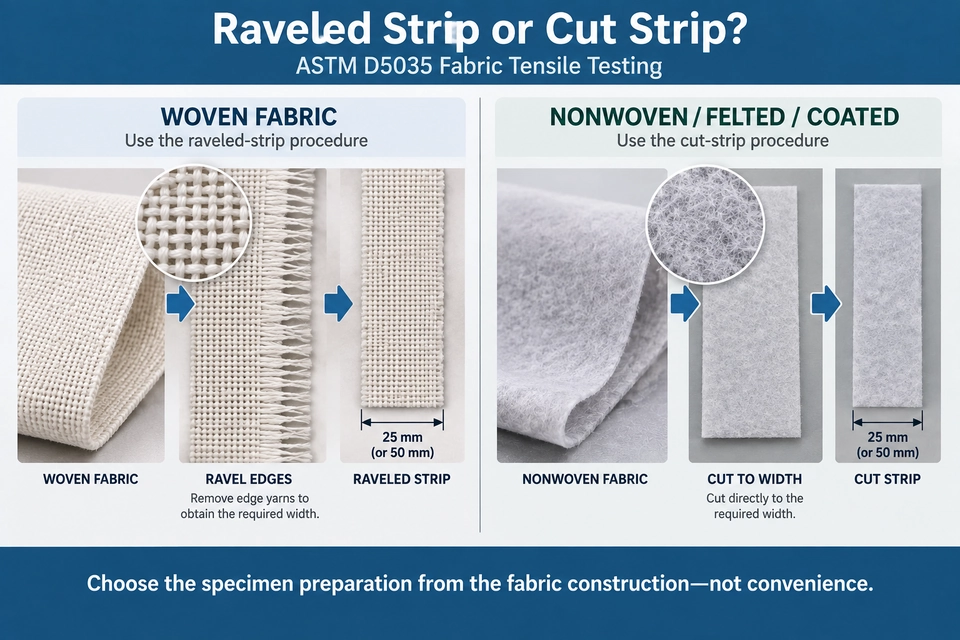
ASTM D5035 includes both raveled-strip and cut-strip procedures, but they are not simply two convenient ways of preparing the same sample.
For woven fabric, the raveled-strip procedure is the normal route. Edge yarns are removed until the intended specimen width is established.
That leaves a defined group of yarns running through the test strip.
The cut-strip procedure is used for materials including nonwoven, felted, dipped, and coated fabrics, as well as some woven materials that cannot readily be raveled. ASTM cautions against using the cut-strip procedure on fabrics that can be properly raveled because edge yarns can continue to unravel during testing.
This distinction becomes very physical once you handle the specimens.
A woven strip with controlled raveled edges and a nonwoven strip cut directly to width may look similar from across the laboratory. Mechanically, they are not the same specimen.
That's why an equipment inquiry that begins with:
We need an ASTM D5035 tensile tester.
still needs a follow-up:
What fabric are you testing?
One Fabric Can Have Two Very Different Results
A woven fabric does not necessarily have one universal "breaking force."
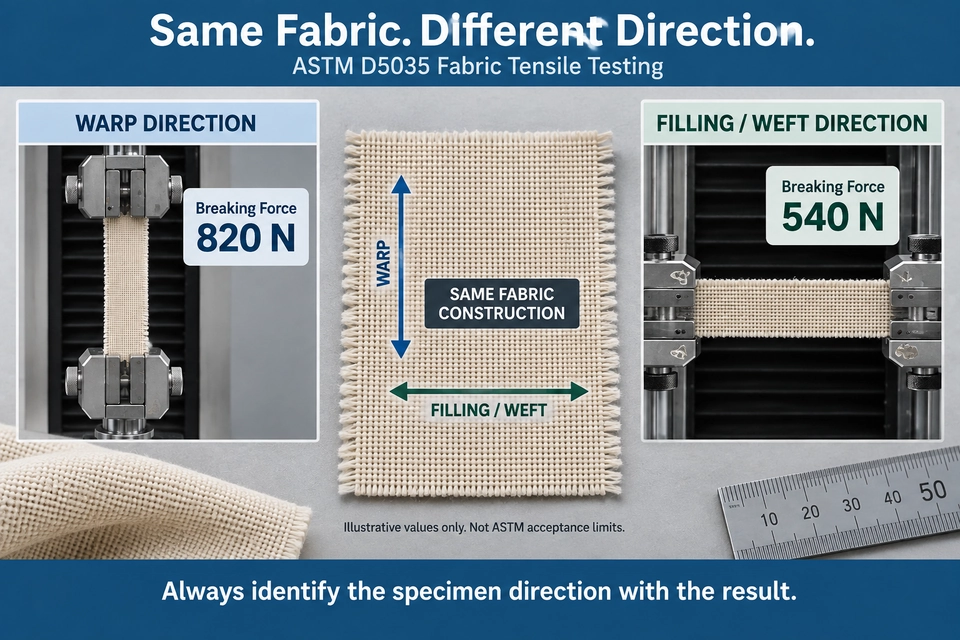
Direction matters.
Take specimens along the warp direction and you are loading one yarn system. Rotate the sampling direction and test along the filling—or weft—direction, and the response may be quite different.
For example, imagine a woven industrial fabric producing:
Warp: 820 N
Filling: 540 N
These are illustrative values only, but the difference itself would not be surprising.
Yarn type, yarn count, crimp, construction, and processing can all contribute to directional behavior.
So if someone tells us:
Our fabric normally breaks at about 700 N.
a useful next question is:
In which direction?
That information matters for equipment selection too.
If both principal fabric directions are part of the QC program, the load-cell and grip configuration needs to cover both—not just whichever specimen happened to be tested during the initial equipment discussion.
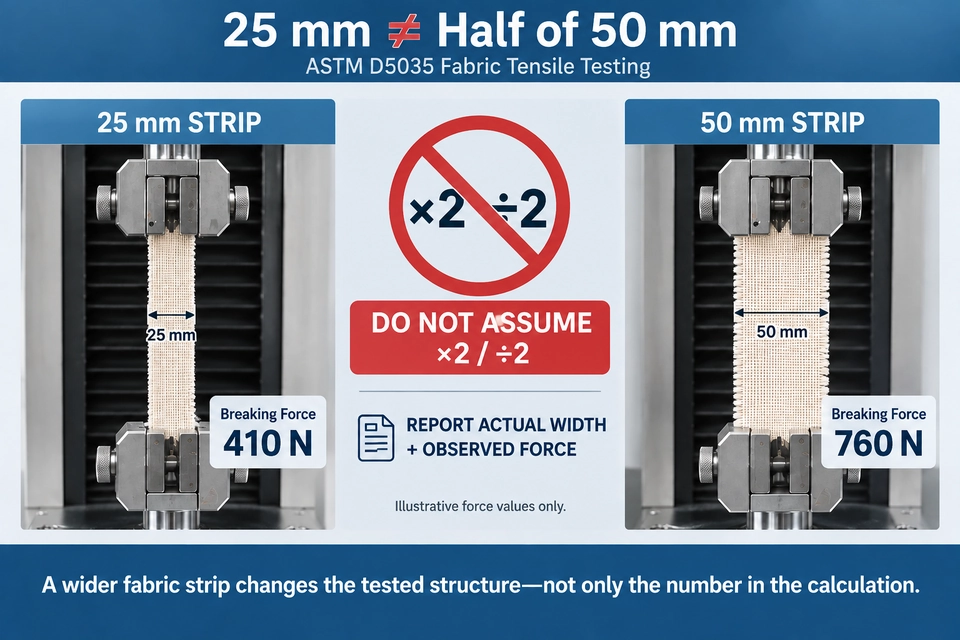
The 50 mm Result Is Not the 25 mm Result × 2
This is one of the easiest mistakes to make in strip testing.
Suppose a laboratory normally prepares a:
25 mm (1 in.) raveled strip
A low-yarn-count woven fabric arrives, and that width cannot provide enough yarns.
The laboratory therefore uses a:
50 mm (2 in.) strip
Now imagine the tests produce:
25 mm specimen → 410 N
50 mm specimen → 760 N
It is tempting to normalize the second result:
760 ÷ 2 = 380 N
Don't.
ASTM D5035 says the raveled-strip procedure is not recommended when there are fewer than 20 yarns across the specimen width. If 20 yarns cannot be obtained in a 25 mm strip, a 50 mm strip should be used.
More importantly, ASTM specifically notes that the observed force of the 50 mm specimen is generally not twice the force observed on a 25 mm specimen. The 50 mm result is therefore reported as observed rather than mathematically adjusted to a 25 mm result.
That tells us something useful about fabric testing:
Width changes the tested structure, not merely a multiplier in a calculation.
Two nominally adjacent groups of yarns do not necessarily behave like two independent 25 mm specimens operating side by side.
So preserve the specimen context when reporting the result.
760 N on a 50 mm strip is more meaningful than a mathematically convenient "380 N equivalent" that the test never actually produced.
The Grip Is Often the Hardest Part of the Test
A 5 kN frame has plenty of capacity for a fabric that normally breaks around 600 N.
That does not mean the test is easy.
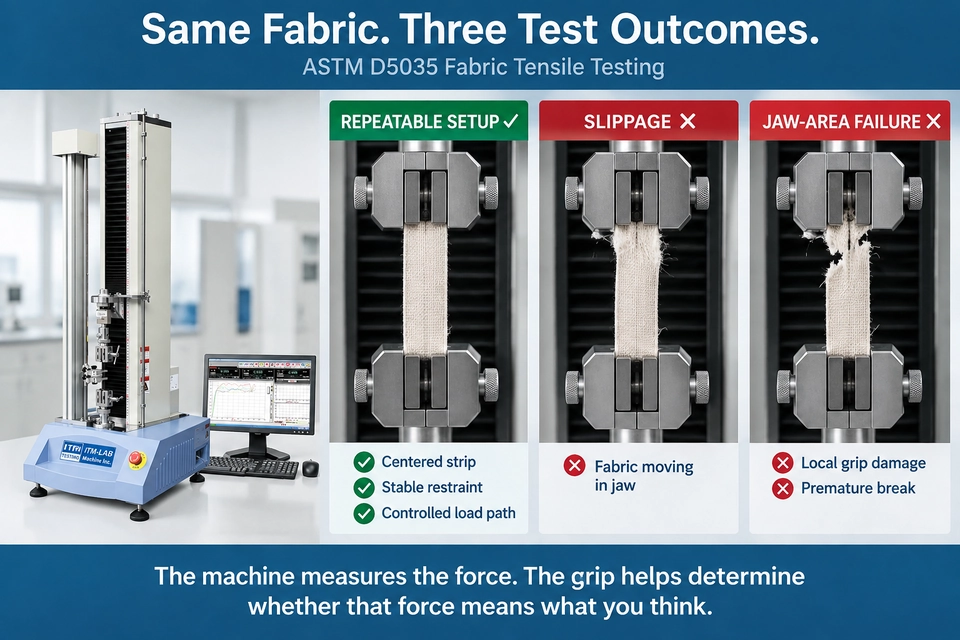
Clamp too lightly and the specimen walks out of the jaws.
Clamp too aggressively and the fabric may fail where the grip ends.
Install it slightly crooked and one side begins carrying load before the other.
All three situations can still produce a perfectly believable number on the screen.
That's the problem.
A believable number is not necessarily a valid result.
ASTM D5035 recognizes this practical issue. For strong fabrics and glass-fiber fabrics in particular, precautions may be necessary to prevent specimens from slipping in the clamps or being damaged by the gripping action.
In practice, we look for three things.
First, the specimen needs to remain where it was installed. If it slides during the test, part of what looks like specimen extension may actually be movement inside the grip.
Second, the jaw itself should not become the dominant failure initiator.
A specimen that repeatedly breaks immediately beside the grip deserves investigation. More clamping force is not automatically the answer.
Third, the strip needs to enter the load path straight.
A fabric strip installed at an angle can begin loading unevenly across its width, making repeatability harder before the test has progressed very far.
The objective is therefore not:
Maximum gripping force.
It is:
Enough restraint to prevent uncontrolled movement without creating a new failure mechanism.
That's why the textile grip should be treated as part of the test system rather than an accessory added after selecting the machine.
Before You Blame the Fabric
High scatter does not automatically mean poor material consistency.
When a result looks wrong, the failed specimen and the test setup often tell you where to start.
| What you see | Check first |
|---|---|
| Repeated break beside the jaw | Grip pressure, grip surface, and local specimen damage |
| Fabric moves during loading | Grip face, clamping condition, and specimen installation |
| One edge becomes taut first | Alignment and specimen preparation |
| Elongation looks unusually high | Specimen slip and extension measurement method |
| Results suddenly become more scattered | Specimen preparation, conditioning, alignment, and grip setup |
This is a diagnostic checklist, not an ASTM acceptance table.
The point is to separate a material failure from a test-system problem before making a production decision.
Breaking Force and Elongation Tell Different Parts of the Story
The specimen is installed.
The machine begins extending it.
Force rises while the fabric changes shape.
Eventually, rupture occurs.
The force measurement answers:
How much load did the strip carry?
The elongation result answers:
How much did the specimen extend?
Those are related measurements, but they are not interchangeable.
This becomes especially important with textile structures because extension can involve several mechanisms before actual yarn failure: straightening, yarn rearrangement, decrimping, and deformation of coatings or bonded structures, depending on the fabric.
Two fabrics can reach similar breaking forces and still produce very different force-extension behavior.
So when configuring the test system, don't stop with:
Maximum force = 800 N.
Also ask:
How much extension do we expect before rupture?
and:
What elongation result does the applicable procedure require us to report?
The answers influence machine travel, test space, and measurement strategy.
Don't Start With "What Speed Should I Enter?"
This is one of the most common questions in tensile testing.
It is also often asked too early.
ASTM D5035 prefers a constant-rate-of-extension (CRE) tensile testing machine. It also cautions against directly comparing results from tensile machines operating on different principles.
When different machine types are used for comparison testing, ASTM identifies a 20 ± 3 s constant time-to-break approach. The same constant-time-to-break condition applies in dispute situations unless purchaser and supplier agree otherwise. Even under those conditions, ASTM notes that data from different machine principles can still differ significantly.
That is more useful than copying a crosshead-speed number from an unrelated laboratory procedure.
The actual setup needs to consider:
applicable procedure
specimen geometry
fabric response
machine principle
customer or product specification
A speed setting is part of the method.
It is not the method by itself.
Where Do Your Fabrics Actually Break?
Now we can talk about machine and load-cell capacity.
Suppose a QC laboratory tests six fabric families.
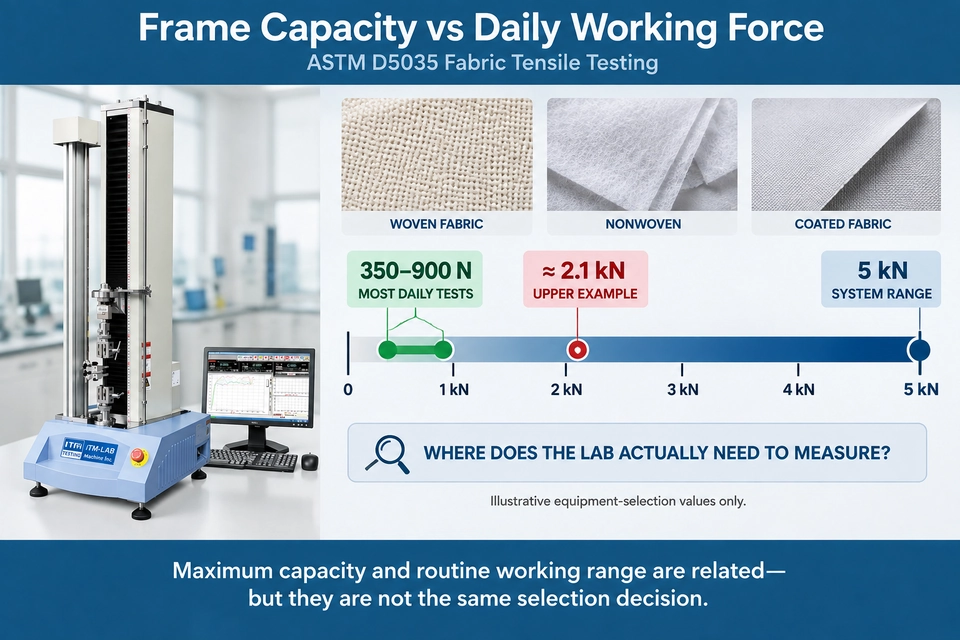
Historical breaking-force results range from roughly:
180 N to 2.1 kN
But about three quarters of the specimens tested every day fall between:
350 and 900 N
A 5 kN frame can cover the maximum expected force.
Good.
But that answers only one question:
Can the system carry the load?
It does not completely answer:
Where does the laboratory need reliable force measurement every day?
That's why we want to know both:
maximum expected force
and
normal working-force distribution
when configuring the load cell.
The same logic applies if the laboratory tests only one product.
"Less than 5 kN" is not nearly as useful as:
Typical specimens break between 450 and 700 N. We occasionally see values around 900 N.
Now we know where the test actually lives.
Dry Result or Wet Result?
Specimen condition should not become a forgotten line at the bottom of the report.
ASTM D5035 provides for testing fabrics in the conditioned or wet state.
If the applicable requirement calls for wet testing, the material entering the grips is physically different from the conditioned specimen tested yesterday.
That may influence the fabric response and, depending on the material, even its behavior at the gripping interface.
Record the condition with the result.
And if both conditioned and wet tests are part of the program, tell the equipment supplier. Fixture suitability should be considered for the actual specimen condition—not just a dry sample sent during the quotation stage.
What Does a Practical ASTM D5035 Test System Need?
By this point, the answer should be clearer.
Not just "a tensile machine."
The complete setup needs to make the test repeatable.
The frame
It must provide sufficient force capacity, controlled extension, test space, and travel for the intended fabrics.
The load cell
It needs to cover the expected force while making sense for the region where routine tests actually occur.
The textile grips
They need to hold the specimen without uncontrolled slip and without turning the jaw edge into the preferred failure location.
The measurement and software
The system needs to produce the outputs required by the laboratory, which may include breaking force, elongation, and the force-extension curve, together with the specimen and test information required for reporting.
All of those decisions depend on the fabric.
Selecting the frame first and figuring out the specimen later is backwards.
Configuring the ITM-LAB RS-8010A for Fabric Testing
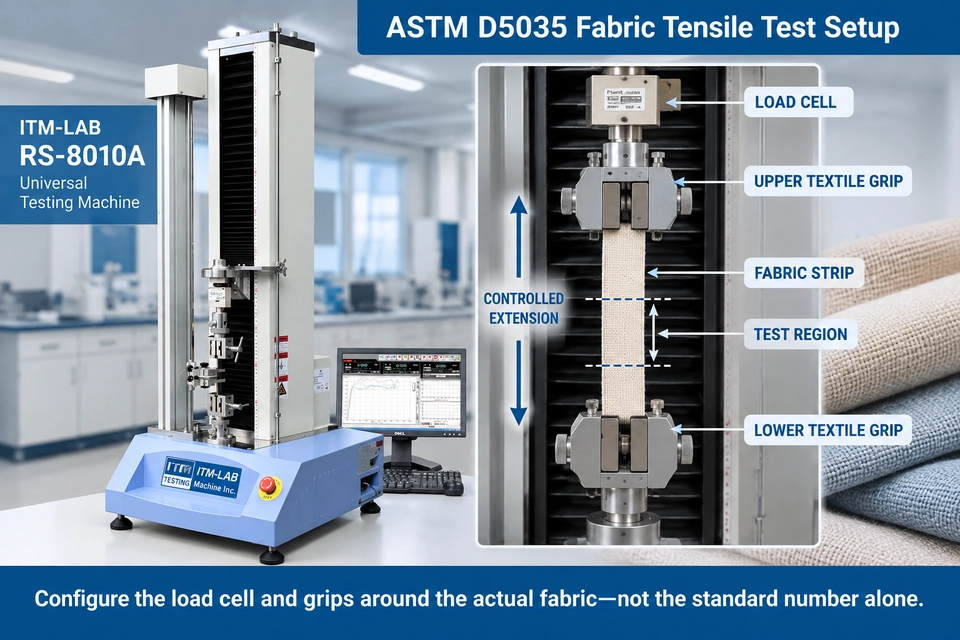
For low- to medium-force textile programs, the ITM-LAB RS-8010A can be configured with an appropriate textile grip for strip tensile testing.
The RS-8010A platform covers force configurations from:
50 N to 5 kN
That does not mean ASTM D5035 requires a 5 kN machine.
It means the platform can be configured within that range according to the actual application.
Before configuring an RS-8010A, the information we would rather receive is:
- fabric construction;
- raveled- or cut-strip requirement;
- specimen width;
- warp and/or filling direction;
- typical breaking force;
- maximum expected breaking force;
- expected elongation;
- conditioned or wet testing;
- approximate tests per day;
- any current slip or jaw-break problem.
With that information, frame capacity is often the easy part.
Load-cell range and textile gripping are where the configuration becomes application-specific.
A Realistic Equipment-Selection Example
Consider this inquiry:
Material: Woven polyester fabric
Method: ASTM D5035
Procedure: Raveled strip
Directions: Warp + filling
Typical Breaking Force: 350–650 N
Expected Maximum: <800 N
Required Results: Breaking force + elongation
Volume: 120 specimens/day
There is enough information here to start making sensible equipment decisions.
The first thing we would not do is jump straight to:
5 kN machine.
The frame is only one piece.
Because this is woven fabric, the raveled-strip procedure can be evaluated against the applicable requirement. We would then confirm specimen width and yarn population rather than automatically assuming every specimen should be 25 mm.
Next, look at force.
Most specimens are expected between 350 and 650 N, with an upper expectation below 800 N.
That gives us a much better picture of the working-force distribution than simply saying:
<5 kN
Now look at the grip.
If the customer's current problem is specimen slip at 500 N, a larger frame will not solve it.
If the specimen repeatedly breaks at the jaw at 390 N, increasing clamping pressure without understanding the failure may make the problem worse.
The fixture needs to be evaluated with the actual fabric.
Elongation is also required, so expected specimen extension and the measurement method need to be confirmed. Available travel and test space must comfortably accommodate the test.
Then there is one number that has nothing to do with breaking force:
120 specimens/day
At that volume, the operator spends substantial time outside the actual tensile movement:
identify → load → align → clamp → test → remove → record
A grip that is technically capable but awkward to load can become a daily productivity problem.
For this example, an RS-8010A + suitable textile grip is therefore a logical system to evaluate.
But that conclusion comes at the end of the selection process—not the beginning.
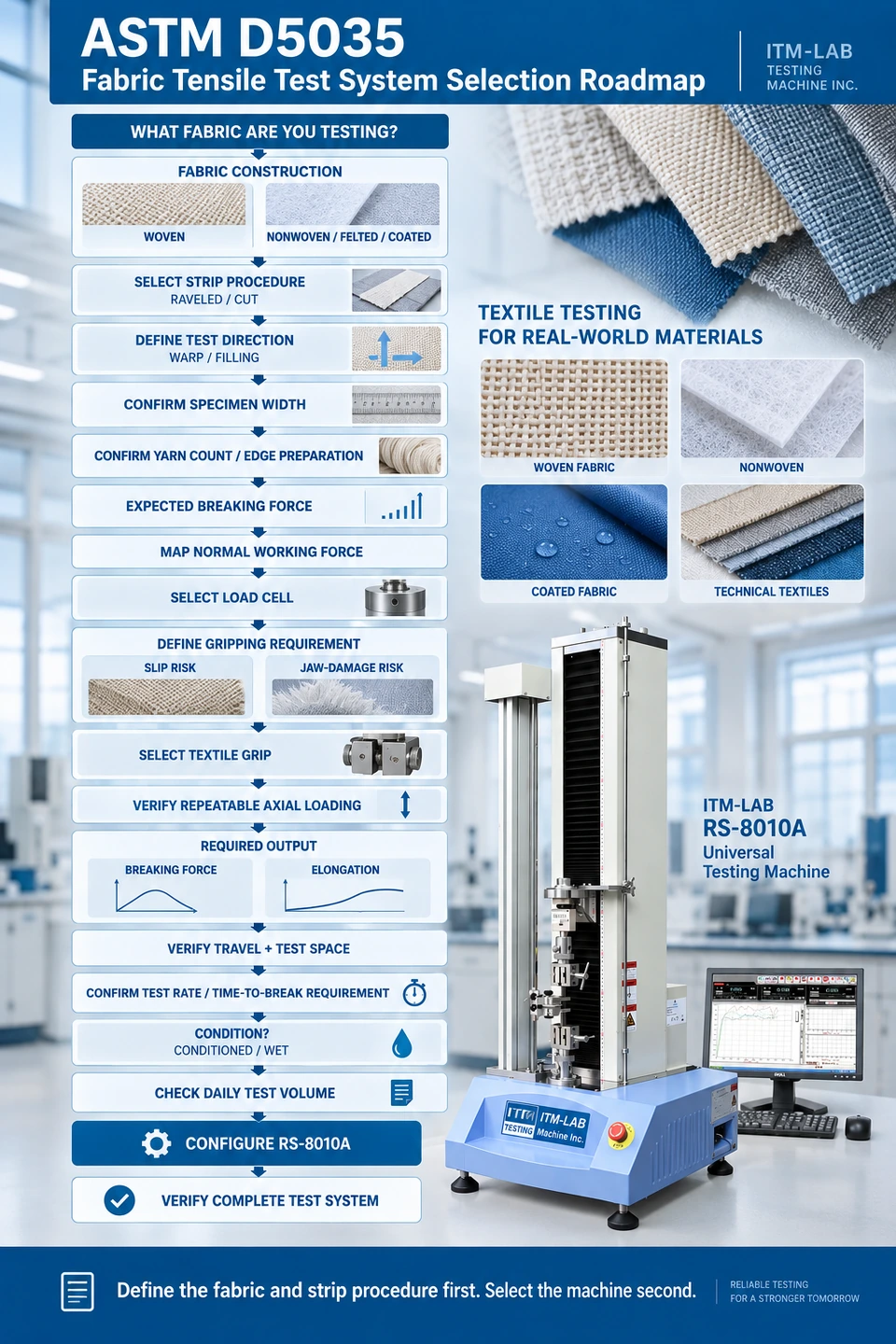
ASTM D5035 Fabric Tensile Test System Selection Roadmap
What Should You Send With an Equipment Inquiry?
You don't need a twenty-page specification.
A useful inquiry can be short.
Send the fabric construction, applicable D5035 procedure, specimen width, test direction, expected force range, required elongation result, specimen condition, and approximate daily test volume.
If there is already a problem, show us that too.
A photo of a specimen that slipped out of the grip can be more useful than another paragraph describing the machine you think you need.
The same is true for a specimen that consistently breaks beside the jaw.
The failed specimen contains information.
ASTM D5035 FAQ
What does ASTM D5035 test?
The current ASTM D5035-11(2024) covers raveled-strip and cut-strip procedures for determining the breaking force and elongation of most textile fabrics, with provision for wet testing.
What is the difference between ASTM D5034 and ASTM D5035?
ASTM D5035 covers the strip method. ASTM D5034 covers grab and modified-grab procedures. The D5035 scope specifically directs users to D5034 for determining breaking force and elongation using those procedures.
They should not be treated as interchangeable simply because both can be performed using tensile test equipment.
What is the difference between a raveled strip and a cut strip?
The raveled-strip procedure applies to woven fabrics. Edge yarns are removed to establish the test width.
The cut-strip procedure applies to materials including nonwoven, felted, dipped, and coated fabrics, and can also be used for woven fabrics that cannot readily be raveled. ASTM does not recommend the cut-strip approach for fabrics that can appropriately be raveled because edge yarns can unravel during testing.
Is ASTM D5035 suitable for knitted fabric?
ASTM D5035 is not recommended for knitted fabrics or other textile fabrics with high stretch above 11%.
The applicable product or customer specification should be checked before selecting an alternative method.
Can I convert a 50 mm strip result into a 25 mm result?
Not by simply dividing the force by two.
ASTM D5035 states that when a 25 mm raveled strip cannot provide the minimum 20 yarns, a 50 mm strip should be used. It also notes that the observed force of a 50 mm specimen is generally not twice the force of a 25 mm specimen, so the 50 mm result is reported as observed rather than mathematically adjusted to 25 mm.
Why does my fabric keep breaking at the grip?
Possible causes include excessive local gripping pressure, an unsuitable jaw surface, specimen misalignment, or grip-induced stress concentration.
ASTM specifically recognizes clamp slip and grip damage as issues requiring special precautions for some strong and glass-fiber fabrics.
Repeated jaw-area failure should therefore be investigated rather than automatically accepted as representative fabric rupture.
What tensile testing machine is suitable for ASTM D5035?
There is no single machine capacity defined merely by saying "ASTM D5035."
Selection should consider the expected breaking force, normal working-force distribution, fabric construction, specimen width, grip requirement, expected elongation, travel, and daily test volume.
For applications within its configured force and travel capabilities, the ITM-LAB RS-8010A (50 N–5 kN) can be evaluated with an appropriate textile grip.
The Standard Number Is Only the Starting Point
ASTM D5035 gives the laboratory a defined framework for strip testing.
The fabric determines much of what happens next.
A woven fabric may need a raveled strip.
A nonwoven may need a cut strip.
Warp and filling specimens from the same roll may produce very different breaking forces.
A low-yarn-count fabric may require moving from 25 mm to 50 mm—and the resulting force cannot simply be divided by two.
A slippery textile may make gripping more important than frame capacity.
And a laboratory testing 120 specimens every day has a different equipment problem from an R&D team running five specimens a week.
So instead of starting with:
What size tensile tester should we buy?
start here:
What fabric are we actually testing?
Then work outward:
Fabric Construction → Strip Procedure → Direction → Specimen Width → Breaking Force → Working Range → Load Cell → Textile Grip → Elongation → Test Conditions → Machine
For many low- to medium-force fabric programs, that process may lead to an RS-8010A with a properly selected textile grip.
But the machine should be the result of the selection process.
Not the starting assumption.
