
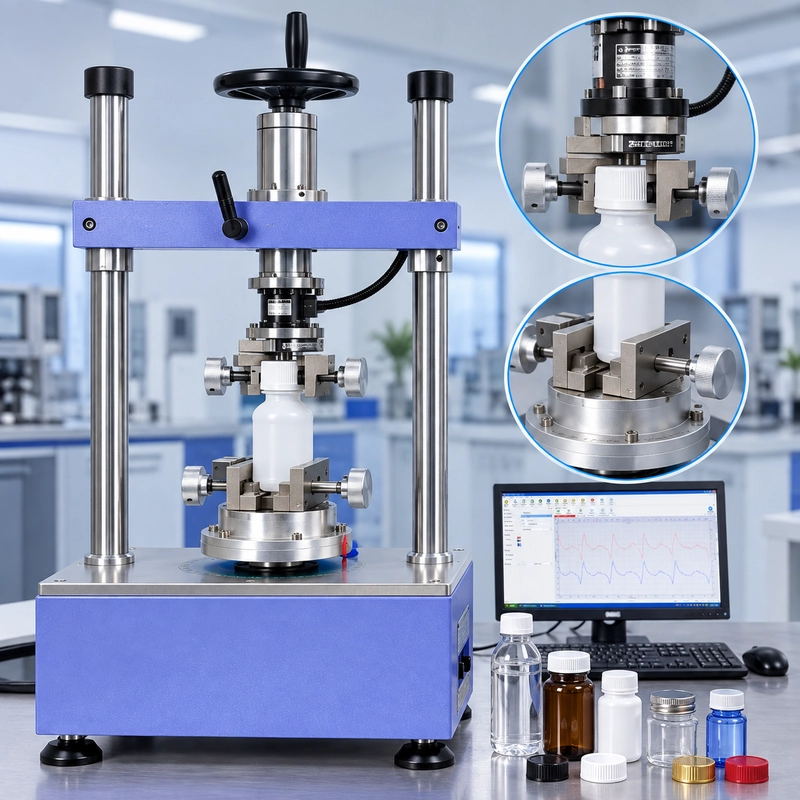
For a handful of bottles, manual closure torque testing can be easier.
There is no automated fixture to configure. No upper and lower grips to adjust. The operator positions the package, performs the removal, reads the torque, and moves on to the next specimen.
So why does ASTM have a separate method for automated closure torque testing?
Because convenience and measurement control are not the same thing.
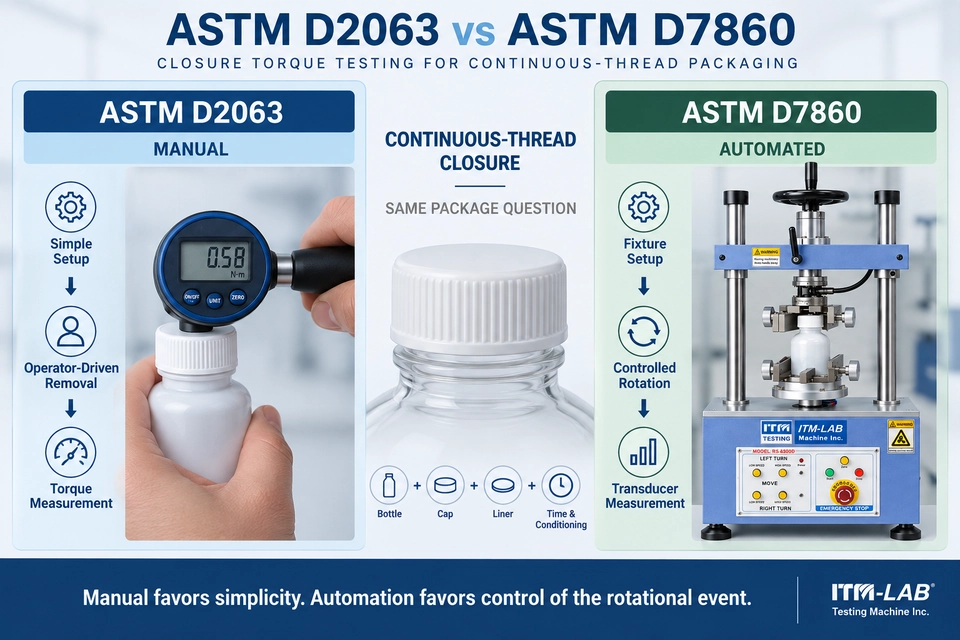
ASTM D2063/D2063M-24 uses non-automated manual torque testing equipment. ASTM D7860-14(2022) uses automated, transducer-based torque equipment operating at a known rotational velocity or known torque ramp. Both address torque retention in continuous-thread closure/container systems, but they control the removal event differently.
For an engineer choosing between the two, the useful question is therefore not:
Which method is more advanced?
It is:
How much control does this test actually require?
ASTM D2063 vs ASTM D7860: The Practical Difference
ASTM D2063/D2063M-24 is specifically a non-automated (manual) method. ASTM describes the measurement equipment as a non-automated spring torque meter with dial or digital readout, or a torque wrench. The current method quantitatively measures removal torque for continuous-thread closures under predetermined environmental conditions over time.
ASTM D7860-14(2022), by comparison, specifies an automated transducer-based torque meter operating at a known rotational velocity or known torque ramp. It covers defined child-resistant and non-child-resistant continuous-thread closure systems and is intended for dry torque measurement.
| Test Consideration | ASTM D2063/D2063M-24 | ASTM D7860-14(2022) |
|---|---|---|
| Measurement approach | Non-automated / manual | Automated |
| Primary equipment | Spring torque meter or torque wrench | Transducer-based automated torque meter |
| Removal motion | Operator-driven | Machine-controlled |
| Rotational condition | Depends on manual operation | Known rotational velocity or torque ramp |
| Specimen setup | Generally simpler | Requires fixture setup and alignment |
| Low-volume testing | Practical | May involve unnecessary setup |
| Repeated comparative testing | More operator involvement | Controlled repeated motion |
| Defined CR configurations | Not the same scope | Included |
| Dry torque | Not stated in the same way | Specifically intended for dry torque |
One point is worth making immediately:
ASTM D7860 is not simply the “newer replacement” for ASTM D2063.
ASTM lists both as active standards. D2063/D2063M was updated in 2024; D7860 is currently the 2022 reapproval of the 2014 standard.
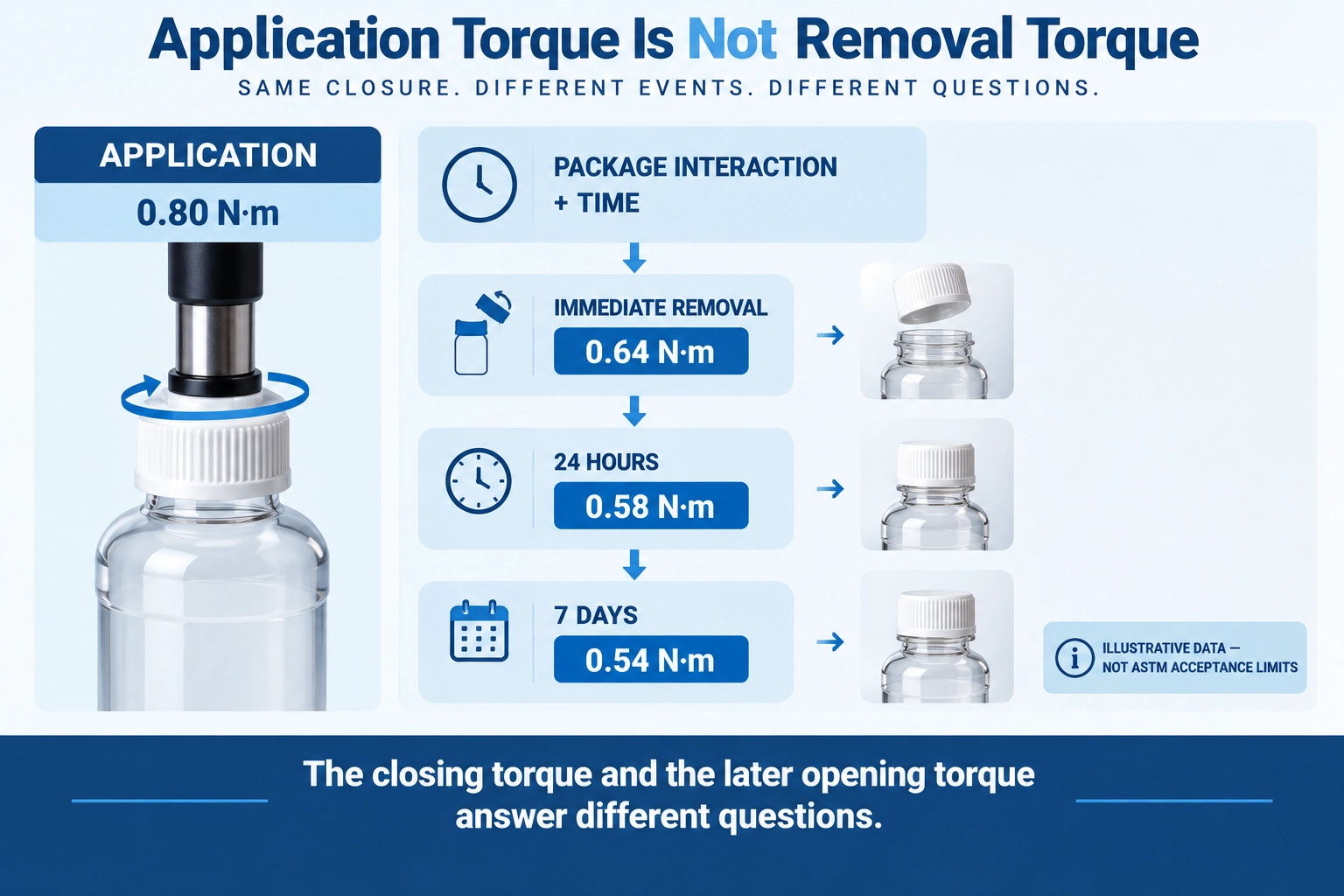
Application Torque Is Not Removal Torque
Before comparing equipment, it helps to separate three terms that are often mixed together.
Application torque is the torque used to tighten the closure.
Removal torque is measured when that closure is later opened.
Torque retention describes how the container/closure system behaves between those events.
ASTM D2063 describes the evaluation of continuous-thread closure/container systems under controlled conditions where application torque is known. ASTM D7860 similarly addresses torque-retention properties under defined conditions.
Consider an illustrative development test:
| Test Stage | Torque |
|---|---|
| Application | 0.80 N·m |
| Immediate removal | 0.64 N·m |
| Removal after 24 h | 0.58 N·m |
| Removal after 7 days | 0.54 N·m |
These values are examples only. They are not ASTM acceptance limits.
The fact that a closure was applied at 0.80 N·m does not mean it should later require 0.80 N·m to remove.
After application, the closure, threads, liner or sealing interface, container finish, package materials, time and environmental exposure form a mechanical system. Changes in that system can affect subsequent removal torque.
This is why the test condition needs to be documented along with the number.
A removal torque of 0.58 N·m immediately after application and 0.58 N·m after a defined conditioning period may look identical on a spreadsheet, but they do not represent the same test condition.
And a lower removal value is not automatically a failure.
Acceptance should come from the applicable product specification, customer requirement, validation protocol or other defined criteria—not from an invented universal ASTM torque limit.
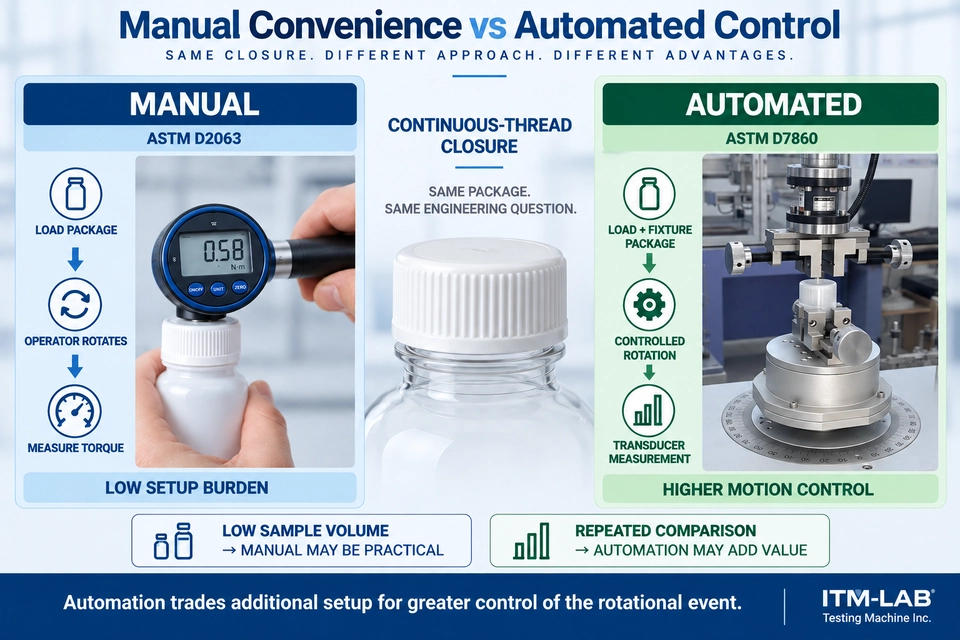
What Changes When Removal Torque Is Measured Manually?
Manual torque testing has an obvious advantage:
It is straightforward.
For a small batch of ordinary bottles, an operator can position the container, engage the measuring device, perform the removal and record the result without configuring an automated fixture for every new package geometry.
That simplicity matters in a real laboratory.
But the operator is also part of the measurement process.
If two technicians remove nominally identical closures, differences can enter through the way rotation begins, how smoothly the closure is turned, package handling and alignment.
That does not make manual testing unreliable.
It means the procedure and operator technique matter.
Fixture restraint still matters
Even a manual test needs the package to remain stable enough for a meaningful measurement.
Too little restraint can allow the bottle to rotate.
Too much restraint can create a different problem.
A thin-wall plastic container, for example, can deform if it is clamped aggressively. The bottle may no longer have exactly the same geometry it had before being placed in the fixture.
The correct objective is therefore not:
Clamp as hard as possible.
It is:
Prevent unwanted movement without materially changing the package.
The same principle applies to alignment. A clean digital number does not prove that the package was positioned correctly.
If Manual Torque Testing Is Easier, Why Automate It?
This is where the distinction between D2063 and D7860 becomes more useful.
For five routine bottle checks, manual testing may genuinely be the more practical approach.
An automated system has additional preparation:
the container must be restrained, the closure must engage correctly with the upper fixture, the rotational axes must be aligned, and a new package geometry may require fixture adjustment.
If setup takes longer than the entire manual test, automation has not made that particular job more convenient.
So the reason to automate is not necessarily faster specimen loading.
It is control after the test starts.
Imagine a development program with 100 specimens across several closure designs and conditioning periods.
With manual testing, the removal action has to be reproduced by the operator 100 times.
With an automated system, the specimens still have to be loaded correctly, but the subsequent rotational condition can be defined by the machine.
ASTM D7860 specifically describes an automated transducer-based torque meter operating at a known rotational velocity or known torque ramp.
That becomes useful when the engineering question changes from:
“What torque does it take to open this bottle?”
to:
“Can these packages be compared under a consistently controlled removal condition?”
Manual and Automated Testing Solve Different Practical Problems
| Test Situation | Manual Testing | Automated Testing |
|---|---|---|
| A few routine specimens | Simple and practical | Additional setup |
| Frequently changing package sizes | Easy to adapt | Fixture adjustment may be required |
| Large comparison study | More operator involvement | Controlled repeated motion |
| Rotation condition matters | More operator-dependent | Machine-defined |
| Operator-to-operator variation | Requires procedural control | Less dependent on manual rotation |
| R&D comparison work | Suitable | Useful when rotational control matters |
| High test volume | Repetitive for operator | Better suited to repeated programmed testing |
The point is not that automated testing is always better.
It is that the two approaches optimize different parts of the test.
Choose automation for measurement control—not simply because automation sounds more advanced.
What Automation Actually Controls Under ASTM D7860
Once the specimen is installed correctly, automation removes one important variable from the process: the operator no longer has to manually reproduce the rotational motion for every test.
The machine can perform the rotation according to its programmed condition while the transducer measures the torque response.
For comparative engineering work, this can make the mechanical input easier to reproduce from specimen to specimen.
But automation does not fix a bad setup.
A bottle that is incorrectly clamped is still incorrectly clamped.
A cap that slips in the upper fixture still produces an invalid mechanical event.
A badly aligned package does not become aligned because the rotation is motorized.
And a sensor with an unsuitable measurement range remains the wrong sensor.
The better way to think about automated torque testing is:
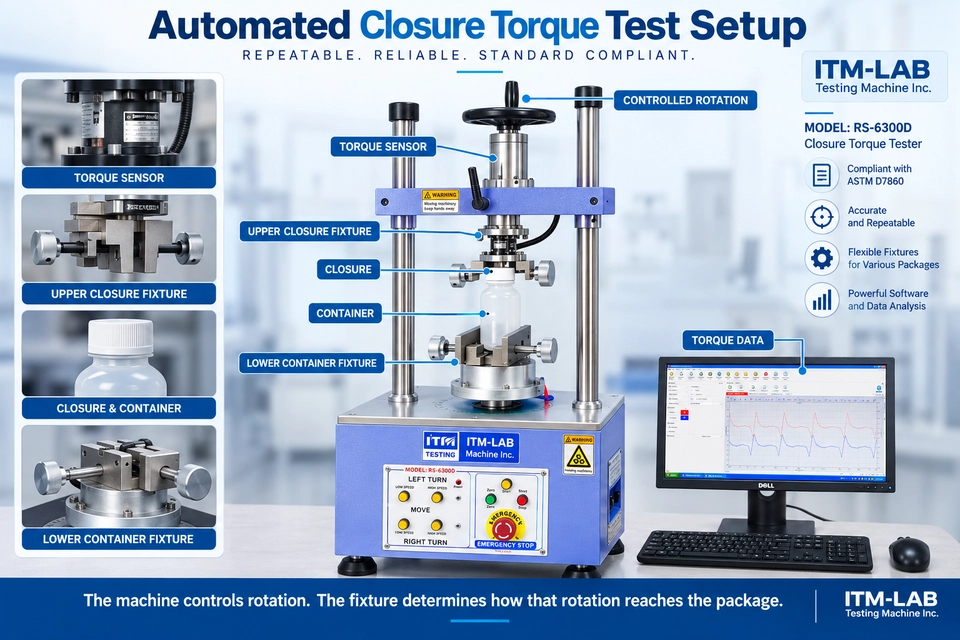
automation controls the motion; the fixture and setup determine whether that motion is correctly transferred to the DUT.
This distinction is particularly important when selecting equipment.
Same Closure. Different Measurement Process.
Suppose a packaging laboratory wants to compare three closure designs after 1 day, 7 days and 14 days of conditioning.
The laboratory is not simply collecting nine numbers.
It is comparing mechanical behavior across multiple conditions.
With a manual approach, operator technique becomes one of the variables that must be controlled through the procedure.
With an automated approach, the laboratory spends more time configuring the specimen and fixture, but gains tighter control over the rotational condition during the measurement.
Neither approach eliminates the need for good test practice.
They simply place the control in different places.
Where Closure Torque Testing Goes Wrong
Some of the most troublesome errors produce perfectly believable numbers.
That is what makes them difficult to spot.
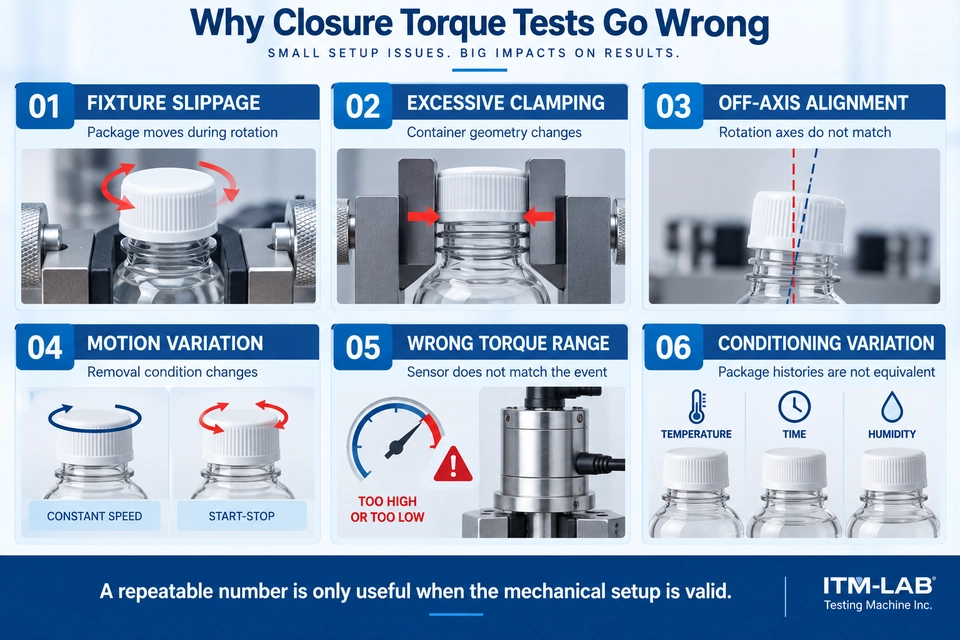
Fixture slippage
If the closure slips inside the upper fixture or the container rotates in the lower fixture, some of the commanded rotation occurs at the fixture interface rather than the closure threads.
The instrument can still display torque.
That does not mean the intended mechanical event was measured correctly.
Excessive container clamping
Increasing clamping force can stop movement, but it can also deform flexible packaging.
A fixture should restrain the container—not redesign it.
Off-axis alignment
The closure axis, package axis and measurement axis should form a sensible rotational system.
Misalignment can introduce unwanted mechanical loading into what is intended to be a torque measurement.
Inconsistent manual motion
This matters particularly when results show more scatter than expected.
Before concluding that the closure is inconsistent, check whether the removal action itself is being reproduced consistently.
Wrong sensor range
A common equipment-selection mistake is choosing only by maximum capacity.
Suppose normal removal torque is relatively low but the selected sensor has a very large full-scale range.
The system may technically cover the event while being poorly matched to the measurement of interest.
The better question is:
What torque range will the specimens actually produce?
Inconsistent conditioning
Torque retention is explicitly associated with environmental conditions over time in both ASTM methods. If specimens do not share equivalent conditioning histories, the test is comparing more than closure behavior.
Start With the Required Method—Then Consider Test Volume
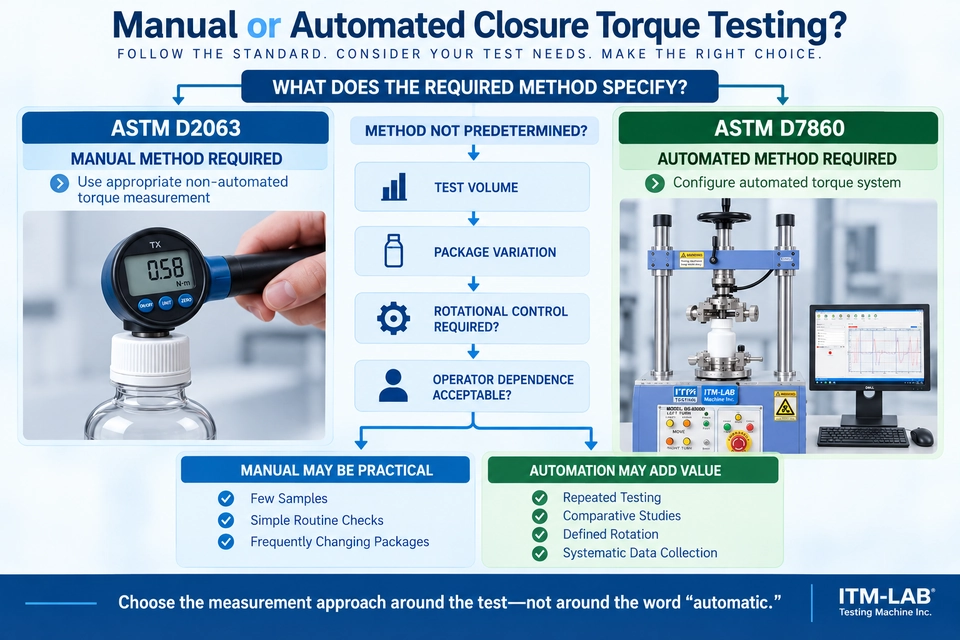
Equipment convenience should not determine the standard.
If a customer specification, validation protocol, drawing or internal procedure requires ASTM D2063/D2063M, that requirement comes first.
Likewise, if ASTM D7860 is specified, substituting a manual measurement simply because it is easier would not reproduce the automated method described by the standard.
Where the method is not predetermined, the practical decision becomes more interesting.
Ask:
How many specimens are being tested?
How frequently does package geometry change?
Is a manually produced removal motion acceptable for the engineering objective?
Does the study require a defined rotational velocity or torque ramp?
How important is operator independence?
Is the objective a routine torque check or a controlled comparative study?
Those questions tell you far more about the appropriate equipment than the word “automated.”
Child-Resistant Closures Need Separate Attention
Do not assume that D2063 and D7860 have identical closure scope.
ASTM D7860 explicitly defines methods for child-resistant as well as non-child-resistant continuous-thread closures. Its significance-and-use section also distinguishes non-child-resistant systems with zero downward force from defined push-down-and-turn CR systems where application torque and downward force are known.
That is an important equipment issue.
For an ordinary closure, unwanted axial force can contaminate the intended test condition.
For a defined push-down-and-turn configuration, axial force can be part of the required mechanical event.
So before discussing torque range or fixtures, identify the closure mechanism.
Configuring an Automated Closure Torque Tester
For applications where automated testing is appropriate, selecting the machine by maximum torque capacity alone is a mistake.
For a system such as the ITM-LAB RS-6300D, we would normally start with the actual package and test requirement.
1. Expected Torque Range
Provide the expected application torque and removal torque where available.
The sensor must cover the highest expected event and product variation, but it should also be appropriately matched to the normal working range.
Bigger is not automatically better.
2. Closure Geometry
Send the closure diameter, height and preferably a photograph or drawing.
A ribbed cap, smooth closure, shallow closure or unusual geometry may require a different upper fixture.
3. Container Geometry
The bottle matters just as much as the cap.
A rigid cylindrical bottle is much easier to restrain than a thin-wall, flexible or irregular container.
For unusual packages, fixture feasibility can become the main engineering question.
4. Upper Fixture
The upper fixture must engage the closure strongly enough to transmit rotation without slipping or unnecessarily damaging it.
The fixture should follow the real closure geometry rather than forcing every product into one universal gripping concept.
5. Lower Fixture
The lower fixture restrains the container while the upper system applies rotation.
It needs sufficient holding capability without introducing excessive package deformation.
This is one reason why actual product samples or detailed dimensions are valuable before equipment configuration.
6. Rotational Condition
For D7860-type automated testing, establish the required rotational condition rather than treating “automatic rotation” as a sufficient specification.
ASTM D7860 describes operation at a known rotational velocity or known torque ramp.
7. Axial Force
Determine whether the closure mechanism requires a controlled downward force.
This becomes particularly important with defined push-down-and-turn CR systems.
8. Data Requirement
Do you need the specified torque result only?
Or does the engineering program also require more detailed recorded data for comparison between specimens?
Define this before configuring software and reporting requirements.
What We Need Before Recommending an Automated System
If a customer asks us for an automated closure torque tester, the first useful information is not simply:
“I need a 10 N·m machine.”
We would rather know:
- applicable standard and edition
- closure type
- closure diameter
- container dimensions
- photos or drawings of the complete package
- application torque
- expected removal torque
- required rotational condition
- whether axial force is required
- number of specimens per batch or per day
- required results and data output
This information lets us evaluate the complete measurement system: sensor + rotation + upper fixture + DUT + lower fixture + data acquisition.
So, ASTM D2063 or ASTM D7860?
There is no useful universal answer that says automated testing should replace manual testing.
For a small number of straightforward measurements, manual testing may be simpler and entirely appropriate when it matches the required method.
For repeated comparative work where control of the rotational event matters, automated testing can justify the additional specimen setup by reducing dependence on manually produced rotation.
ASTM reflects that distinction by maintaining separate active approaches: D2063/D2063M-24 for non-automated manual torque testing and D7860-14(2022) for automated torque testing.
The equipment decision should therefore follow this order:
Standard → Closure System → Measurement Objective → Test Volume → Torque Range → Fixture → Motion Control → Data
Not:
Manual → old
Automated → better
That distinction is important when building a test that produces data you can actually compare.
Configure a Closure Torque Test with ITM-LAB
For an automated RS-6300D configuration, send us the actual bottle and closure photos or drawings, package dimensions, expected torque range, applicable standard, test volume and required data.
For unusual closures or flexible containers, send the package geometry first.
In many projects, selecting the torque range is straightforward.
Designing the correct interface between the tester and the package is the more important part.
