
A Complete Guide to Lithium-Ion Battery Safety Testing Standards & Test Methods
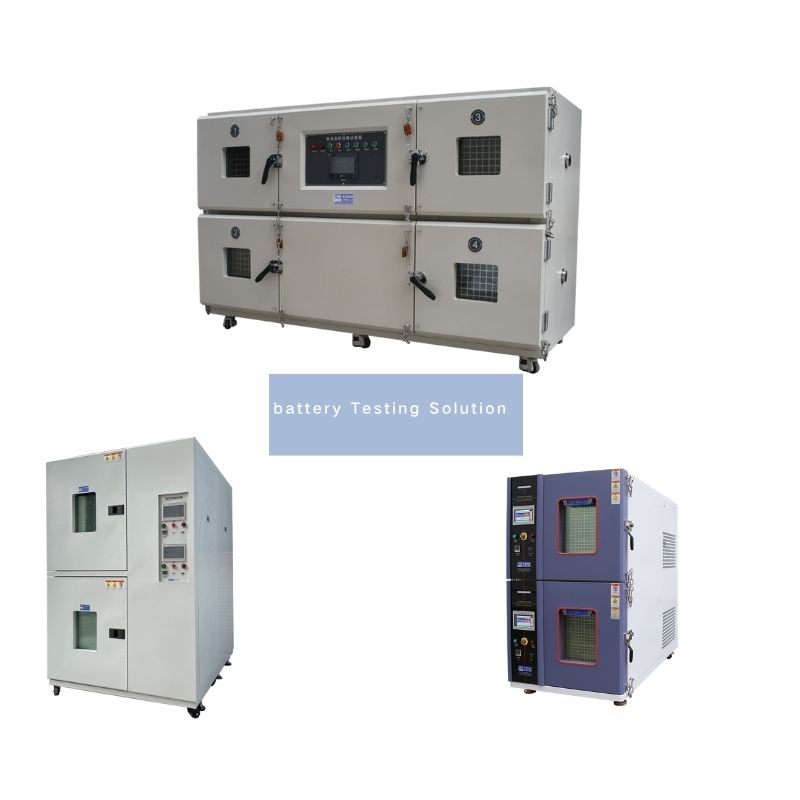
Lithium-Ion Battery Safety Testing: Full Procedures & Global Standards
Lithium-ion batteries power EVs, consumer electronics, energy storage systems, and portable devices. To ensure safety during transportation, storage, and daily use, every battery must pass strict safety tests based on global standards.
This article explains all test items, detailed steps, temperature profiles, test conditions, and pass/fail criteria from your official testing protocol, covering:
- Environmental Testing
- Mechanical Abuse Testing
- Electrical Performance Testing
It fully complies with UL 1642, UN 38.3, IEC 62133, JIS C8714, GB/T 18287, GB 31241, GB/T 31485.
1. Environmental Testing (Detailed Procedures)
1.1 Temperature Cycle Test (Detailed Steps)
Fully charge the battery at 20±5℃.
Place in a temperature chamber and run:
- Heat to 70±3℃ within 30min → hold 4h
- Cool to 20±3℃ within 30min → hold 2h
- Cool to -20±3℃ / -40±3℃ within 30min → hold 4h
- Return to 20±5℃ → hold 2h Repeat for 4–10 cycles, then rest 7 days.
Standards: UL 1642, UN 38.3, IEC 62133, JIS C8714, GB/T 18287
Pass: No fire, no leakage, no explosion, no smoke
1.2 Thermal Shock Test
Heat at 5℃/min to:
- 130℃ (international standard) → hold 10–30min
- 150℃ (Chinese standard) → hold 30min
Pass: No fire, no explosion
1.3 High Temp & High Humidity Test
Conditions:
- 40℃~65℃, 90–95%RH
- 48h~7 days
Pass: No deformation, no rust, no smoke, no burst
1.4 Low Pressure (Altitude) Test
- Pressure: 11.6 kPa
- Temp: 20±3℃
- Time: 6 hours
Simulates 15,000m air transport.
Pass: No fire, no leakage, no burst
1.5 Burning & Projectile Test
Flame-heat fully charged cell.
No particles or flames must not penetrate the 20-mesh aluminum wire mesh.
Standard: UL 1642, UL 2054
2. Mechanical Abuse Testing (Detailed Steps)
2.1 Vibration Test
- Frequency sweep: 10–55Hz
- 3-axis (X/Y/Z)
- 60–90min per axis
Pass: No damage, capacity loss <5%
2.2 Free Drop Test
- Drop from 1m height
- Surface: concrete or 18–20mm hard board
- 3–6 directions
Pass: No leakage, no fire, discharge ≥51min
2.3 Collision / Shock Test
- Acceleration: 75g–175g
- Half-sine wave
- 3 directions × 3–6 times
Pass: No damage, no leakage
2.4 Crush (Extrusion) Test
- Force: 13kN ±1kN
- Extrude until:
- Max pressure reached
- Voltage drops to 1/3
- Deformation ≥10%
Pass: No fire, no explosion
2.5 Heavy Impact Test
- Weight: 9.1kg
- Drop height: 610mm
- Bar: 15.8mm steel rod across cell center
Standard: UN 38.3, UL 1642
Pass: No fire, no explosion
2.6 Nail Puncture Test
- Needle: 2.5mm–8mm tungsten steel
- Speed: 9mm/s
- Penetrate fully charged cell
Pass: No fire, no explosion
3. Electrical Performance Testing (Detailed Steps)
3.1 Overcharge Test
- Current: 2×–3× rated
- Voltage: up to 10V or 2× rated
- Duration: 24–48h
Standards: UL 1642, UN 38.3, IEC 62133, GB/T 18287
Pass: No fire, no explosion
3.2 Over-Discharge Test
- Reverse charge at 1C for 90min
- Or deep short-circuit with 0.1Ω wire
Pass: No fire, no explosion
3.3 External Short Circuit Test
- Short with <0.1Ω (50mΩ for GB)
- Test at 20℃ and 55℃ (60℃ for UL)
Pass: No fire, no explosion, temperature within limits
3.4 High-Temp Discharge Test
- 55℃ or 60℃ for 2h
- Discharge at 0.2C–1C
Pass: Discharge ≥51min, no deformation
3.5 Low-Temp Discharge Test
- -10℃ or -20℃ for 2–24h
- Capacity ≥70–80%
3.6 Cycle Life Test
- 300 cycles: ≥80% capacity
- 500 cycles: ≥60% capacity
Global Standards Summary
- UL 1642: US lithium battery safety
- UN 38.3: Air & sea transport
- IEC 62133: International secondary battery
- JIS C8714: Japanese standard
- GB/T 18287, GB 31241, GB/T 31485: Chinese portable & EV battery
Need Professional Battery Testing Equipment?
ITM-LAB provides full-series battery safety test machines that fully support all the above standards:
- Battery Crush & Puncture Testers
- Heavy Impact Chambers
- Temperature Cycling & Environmental Chambers
- Burning & Thermal Abuse Test Chambers
