1. Product Overview
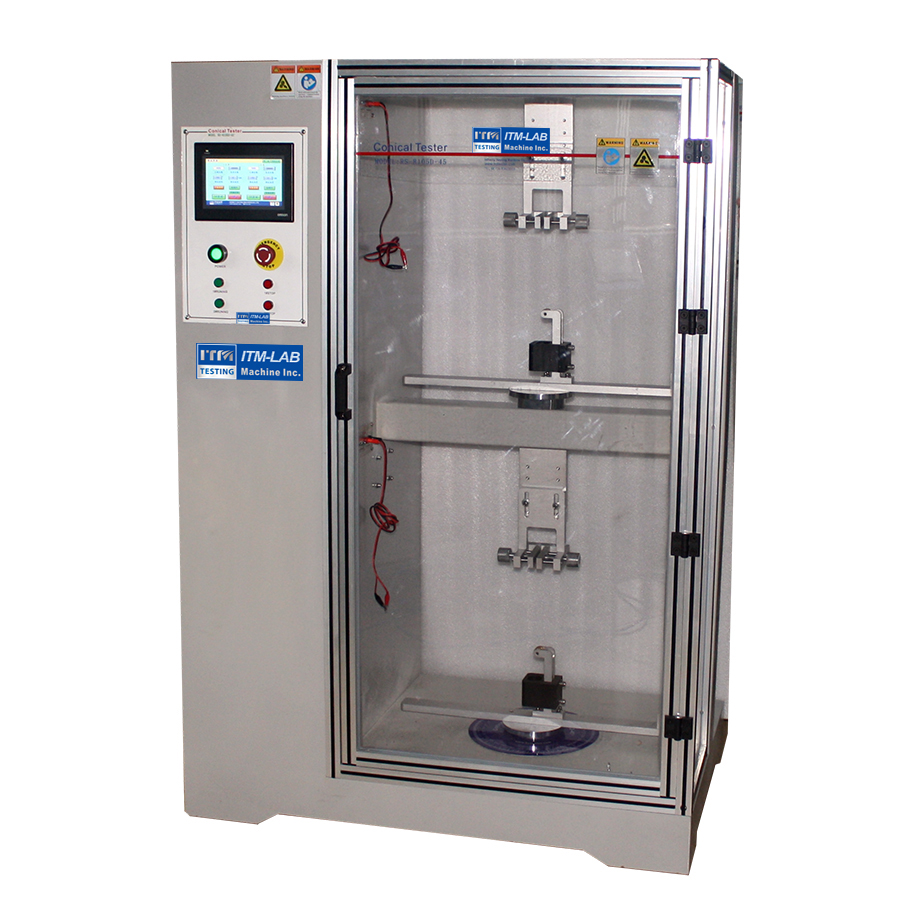
The RS-8105D-45° is a specialized, high-precision durability tester engineered to evaluate the flex and rotational fatigue life of power cables, headphone cords, and USB charging cables under a strict 45-degree conical trajectory. It simulates real-world twisting and bending stresses experienced by cables used in mobile phones, laptops, tablets, and wearable electronics.
Featuring two fully independent testing stations, the system allows QA labs to run concurrent test profiles simultaneously without cross-station mechanical interference. Additionally, an integrated on-line conduction monitoring system automatically stops the test the exact moment a wire fracture or electrical failure occurs, ensuring fully traceable and unattended reliability validatio.
![]()
2. Engineering & Motion Highlights
- Independent Dual-Station Throughput: Run separate test cycles or distinct cable profiles on two isolated stations simultaneously to maximize laboratory workspace and efficiency.
- On-Line Conduction Monitoring: Supports real-time failure detection. By soldering sample leads to the built-in test terminals, the machine instantly halts operation upon detecting any disconnection or high-resistance failure.
- Premium Japanese Motion Train: Driven by a Panasonic AC servo motor paired with a SHIMPO planetary gear reducer and Mitsubishi timing belts. This combined architecture guarantees an elite angular accuracy of ±1° , near-zero backlash, and silent operation.
- Industrial Logic Control: Features an OMRON touch panel and a Mitsubishi PLC , allowing operators to input testing parameters easily and monitor real-time cycle counts, speeds, and test status.
- Robust Safety Guard: A transparent, high-visibility protective cover shields operators from high-speed moving parts while allowing uninterrupted visual observation of the cable behavior.
3. Test Methodology & Execution
-
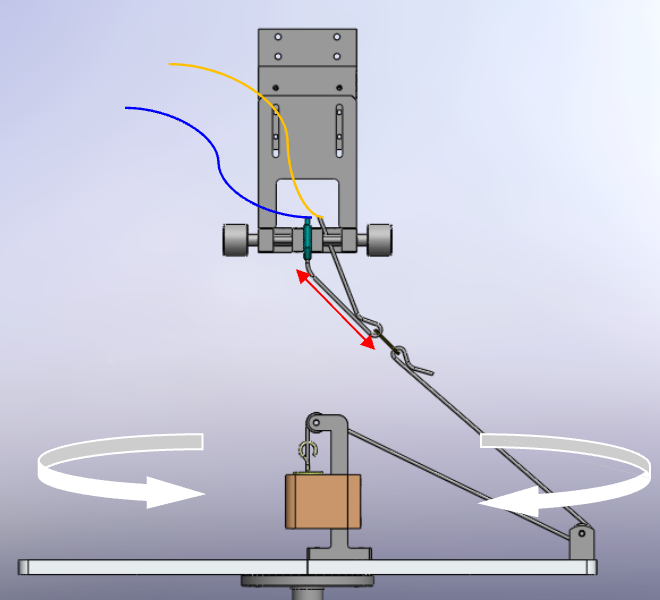
Sample Setup: One end of the cable or headphone cord is secured in the main fixture. At 80–100mm from the grip point, the cable is folded back, passed through a rotatable buckle, guided over dual flexible pulleys, and tensioned with a specified counterweight.
-
Standard Test Profile: The system defaults to a standard speed of 42 rpm with an angular sweep of ±720°. One complete cycle constitutes a 720° clockwise rotation followed by a 720° counter-clockwise return (1 cycle = 720° CW + 720° CCW).
-
Automated Interruption: If any internal core wires break during the continuous angular rotation, the loop circuit opens, and the PLC immediately triggers an emergency stop to preserve the exact cycle count at failure.
4. Technical Specifications
| Parameter |
Technical Specifications & Engineering Data |
| Model |
RS-8105D-45°
|
| Testing Configurations |
2 Independent Stations (Upper / Lower arrangement)
|
| Radius of Gyration |
280 mm
|
| Rotational Angular Range |
0 to ±720° (Fully adjustable via touch panel)
|
| Angular Precision |
±1°
|
| Testing Speed |
30 to 60 rpm adjustable (Standard: 42 rpm)
|
| Tension Load (Weight) |
Up to 500g per station (Customizable per test criteria)
|
| Control System |
OMRON Color Touch Panel + Mitsubishi PLC
|
| Main Drive Train |
Panasonic AC Servo Motor + SHIMPO Planetary Reducer
|
| Dimensions (W×D×H) |
1030 × 650 × 1500 mm
|
| Machine Weight |
Net approx. 155 kg
|
| Power Supply |
Single-phase AC 220V, 5A
|
5. Primary Applications
This 45-degree conical durability tester is the industry standard for component-level fatigue evaluation in consumer electronics and wire manufacturing:
-
Consumer Electronics Cables: Charger cables, USB-C/Lightning data lines, and laptop power supply cords.
-
Audio Components: Headphone cables, earbud cords, and auxiliary audio lines.
-
Smart Devices: Flex-life evaluation for wearable device charging links and e-reader components.
6. FAQ
Q: Can the two stations be programmed with completely different rotational angles simultaneously?
A: Yes. The Mitsubishi PLC manages two fully isolated control paths. Each station can execute distinct angular limits (up to ±720°) , test speeds, and cycle thresholds without any cross-station vibration or data interference.
Q: How does the on-line conduction monitoring work for unstripped cables?
A: To utilize the auto-stop feature on wire breakage, you simply solder a lead wire to the gripped end and the folded end of the cable sample, then connect them to the machine's test terminals. If internal core continuity drops during the ±720° cycles , the machine immediately freezes the station.
Q: Are the test weights adjustable for different wire thicknesses?
A: Yes. The machine supports a dynamic deadweight tension system up to 500g per station. You can freely swap or adjust the weights to comply with your specific internal QC protocols or international OEM testing standards.
7. Contact ITM-LAB
For technical consulting, custom fixture inquiries, or a formal quotation: