
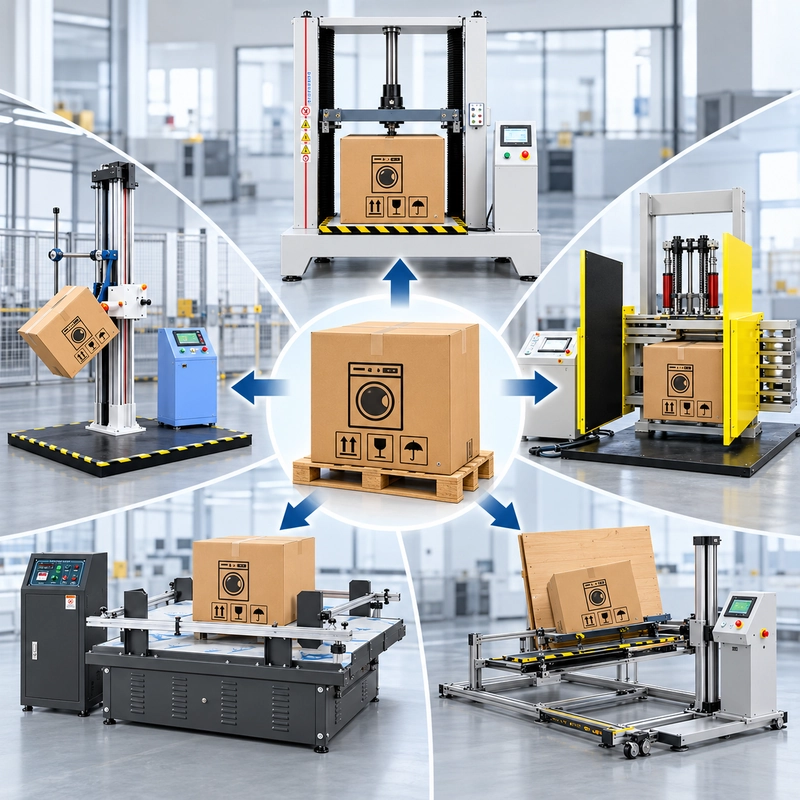
Search for packaging testing equipment manufacturers and you will find companies selling very different kinds of machines.
Some build systems that reproduce truck vibration, drops and handling impacts. Others concentrate on corrugated board, flexible films, seals, friction or package integrity. Both belong to the packaging-testing industry, but they solve different problems.
That difference becomes important when the test item is a complete shipping package.
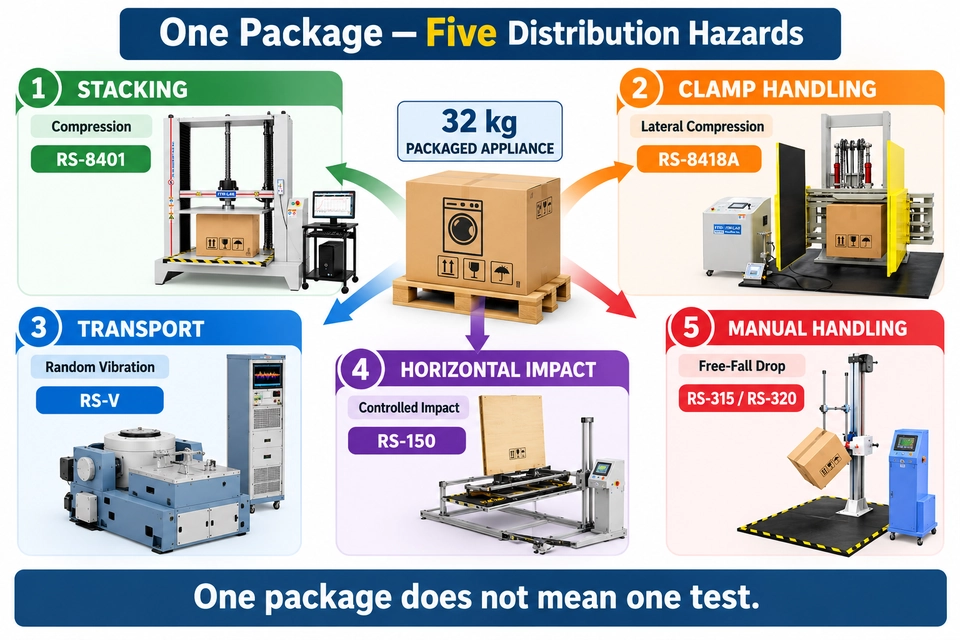
Consider a 32 kg appliance carton. During distribution it may be stacked in a warehouse, squeezed by a clamp truck, vibrated for hours on the road, subjected to a horizontal impact and dropped during handling.
Those are five different mechanical events. No single “packaging tester” reproduces all of them.
This guide looks at ten packaging testing equipment manufacturers active in different parts of that market in 2026. It is not a best-to-worst ranking. The aim is more practical: understand what each manufacturer is positioned to test, then match that capability to your package, distribution route and laboratory requirements.
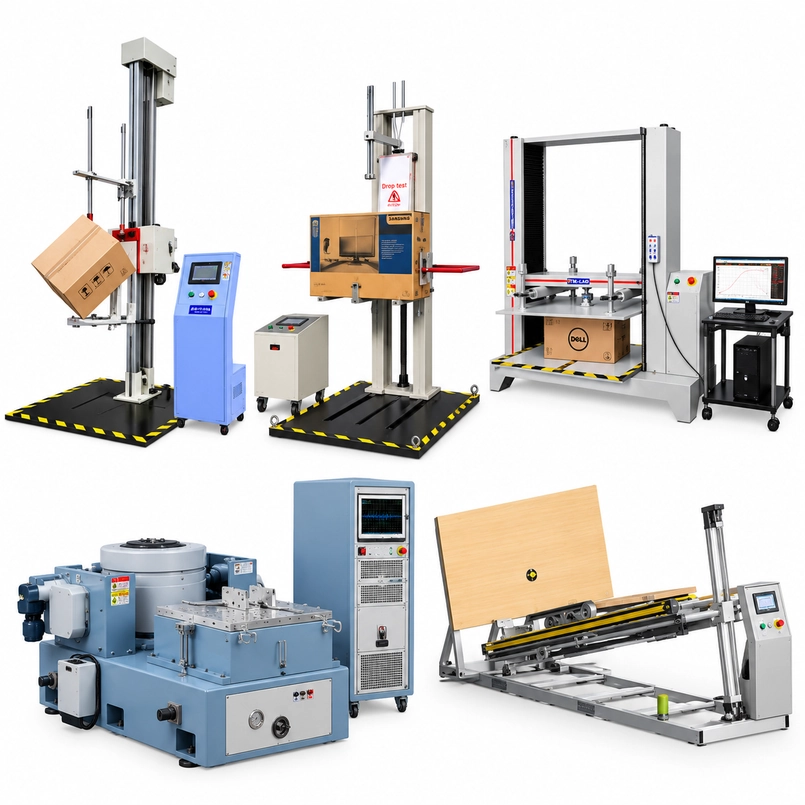
Packaging Testing Equipment Manufacturers at a Glance
| Manufacturer | Main Focus | Typical Test Level | Worth Considering For |
|---|---|---|---|
| Lansmont | Distribution simulation | Complete package / large package | Drop, vibration, compression, distribution testing |
| Safe Load Testing Technologies | Transport simulation | Package / unit load | Vibration, impact, compression, load stability |
| Labthink | Packaging & material testing | Material → finished package | Films, package integrity, compression |
| Thwing-Albert | Physical properties | Material / component | Flexible packaging, friction, peel, puncture |
| AMETEK / Lloyd Instruments | Force & materials testing | Material / component / package | Tensile, compression, peel and fixture-based tests |
| Presto | Packaging QC | Material / carton | Production and routine packaging QC |
| Pacorr | Paper & packaging testing | Material → carton | Corrugated, compression, drop, vibration |
| Haida | Multi-category testing | Package / product | General packaging and reliability laboratories |
| IMV | Dynamic testing | Package / product | Controlled vibration and shock |
| ITM-LAB | Complete-package mechanical testing | Complete package | Drop, compression, clamp, vibration, horizontal impact |
The useful distinction is not which company has the longest catalog.
It is where in the packaging system you need to measure performance.
Lansmont — Distribution Simulation
Lansmont is one of the names most closely associated with laboratory simulation of distribution hazards.
Its equipment portfolio spans several mechanical events encountered during transportation, including drop, vibration and compression. The company's published product information also shows how wide the term drop tester can be: different systems are designed for dramatically different package scales and payloads. ITM Lab
That matters because buyers often begin with a machine category when they should begin with the distribution event.
An 8 kg electronics carton, an 80 kg appliance package and a large industrial shipping container can all require drop testing. They do not require the same release geometry, impact area, lifting mechanism or test envelope.
For laboratories working with complete packages rather than packaging materials alone, Lansmont is particularly relevant to the distribution-simulation side of the market.
Its broader significance is methodological: field transportation conditions and laboratory simulation can be treated as parts of the same engineering problem rather than separate activities.
A useful procurement question here is not simply:
How high can the machine drop?
It is:
Can the system reproduce the event we are trying to simulate with our actual package installed?
Safe Load Testing Technologies — Transport & Unit-Load Simulation
Safe Load Testing Technologies focuses on mechanical testing and transportation simulation.
The company describes systems for reproducing vibration, shock, impact, compression and stability under controlled laboratory conditions, with applications extending from individual packages to unit loads. Safe Load Testing Technologies
That last point is important.
Once the test item becomes a palletized load, the questions change.
A laboratory may need to investigate:
- load stability during acceleration;
- pallet behavior;
- stretch-film contribution;
- horizontal movement;
- transport vibration;
- interaction between individual packages within the unit load.
A corrugated box tester cannot answer all of those questions.
Safe Load therefore sits closer to transport and unit-load simulation than conventional packaging-material QC.
For a company shipping palletized goods, large loads or products through complex logistics networks, this supplier category deserves a separate evaluation from film, seal or board-testing manufacturers.
Labthink — Packaging Materials and Finished-Package Performance
Labthink approaches packaging from a different direction.
Its portfolio extends across packaging materials and finished-package measurements, including compression, tear and other material/property tests. Its box compression systems are intended to measure compressive resistance, deformation and stacking capability of complete packages. Labthink lists ISO 12048, ASTM D642 and ASTM D4169 among applicable methods for this equipment. Labthink
This is where the phrase packaging testing equipment becomes ambiguous.
One laboratory may be concerned with:
film properties;
seal performance;
tear resistance;
barrier performance;
package integrity.
Another may be concerned with:
drop;
truck vibration;
clamp handling;
horizontal impact.
Both can legitimately be called packaging laboratories.
Their equipment lists may have little overlap.
For buyers comparing packaging testing equipment suppliers, deciding between material/package-property testing and distribution simulation should happen before comparing models or prices.
Thwing-Albert — Flexible Packaging and Physical Properties
Thwing-Albert is particularly relevant to physical-property testing of flexible packaging materials.
Its published flexible-packaging portfolio includes universal testing equipment for tensile strength, elongation, coefficient of friction and puncture, along with dedicated friction/peel systems and related fixtures. Thwing-Albert
The company also supports package-integrity applications. Its ASTM D3078 information, for example, covers vacuum bubble leak testing of flexible packages. Thwing-Albert
This sits upstream of many complete-package distribution failures.
A package may fail in transit because the entire carton cannot tolerate a drop.
But failure can start much earlier:
a seal opens;
a film punctures;
an adhesive bond separates;
friction is outside the intended range;
or the package loses integrity.
These are different engineering questions.
A complete packaging-development program may need both material-level characterization and complete-package validation. One should not be used as a substitute for the other.
AMETEK / Lloyd Instruments — Force-Based Packaging Tests
AMETEK Test & Calibration Instruments brings a materials-testing approach to packaging.
Universal testing systems are useful when the result of interest is force, displacement or deformation under a controlled mechanical input.
Typical packaging work can involve:
tensile;
compression;
peel;
puncture;
closure forces;
fixture-specific package tests.
This flexibility is valuable in R&D because one test frame can support several methods by changing the load cell and fixture.
But there is a boundary.
A UTM can measure controlled compression.
It does not reproduce a truck vibration environment.
It can perform a peel test.
It does not reproduce a free-fall package impact.
That distinction sounds obvious, yet it matters in RFQs where several very different requirements are grouped under “packaging testing machine.”
For force-based tests, define the measurement problem first: expected load, geometry, displacement, speed, fixture and required result.
Presto — Production and Packaging QC
Presto Group is better viewed through the day-to-day QC side of packaging testing.
For a carton plant, packaging supplier or production quality laboratory, the job is often less about reconstructing a complete logistics route and more about maintaining consistency.
Questions are practical:
Did carton strength change after a material change?
Does the incoming packaging meet specification?
Is the production batch behaving differently?
Does the finished package survive the required routine test?
That kind of laboratory needs repeatability, straightforward workflows and equipment suited to regular QC volume.
A highly instrumented distribution simulator may be unnecessary.
The right equipment depends on the question the lab is expected to answer—not on how advanced the machine appears.
Pacorr — Paper, Corrugated and Packaging QC
Pacorr covers a broad range of paper and packaging testing instruments.
Its current packaging portfolio includes box compression, bursting strength, drop, edge crush, puncture and packaging vibration equipment, among other systems. Pacorr Testing Instruments Pvt. Ltd.
That breadth is useful for laboratories working across corrugated material and finished cartons.
It also illustrates a common purchasing trap.
A broad catalog makes it easy to buy equipment category by category:
compression tester;
drop tester;
vibration table;
burst tester;
edge crush tester.
But owning one machine from every category does not automatically produce a coherent packaging-validation program.
The missing step is the test map:
Which real failure risk does each machine represent?
Without that map, laboratories can accumulate equipment and still leave an important distribution hazard untested.
Haida — Multi-Category Reliability Testing
Haida International Equipment operates across multiple testing-equipment categories rather than packaging alone.
That model can make sense for manufacturers whose laboratory responsibilities extend beyond shipping packages.
An appliance or electronics lab, for example, might need:
package testing;
materials testing;
product vibration;
environmental testing;
mechanical reliability testing.
Buying across several disciplines from a broad equipment manufacturer can simplify sourcing.
It does not remove the need to inspect each system technically.
A basic mechanical vibration table and a closed-loop random vibration system may both appear in a catalog under vibration testing. Their capabilities are not interchangeable.
Catalog category names are useful for navigation.
They are poor substitutes for specifications.
IMV — Controlled Vibration and Dynamic Testing
IMV Corporation represents the more specialized dynamic-testing end of the comparison.
This becomes relevant when transport vibration is defined as an engineering input rather than simply repetitive shaking.
For a controlled random vibration test, an RFQ may need to define:
PSD profile
frequency range
Grms
duration
package mass
fixture/restraint mass
table dimensions
displacement
velocity
required force
Notice what is missing from that list:
“We need a 200 Hz packaging vibration tester.”
Frequency range alone tells very little about whether the required test can actually be run.
A shaker may reach the requested frequency unloaded and still be unable to reproduce the required profile once the package, fixture and table mass are included.
For serious transport-vibration work, evaluate the loaded profile, not the headline frequency.
ITM-LAB — Complete-Package Mechanical Testing
ITM-LAB Packaging & Transport Testing Equipment is positioned on the complete-package mechanical side of the market.
The product range separates different distribution hazards rather than treating them as one generic packaging test.
For example, the RS-315 / RS-320 family is used for package drop testing. Current published configurations include face, edge and corner drops, with RS-315PW / RS-320PW specifications extending to an 80 kg test load and 300–2000 mm drop height. ITM Lab
The broader laboratory configuration can include:
RS-315 / RS-320 — free-fall package drop;
RS-8401 — box compression / stacking;
RS-8418A — clamp-handling simulation;
RS-150 — horizontal impact;
RS-V Series — controlled vibration.
The important point is not the number of models.
It is the load path.
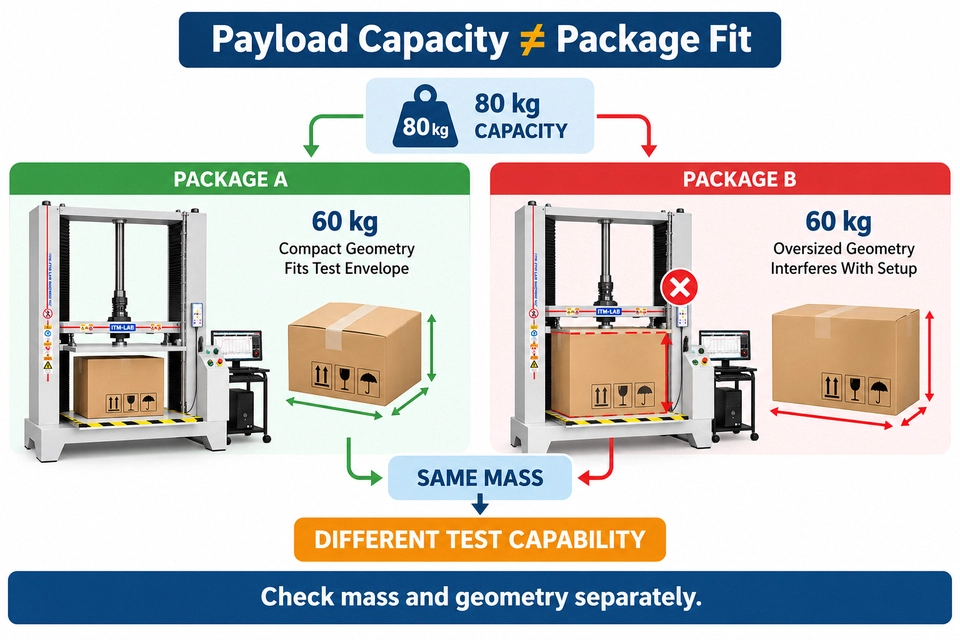
An appliance package may see vertical stacking load in a warehouse, lateral pressure from clamp handling, random vibration in a truck, horizontal impact during logistics and a free-fall event during manual handling.
Those events need different machines because they impose different mechanical inputs.
This type of product combination is most relevant when the laboratory needs to reproduce several stages of complete-package distribution, rather than characterize films, seals or barrier properties.
Which Type of Packaging Testing Equipment Manufacturer Do You Need?
This is a more useful first filter than comparing ten catalogs line by line.
| Your Main Requirement | Manufacturer Type to Investigate |
|---|---|
| Flexible film, seal, friction, barrier | Packaging material testing specialist |
| Corrugated board QC | Paper / corrugated testing supplier |
| Carton compression and routine drop | Finished-package QC equipment supplier |
| Complete shipping-package validation | Complete-package testing manufacturer |
| Truck / rail random vibration | Dynamic / vibration system manufacturer |
| Pallet and unit-load behavior | Distribution simulation specialist |
| Appliance package: drop + clamp + vibration + impact | Multi-system complete-package supplier |
A company can fit more than one category.
The point is to narrow the search based on the laboratory problem before comparing specifications.
Packaging Testing Is a Chain of Mechanical Events
The machine itself is only the middle of the story.
A stronger test definition follows four steps:
Distribution Hazard → Test Input → DUT Response → Measurement
| Hazard | Test Input | Typical DUT Response | What You May Measure |
|---|---|---|---|
| Stacking | Force / displacement / duration | Buckling, deformation, collapse | Peak force, displacement, pass/fail |
| Drop | Height + orientation | Impact damage, deformation, functional failure | Inspection, acceleration, pass/fail |
| Transport vibration | PSD + frequency + duration | Loosening, fatigue, abrasion, product movement | Control PSD, acceleration, inspection |
| Clamp handling | Lateral force / displacement | Sidewall deformation, product damage | Force, displacement, damage |
| Horizontal impact | Velocity / orientation | Shock response, package deformation | Acceleration, velocity, inspection |
This is the point where an equipment RFQ becomes much easier to write.
Instead of:
Need packaging test equipment.
you can say:
We need to reproduce a defined handling event and measure a defined response.
That is an engineering specification.
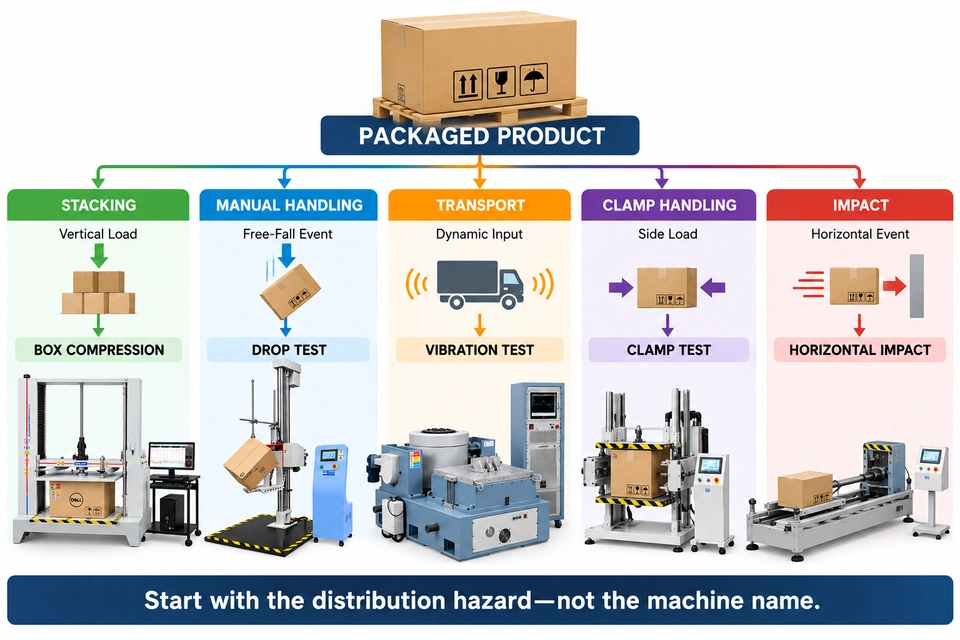
Payload Capacity ≠ Package Fit
Suppose a drop tester is rated for 80 kg.
Your package weighs 62 kg.
At first glance, the machine fits the requirement.
Not necessarily.
You still need to know:
package width;
depth;
height;
center of gravity;
required drop orientation;
release clearance;
drop height;
impact-base dimensions.
A compact 62 kg carton and a tall appliance carton weighing exactly the same can require very different test spaces.
The same logic applies to compression and vibration.
A vibration table may have enough payload capacity but insufficient mounting area.
A compression tester may have enough force but insufficient platen dimensions or vertical opening.
Mass answers one question. Geometry answers another.
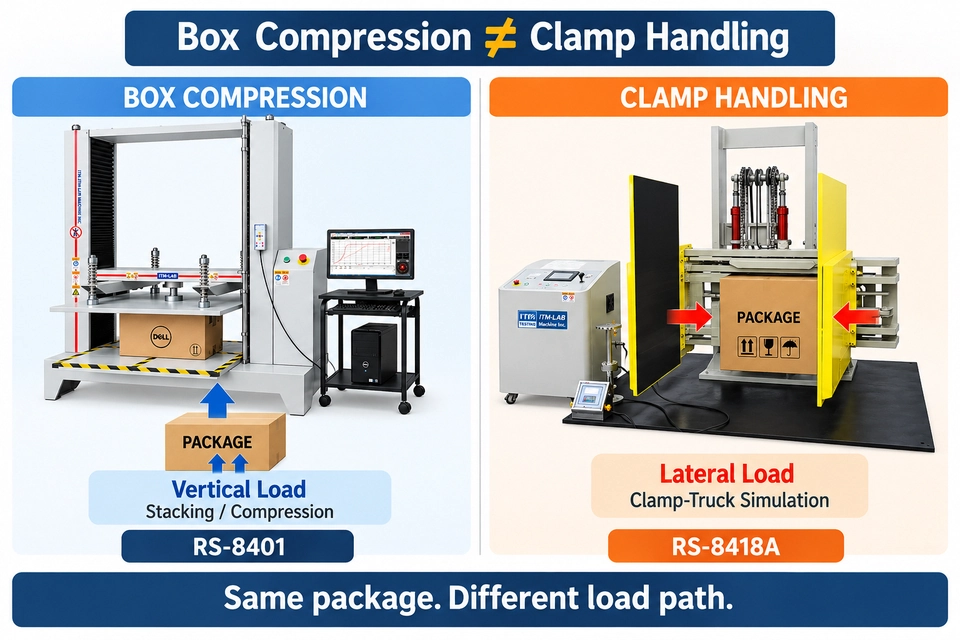
Box Compression ≠ Clamp Handling
Both tests compress the package.
The similarity ends there.
A box compression test typically applies vertical loading to investigate compressive resistance, deformation or stacking performance. ISO 12048 and ASTM D642 are among the methods commonly associated with complete-package compression testing. Labthink
Conceptually:
↓
PACKAGE
↑
Clamp handling changes the load path:
→ PACKAGE ←
Now the force enters through the package sides.
That can matter for appliances and other large packaged products handled with clamp equipment.
A carton that performs well under vertical compression may still deform excessively when loaded laterally.
So:
Compression capacity ≠ clamp-handling performance.
The package is the same.
The mechanical event is not.
Drop ≠ Horizontal Impact
A similar distinction applies to impact.
In a free-fall test:
PACKAGE
↓
↓
↓
IMPACT SURFACE
Gravity creates the incoming velocity.
In a horizontal impact test:
PACKAGE → → → IMPACT SURFACE
The package approaches the impact boundary horizontally.
Both events can damage the same product. They do not reproduce the same mechanical condition.
This is why an RFQ containing only:
Impact test required.
is incomplete.
The first clarification should be:
Free-fall impact or horizontal impact?
Increasing the drop height is not automatically a substitute for a specified horizontal impact event.
Vibration: Don't Buy the Frequency Range
Consider two quotations:
System A — 5 to 200 Hz
System B — 3 to 300 Hz
If those are the only numbers you compare, System B looks more capable.
That conclusion may be wrong.
For controlled random vibration, the test can also depend on:
PSD;
Grms;
duration;
package mass;
fixture and restraint mass;
table size;
force;
velocity;
displacement.
The more useful question is:
Can this system reproduce our specified profile with our actual moving mass?
A simple mechanical vibration table and an electrodynamic shaker may both appear under “packaging vibration equipment” in a supplier catalog.
They are not interchangeable.
One Package, Five Distribution Hazards
Consider a packaged home appliance:
720 × 620 × 950 mm
32 kg filled mass
Its route is:
Factory → Warehouse → Truck → Distribution Center → Customer
Clamp trucks are used during warehouse handling.
Now map the journey.
Warehouse
Packages are stacked.
Hazard: Vertical load
Test: Compression
System: RS-8401
Clamp Handling
The carton is lifted through its side faces.
Hazard: Lateral compression
Test: Clamp simulation
System: RS-8418A
Truck
The package experiences a broadband dynamic environment.
Hazard: Transport vibration
Test: Random vibration
System: RS-V
Logistics Handling
A horizontal collision event is part of the required simulation.
Hazard: Horizontal impact
Test: Impact simulation
System: RS-150
Manual Handling
Face, edge or corner drops are required.
Hazard: Free fall
Test: Package drop
System: RS-315 / RS-320
The original purchasing request might have been:
We need a packaging testing machine.
After mapping the distribution route, the requirement is no longer one machine.
It is a test system built around five different hazards.
Two 80 kg Drop Testers Can Be Very Different Machines
Headline specifications hide a lot.
Consider:
| Specification | System A | System B |
|---|---|---|
| Maximum payload | 80 kg | 80 kg |
| Maximum drop height | 1,500 mm | 1,500 mm |
| Usable DUT envelope | Smaller | Larger |
| Face drop | Yes | Yes |
| Edge setup | Limited | Supported |
| Corner setup | Limited | Supported |
| Release arrangement | Basic | Controlled |
| Impact base | Smaller | Larger |
| Height positioning | Manual | Powered |
A purchasing spreadsheet that compares only:
80 kg / 1,500 mm
will make these machines look almost identical.
The test engineer sees something else.
Can the package physically fit?
Can the required orientation be set up?
Will the release mechanism interfere with the DUT?
Is the impact area large enough?
Can the event be repeated consistently?
Headline capacity is not usable test capability.
How to Compare Packaging Testing Equipment Suppliers
Once manufacturers have been shortlisted, normalize the quotations around the test—not around each supplier's brochure terminology.
| Quotation Says | Ask Next |
|---|---|
| 80 kg drop tester | What maximum W × D × H can actually be tested? |
| 1,500 mm drop | At what maximum DUT size and mass? |
| 50 kN compression | What platen size and usable vertical opening? |
| Vibration to 200 Hz | What loaded PSD / Grms profile can it reproduce? |
| Clamp tester | What force range, platen size and motion are available? |
| Horizontal impact | What DUT mass, size and impact condition are supported? |
| ASTM compliant | Which exact method and revision? |
| ISTA capable | Which procedure and sequence? |
| Software included | What is recorded, calculated and exported? |
| Calibration included | Which channels are calibrated? |
| Installation included | Commissioning only, or operator training as well? |
This is the point at which price comparison becomes meaningful.
Before normalization, two quotations may simply be quoting two different machines.
Standards Are the Starting Point, Not the Entire Specification
Packaging laboratories commonly work with methods from organizations such as:
ISTA, ASTM, ISO, IEC and TAPPI.
But a standard number rarely gives the supplier everything needed to configure the equipment.
Take box compression.
Labthink's current documentation associates its compression systems with ISO 12048, ASTM D642, ASTM D4169 and other methods. Labthink
An RFQ that says:
ASTM D642 required
still leaves practical questions:
What are the package dimensions?
What is the expected force?
How large must the platens be?
How much deformation is expected?
What result must be recorded?
The same applies to an ISTA requirement.
A procedure may include several test events. Those events may require several machines.
The useful sequence is:
STANDARD / CUSTOMER REQUIREMENT
↓
PROCEDURE
↓
TEST EVENT
↓
SEVERITY
↓
PACKAGE
↓
EQUIPMENT CONFIGURATION
The standard defines the method.
It does not replace the DUT specification.
What to Put in a Packaging Test Equipment RFQ
A good RFQ can fit on one page.
Start with the package:
Product type
W × D × H
Filled mass
Package construction
Quantity per test
Then describe the distribution route.
For example:
Factory → truck → regional warehouse → clamp-truck handling → customer.
Next, provide the applicable standard or customer procedure and identify the required test events.
Depending on the test, severity may include:
drop height and orientation;
compression force;
clamp force;
impact velocity;
PSD;
Grms;
frequency;
duration.
Finally, state what must be measured.
That could be:
force;
displacement;
acceleration;
PSD;
peak result;
curve;
pass/fail;
report export.
For large systems, also provide installation country, available power, floor space and other facility constraints.
Weak RFQ vs Useful RFQ
Weak RFQ
Please quote a packaging test machine for a 32 kg carton.
The supplier has to guess almost everything.
Useful RFQ
Product: Packaged home appliance
Package: 720 × 620 × 950 mm
Filled mass: 32 kg
Distribution: Truck + warehouse + clamp-truck handling
Tests: Drop, compression, random vibration and clamp handling
Drop: Face / edge / corner as required by procedure
Vibration: PSD attached
Data: Force / displacement / acceleration as applicable
Installation: USA
Request: Recommend the required systems and identify any missing test information before final quotation.
The second request gives an applications engineer something useful to work with.
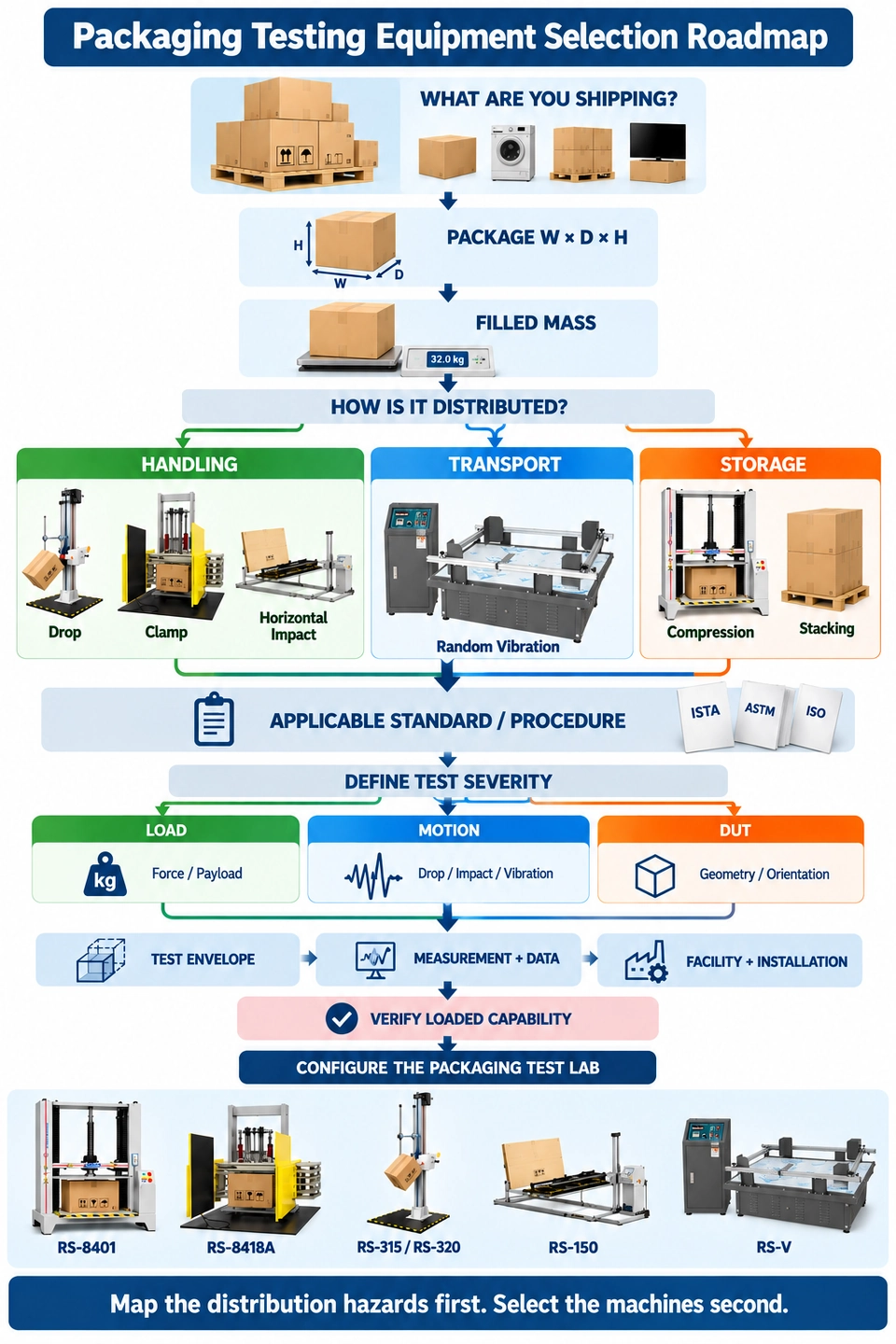
Packaging Testing Equipment Selection Roadmap
Where ITM-LAB Fits
ITM-LAB's packaging equipment is most relevant when the requirement involves the complete packaged product and its mechanical distribution environment.
A practical selection map is:
| Test Requirement | ITM-LAB System |
|---|---|
| Free-fall package drop | RS-315 / RS-320 |
| Box compression / stacking | RS-8401 |
| Clamp handling | RS-8418A |
| Horizontal impact | RS-150 |
| Controlled random vibration | RS-V Series |
For the RS-315PW / RS-320PW packaging drop systems, current published specifications include 300–2000 mm drop height, up to 80 kg test load, face/edge/corner testing and ≤±1 mm height error. ITM Lab
But even here, model selection should not start with the model.
For a drop tester, start with package dimensions, filled mass, drop height and orientations.
For compression, define package dimensions, expected force, platen requirement and deformation.
For clamp handling, define the contact faces and lateral loading requirement.
For horizontal impact, define package mass, geometry and impact condition.
For controlled vibration, define PSD, frequency range, Grms, duration, moving mass and table requirement.
If the RFQ starts with a model number, it may already be starting in the wrong place.
Five Questions to Ask Before Choosing a Packaging Testing Equipment Manufacturer
1. Are we testing the packaging material or the complete packaged product?
That single distinction can eliminate half of an unsuitable supplier list.
2. Which real distribution hazards must the laboratory reproduce?
Drop, stacking, vibration, clamp handling and horizontal impact are different events.
3. What is the largest DUT—not just the heaviest?
Always define both mass and geometry.
4. What result must the machine produce?
Pass/fail, force-displacement curve, PSD control, acceleration data and visual inspection are different measurement requirements.
5. Can the supplier demonstrate capability under the loaded condition?
This matters particularly for vibration and other dynamic systems.
A maximum specification measured without your package installed may not describe the test you actually need.
FAQ
Who manufactures packaging testing equipment?
The market includes distribution-simulation specialists, packaging-material testing companies, dynamic-test manufacturers and broader testing-equipment suppliers. Companies in this comparison include Lansmont, Safe Load Testing Technologies, Labthink, Thwing-Albert, AMETEK/Lloyd Instruments, Presto, Pacorr, Haida, IMV and ITM-LAB. Their test coverage differs substantially, so the relevant shortlist depends on the laboratory requirement.
How do I choose a packaging testing equipment manufacturer?
Define the package, distribution route, applicable procedure, required test events, severity and measurement requirements first. Then compare manufacturers against those requirements. Catalog breadth alone is not a useful selection criterion.
What equipment is needed for package testing?
A complete-package distribution laboratory may require drop, compression, vibration, clamp and horizontal-impact systems. A packaging-material laboratory may instead require tensile, peel, friction, puncture, seal-integrity, barrier or burst testing.
What is the difference between packaging material testing and transport packaging testing?
Packaging material testing measures properties of films, paper, corrugated board, seals and other packaging components. Transport packaging testing evaluates how the complete packaged product responds to hazards encountered during storage, handling and transportation.
Can one machine perform every packaging test?
Generally not for complete-package distribution simulation. Drop, compression, vibration, clamp and horizontal impact impose different mechanical inputs. A universal testing machine can cover several force-based material or component tests with different fixtures, but it does not replace dedicated distribution-simulation equipment.
Start With the Package Journey
The search for the best packaging testing equipment manufacturer should not begin with a brand list.
Begin with the package.
Where is it stacked?
How is it moved?
Does a clamp truck touch it?
What happens during road transport?
Which impact events are realistic?
What does the applicable procedure require?
Once those questions are answered, the equipment list becomes much easier to defend.
For a complete-package project, a useful first submission to a supplier is:
Package W × D × H / Filled Mass / Product Type / Distribution Route / Standard + Procedure / Required Tests / Test Severity / Measurement Requirements / Installation Country
Include the PSD when vibration is defined.
Include a drawing for large or unusual packages.
Identify the clamp-contact faces when lateral handling is part of the route.
And if the required machines are not yet clear, send the distribution sequence first.
Map the distribution hazards first. Select the machines second.
