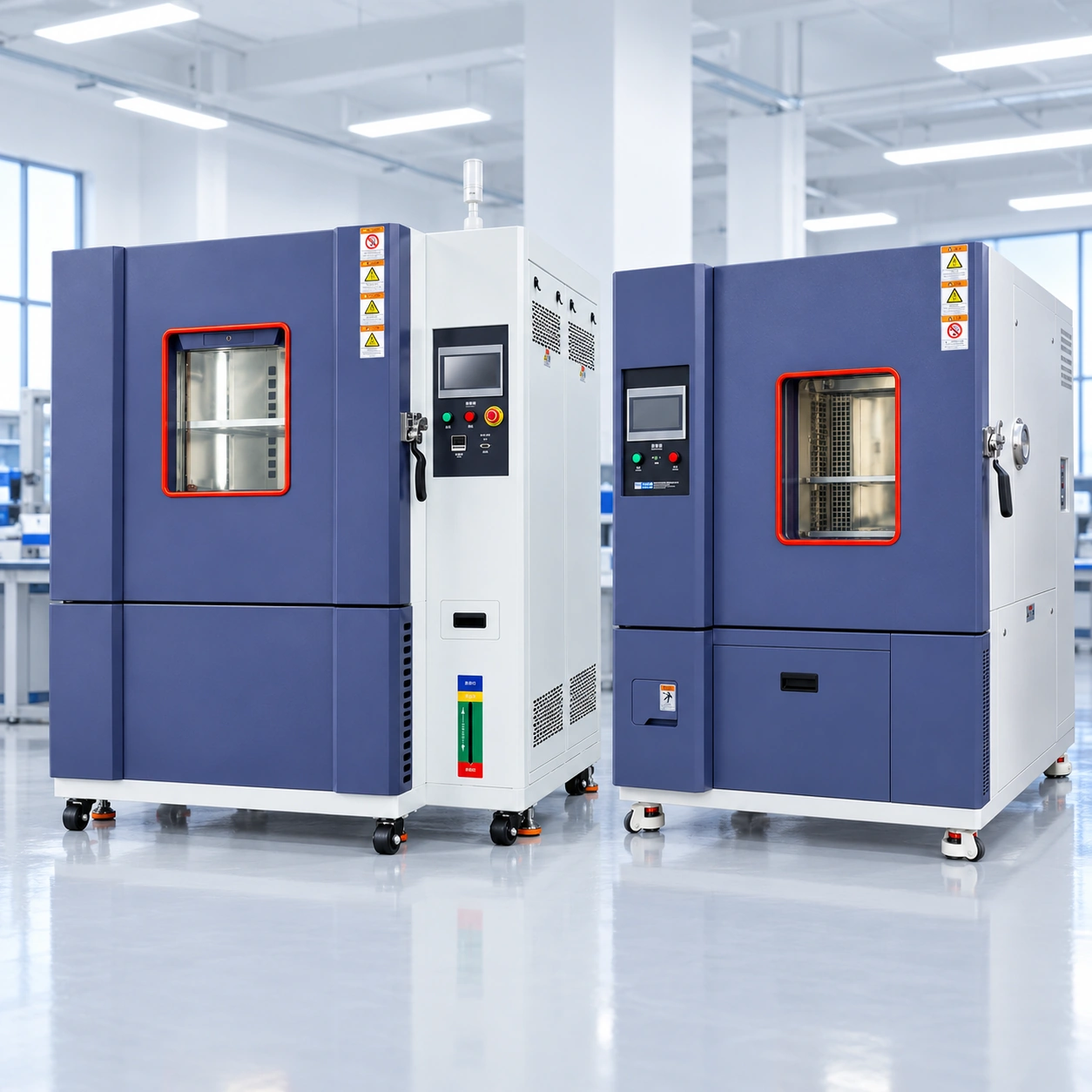
Two environmental test chambers can offer the same temperature range and still be intended for different tests.
If your procedure specifies only high-temperature exposure, low-temperature exposure, or temperature cycling, a temperature chamber may be sufficient. If it also requires controlled relative humidity, you need to evaluate a temperature humidity chamber.
The distinction matters when comparing equipment quotations. A wider list of functions does not necessarily mean a better fit for your application. The correct choice depends on the environmental conditions your product must experience.
This guide explains the differences using the ITM-LAB GDW and GDJS series, with practical examples for testing engineers and equipment buyers.
Temperature Chamber vs Temperature Humidity Chamber: The Short Answer
The main difference is what each chamber is designed to control.
A temperature chamber controls the thermal environment around the device under test (DUT). It is suitable for procedures that specify temperature conditions without requiring active relative humidity control.
A temperature humidity chamber controls both temperature and relative humidity within its specified operating envelope. It is used when moisture exposure is a defined part of the test.
| Test Requirement | Suitable Starting Point |
|---|---|
| High-temperature exposure | Temperature chamber |
| Low-temperature exposure | Temperature chamber |
| Temperature cycling without controlled RH | Temperature chamber |
| Constant temperature and humidity | Temperature humidity chamber |
| Steady-state damp heat | Temperature humidity chamber |
| Cyclic damp heat with specified RH | Temperature humidity chamber |
A temperature humidity chamber may also be used for temperature-only testing, provided the selected configuration meets the applicable requirements.
The choice should begin with the test procedure, not the number of functions listed in a product brochure.
Define the test first. Select the chamber second.
Start with the Test Requirement, Not the Chamber Specification
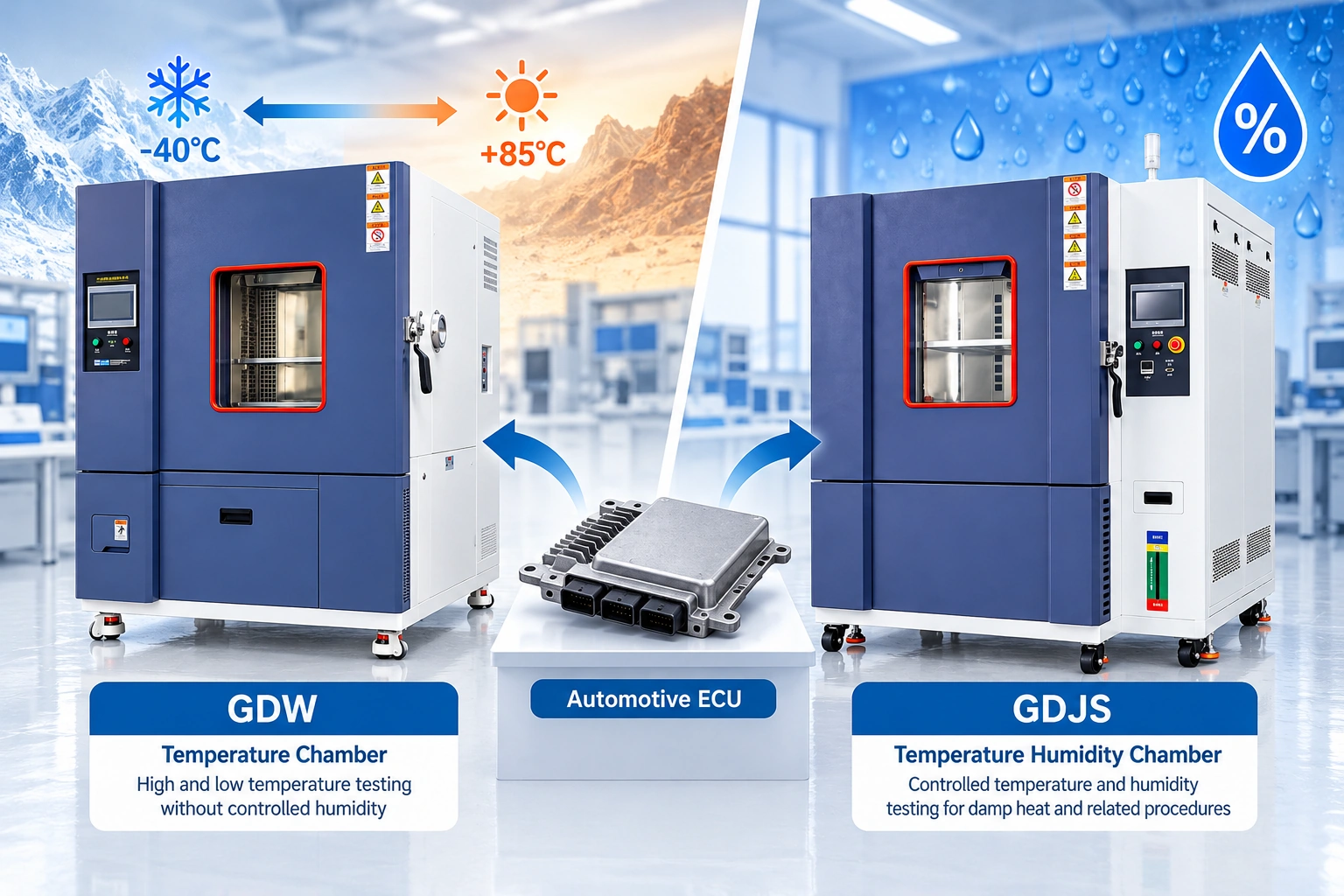
Consider an automotive electronic control unit (ECU) that must undergo environmental reliability testing.
The initial requirement states:
-
Minimum temperature: -40°C
-
Maximum temperature: +85°C
-
Test specimen: Automotive ECU
Both a temperature chamber and a temperature humidity chamber may be capable of covering this temperature range.
But the temperature range alone does not establish which type of chamber is necessary.
Now consider two different test procedures for the same ECU.
Test A: High and Low Temperature Exposure
The procedure requires the ECU to remain at specified high and low temperatures for defined periods. No controlled relative humidity condition is specified.
A temperature-only chamber is a suitable starting point for equipment selection.
Test B: Damp Heat Exposure
The procedure requires the ECU to undergo exposure at a defined temperature and relative humidity for a specified duration.
This test requires a chamber capable of controlling both environmental parameters.
The product has not changed. The test requirement has.
That is why chamber selection should not be based solely on whether the DUT belongs to the automotive, electronics, aerospace, or materials industry.
What Does Each Chamber Actually Control?
Temperature Chamber: Controlled Thermal Exposure
A temperature chamber exposes a specimen to defined thermal conditions.
Typical applications include:
-
Cold testing
-
Dry heat testing
-
High and low temperature exposure
-
Temperature cycling
-
Thermal reliability evaluation of components and materials
For example, a manufacturer may need to assess whether an electronic assembly functions after low-temperature exposure or whether a polymer component maintains acceptable properties after elevated-temperature conditioning.
If the applicable procedure does not require active humidity control, a temperature chamber may meet the environmental requirement.
Temperature Humidity Chamber: Controlled Temperature and Moisture Exposure
A temperature humidity chamber adds the ability to control relative humidity within its permitted operating conditions.
Typical applications include:
-
Constant temperature and humidity testing
-
Steady-state damp heat
-
Cyclic damp heat
-
Moisture-related reliability evaluation
-
Environmental testing of electronic assemblies and materials
Moisture exposure can influence insulation resistance, corrosion-related degradation, and material properties, depending on the DUT and test conditions.
When relative humidity is a specified test parameter, the chamber must be capable of controlling it at the required temperature.
This is the practical difference between the two equipment categories.
ITM-LAB GDW vs GDJS: Side-by-Side Comparison
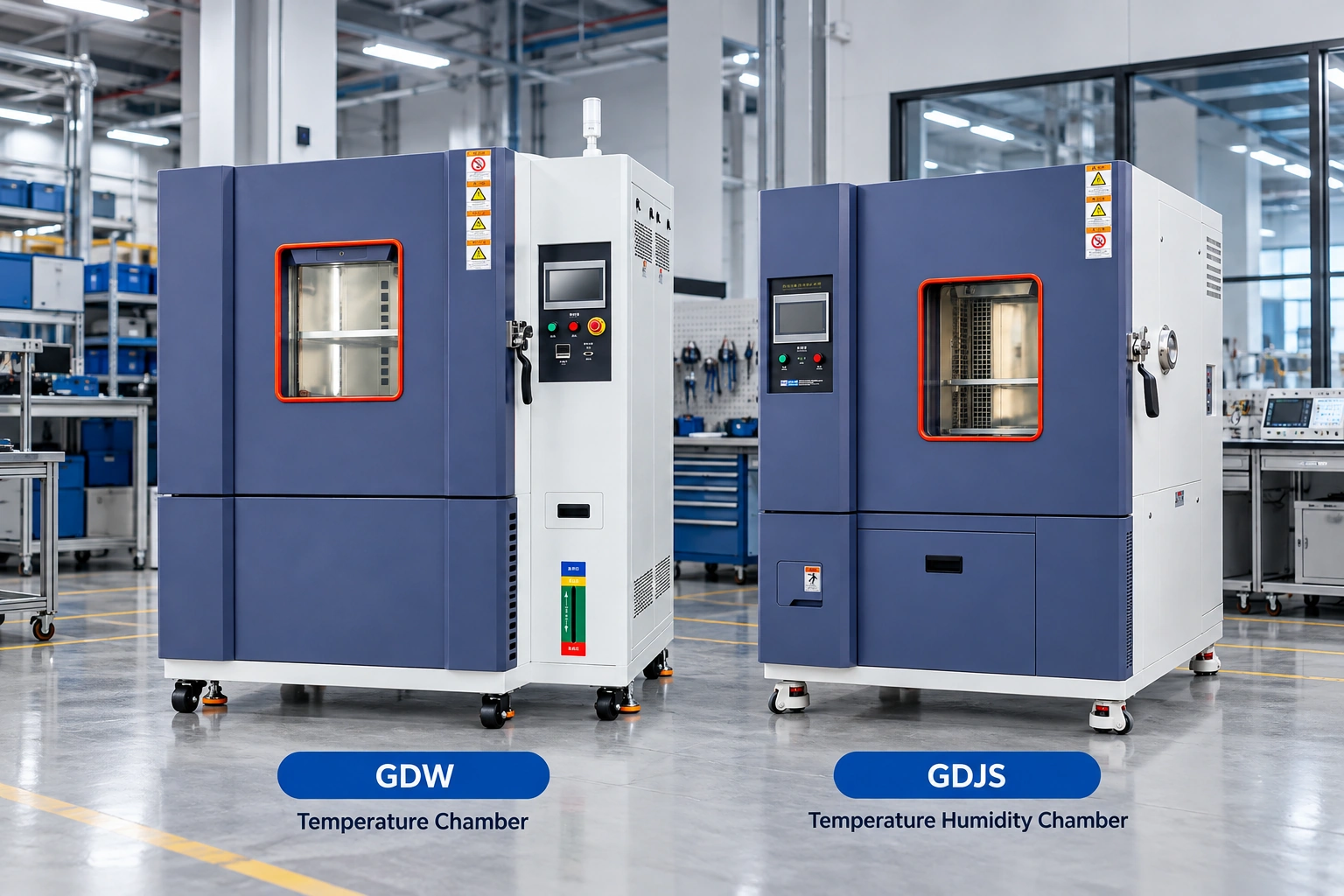
ITM-LAB offers separate chamber series for temperature-only and temperature-humidity applications.
The GDW series is designed for high and low temperature testing. The GDJS series adds controlled humidity capability for applications requiring both environmental parameters.
| Comparison | GDW Temperature Chamber | GDJS Temperature Humidity Chamber |
|---|---|---|
| Primary function | Temperature control | Temperature and humidity control |
| Temperature configurations | -40°C / -70°C to +150°C | -40°C to +150°C; -70°C optional |
| Chamber volume | 100–1000 L | 100–1000 L |
| Active humidity control | No | Yes |
| Published humidity range | Not applicable | 20–98% RH |
| High and low temperature testing | Yes | Yes |
| Temperature cycling | Yes | Yes |
| Controlled damp heat | Not its intended function | Yes, within operating conditions |
| Main selection factor | Temperature test profile | Temperature and humidity test profile |
The figures above describe available series configurations. Actual performance depends on the selected model and test conditions. The GDJS humidity range applies only within its specified temperature-humidity operating envelope.
GDW Series: High and Low Temperature Test Chamber
The ITM-LAB GDW series is intended for testing programs requiring controlled high-temperature, low-temperature, or temperature cycling conditions without active humidity control.
It is a practical starting point when the test procedure specifies thermal exposure but does not require a defined relative humidity setpoint.
GDJS Series: Temperature Humidity Test Chamber
The ITM-LAB GDJS series is designed for applications requiring both temperature and relative humidity control.
It can be evaluated for constant temperature and humidity testing, damp heat exposure, and applicable temperature-humidity cycling procedures.
The required temperature and RH combinations must be checked against the selected configuration's operating capability.
Which Tests Actually Require Controlled Humidity?
One useful way to select a chamber is to examine the applicable test method before comparing equipment specifications.
Different environmental test methods introduce different stresses.
| Test Standard | Primary Environmental Requirement | Suitable Starting Point |
|---|---|---|
| IEC 60068-2-1 | Cold testing | GDW |
| IEC 60068-2-2 | Dry heat testing | GDW |
| IEC 60068-2-78 | Steady-state damp heat | GDJS |
| IEC 60068-2-30 | Cyclic damp heat | GDJS |
These are equipment selection starting points, not automatic claims of full standard compliance.
A temperature humidity chamber may also be used for temperature-only tests, provided the selected configuration meets the applicable test requirements.
The relevant standard edition, test severity, tolerances, specimen condition, and complete procedure must be confirmed for each application.
For example, a qualification program may require both dry heat and damp heat testing.
In that case, the buyer should determine whether one configured chamber can satisfy the complete set of requirements or whether separate equipment is more appropriate.
The objective is to match the equipment to the procedure, rather than choose a chamber simply because it offers more control functions.
Why the Humidity Operating Envelope Matters
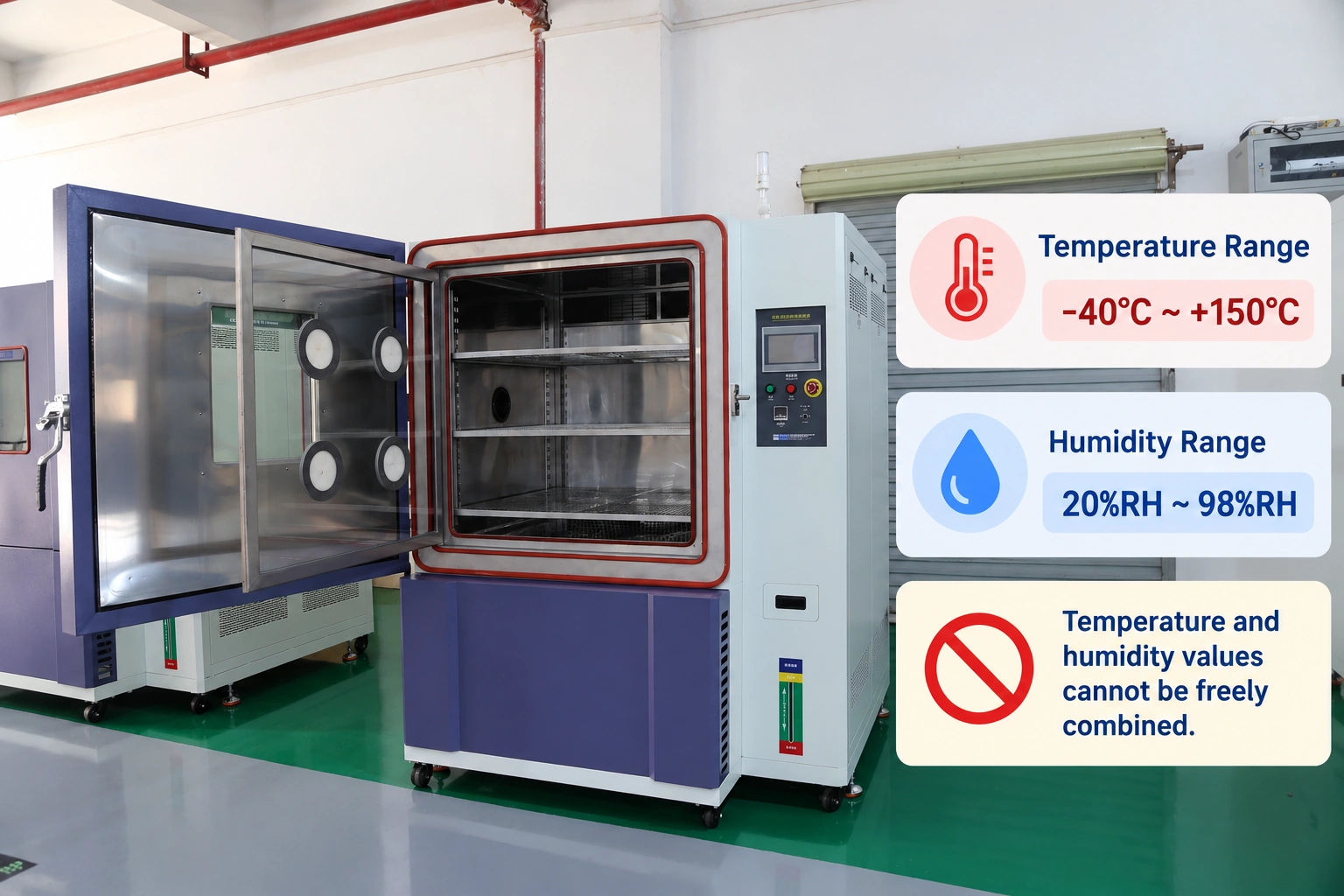
One of the most common specification misunderstandings occurs when buyers treat the published temperature range and humidity range as two independent capabilities.
Consider a temperature humidity chamber with the following specifications:
-
Temperature range: -40°C to +150°C
-
Humidity range: 20–98% RH
These figures do not mean the chamber can maintain every relative humidity value at every temperature within the published range.
Relative humidity depends on temperature. The chamber's humidity-control capability also depends on its design and operating conditions.
The usable combinations are therefore defined by a temperature-humidity operating envelope.
What Should Buyers Confirm?
If your procedure requires multiple temperature and humidity setpoints, provide the complete combinations to the supplier.
Instead of submitting only:
Temperature: -40°C to +100°C
Humidity: 20–98% RH
Specify the actual required test points and holding periods.
For example:
-
Temperature and RH setpoint for each test stage
-
Required holding time
-
Sequence of temperature and humidity changes
-
Applicable tolerances
-
Whether the DUT operates during the test
The supplier can then verify whether the selected configuration supports the required conditions.
This is particularly important when a test program includes both temperature-only and controlled-humidity stages.
Can a Temperature Chamber Perform Humidity Testing?
A temperature-only chamber may experience changes in relative humidity as its internal temperature changes. Condensation may also occur under certain conditions.
However, these effects are not equivalent to controlled humidity testing.
If a procedure specifies a relative humidity setpoint, tolerance, and exposure duration, the equipment must be capable of actively controlling and verifying that condition.
A temperature chamber without humidity-control capability should not be treated as a substitute for a temperature humidity chamber simply because moisture may be present inside it.
The distinction is between humidity occurring during a test and humidity being a controlled test parameter.
Can a Temperature Humidity Chamber Replace a Temperature Chamber?
In some applications, yes.
A temperature humidity chamber can be considered for temperature-only testing if its selected configuration meets the required temperature performance.
However, the additional humidity function does not automatically guarantee:
-
Faster temperature changes
-
Greater refrigeration capacity
-
Higher allowable DUT heat load
-
Better loaded temperature performance
-
Suitability for every thermal test procedure
These requirements must be evaluated independently.
For example, a project requiring a demanding temperature change rate may need a different chamber configuration from one intended primarily for steady-state temperature and humidity exposure.
Likewise, a powered DUT may introduce additional heat into the workspace during testing. That heat load can affect the chamber configuration, particularly at lower temperatures.
For a more detailed explanation, see our guide:
How to Calculate DUT Heat Load for an Environmental Test Chamber
The correct equipment choice depends on the complete test profile, not simply the number of environmental parameters available on the controller.
Five Details to Confirm Before Ordering
Once you have identified the appropriate chamber type, the next step is to define the actual operating requirements.
1. Required Temperature and Humidity Conditions
Provide the minimum and maximum test temperatures.
For humidity testing, specify the actual temperature-RH combinations rather than two independent ranges.
2. DUT Dimensions, Mass, and Quantity
The chamber must accommodate the DUT, fixtures, and required test arrangement.
Nominal chamber volume alone does not establish whether the usable workspace is suitable.
3. Powered or Unpowered DUT
Indicate whether the DUT operates during the test.
If powered, provide its estimated or measured heat dissipation and operating schedule where available.
4. Required Temperature Change Rate
State the required rate, relevant temperature interval, and whether the performance must be achieved with the DUT installed.
A chamber's nominal temperature range does not establish its loaded ramp capability.
5. Applicable Standard or Customer Procedure
Provide the standard designation, edition, and required test severity, or send the customer-defined test profile.
This helps the supplier evaluate the actual environmental conditions rather than recommend equipment from a general product description.
Temperature Chamber Selection Roadmap
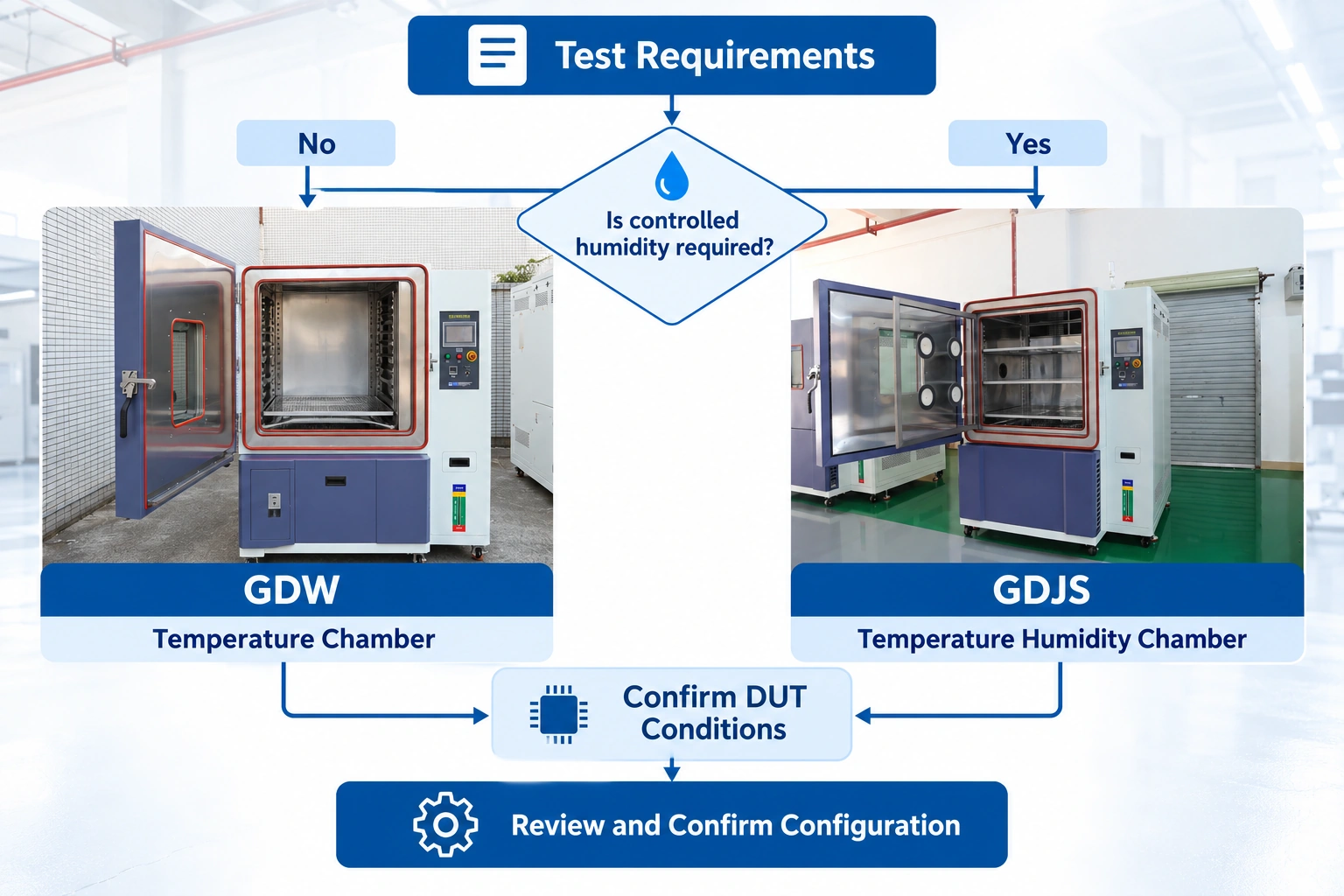
The selection process should begin with the test procedure.
Step 1 — Define the environmental conditions.
Identify the required temperature profile and determine whether relative humidity is a controlled parameter.
Step 2 — Is controlled humidity required?
If no, begin by evaluating a temperature chamber such as GDW.
If yes, evaluate a temperature humidity chamber such as GDJS.
Step 3 — Define the DUT and test arrangement.
Confirm specimen dimensions, mass, quantity, fixtures, and operating condition.
Step 4 — Check the complete test profile.
Review temperature and humidity setpoints, holding periods, temperature change requirements, and DUT heat dissipation.
Step 5 — Confirm the chamber configuration.
Ask the supplier to verify the selected model against the complete application requirements.
FAQ
What is the main difference between a temperature chamber and a temperature humidity chamber?
A temperature chamber controls temperature. A temperature humidity chamber controls both temperature and relative humidity within its specified operating conditions. The correct choice depends on whether the test procedure requires active humidity control.
Do I need a humidity chamber for temperature cycling?
Not necessarily. If the procedure specifies temperature changes without controlled humidity, a temperature chamber may be suitable. If the test also requires defined RH conditions, evaluate a temperature humidity chamber.
Can a temperature-only chamber be used for damp heat testing?
Not when the test requires controlled relative humidity. A temperature-only chamber does not provide the same humidity-control capability as a temperature humidity chamber.
Is a temperature humidity chamber always better?
No. More functions do not automatically mean better suitability. Temperature performance, humidity requirements, DUT conditions, and the complete test procedure should determine the equipment choice.
Does 20–98% RH mean humidity can be controlled at every temperature?
No. The published humidity range must be considered together with the chamber's temperature-humidity operating envelope. Confirm the actual required combinations with the supplier.
Can one chamber be used for both dry heat and damp heat tests?
Potentially, provided the selected configuration meets the requirements of both procedures. The complete test conditions and applicable standard editions should be reviewed before ordering.
GDW or GDJS? Get a Chamber Configuration for Your Test
A temperature chamber and a temperature humidity chamber may look similar from the outside, but they serve different environmental testing requirements.
If your procedure requires controlled thermal exposure without active humidity control, start by evaluating the ITM-LAB GDW series.
If the procedure specifies controlled relative humidity alongside temperature, evaluate the GDJS series and confirm the required operating conditions.
ITM-LAB provides configurable environmental testing equipment for different DUT sizes, test profiles, and application requirements.
Not Sure Whether You Need GDW or GDJS?
Send ITM-LAB your test standard, DUT dimensions, required temperature range, humidity conditions, and operating requirements.
Our team can help review your application and recommend a suitable environmental chamber configuration.
Request a Chamber Configuration & Quotation
Define the test first. Select the chamber second.