
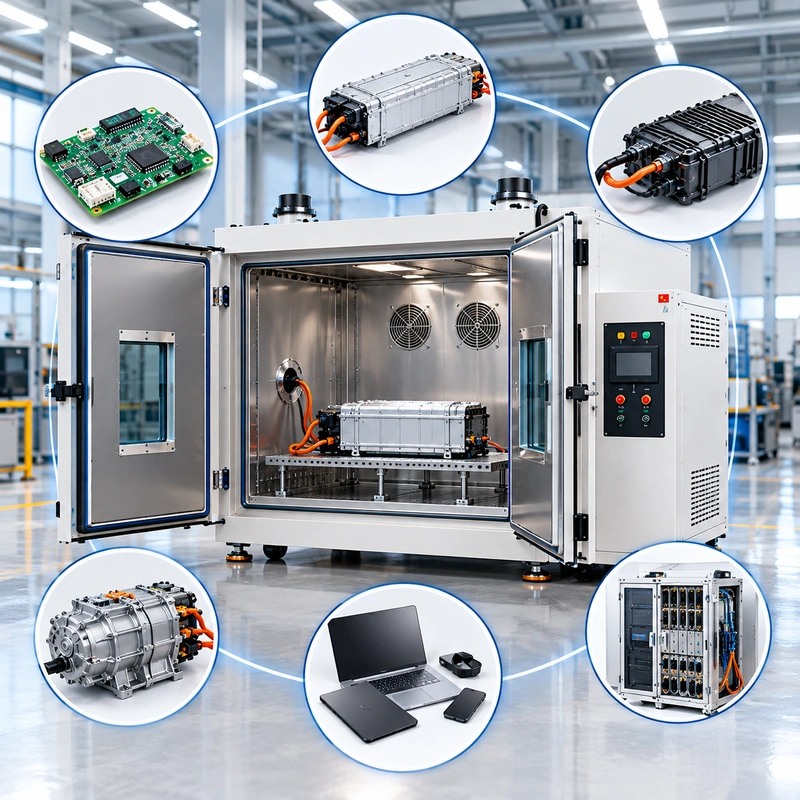
A buyer sends us a chamber requirement:
−40°C to +85°C
800 L workspace
Powered DUT
The specification looks nearly complete. Then one more question comes up:
How much heat will the DUT generate inside the chamber?
That answer can change the chamber configuration.
A 100 kg unpowered assembly and a 100 kg powered battery system may occupy the same space and have the same mass, but they do not create the same thermal demand. The powered DUT may continuously add hundreds—or even thousands—of watts of heat while the chamber is trying to control temperature.
For buyers, the goal is not to design the refrigeration system yourself. What matters is knowing which numbers to provide, what they mean, and when DUT heat generation may push the application beyond a standard chamber configuration.
This guide explains how to estimate DUT heat load, why temperature and operating mode matter, and what information to include when requesting an environmental test chamber.
What Is DUT Heat Load?
DUT stands for device under test.
In this article, DUT heat load means the heat generated inside the chamber by the DUT while it is operating. It is normally expressed in watts (W) or kilowatts (kW).
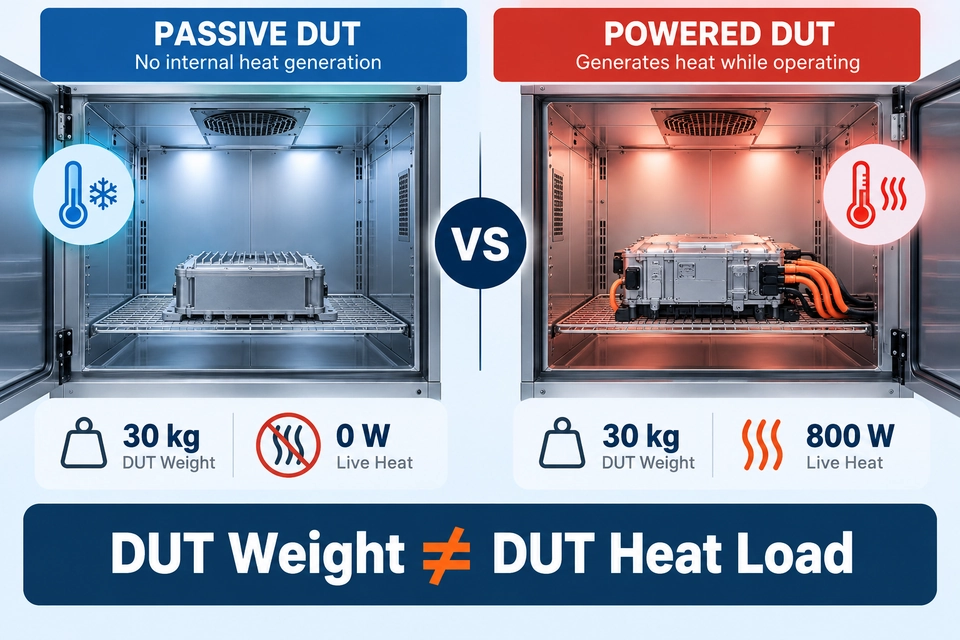
It is not the same as DUT weight.
| Parameter | Example | Why It Matters |
|---|---|---|
| DUT weight | 30 kg | Affects the thermal mass that must be heated or cooled |
| Fixture weight | 15 kg | Adds thermal mass |
| DUT heat load | 800 W | Adds heat that the refrigeration system must remove |
| DUT dimensions | 500 × 400 × 300 mm | Affects workspace and airflow |
| Quantity | 4 pcs | Changes total mass and potentially total heat load |
A useful way to separate the two is:
Weight tells us how much material must change temperature. Heat load tells us how much heat the chamber must continuously remove while the DUT is operating.
A passive 30 kg component may generate almost no continuous heat.
A powered 30 kg electronics assembly might generate 800 W.
Same mass. Very different chamber requirement.
A Note on Terminology
Chamber suppliers may also use terms such as static load, dead load, and live load.
A DUT, shelf or fixture that must change temperature but does not generate its own heat contributes thermal mass.
A powered DUT that releases heat inside the workspace creates an additional live thermal load.
For simplicity, this article uses DUT heat load when referring specifically to heat generated by an operating test specimen.
Why Does DUT Heat Load Matter?
Consider a chamber cooling toward −40°C while the DUT remains powered.
The refrigeration system has to deal with two different demands:
The chamber, DUT and fixture must be cooled.
At the same time:
The operating DUT is adding heat back into the test space.
That additional heat can change the refrigeration capacity required for the application.
This is why a chamber should not be selected from temperature range and workspace volume alone when powered devices are being tested.
How Do You Calculate DUT Heat Load?
For purchasing purposes, you normally do not need a complicated thermodynamic calculation.
Use the best information you actually have.
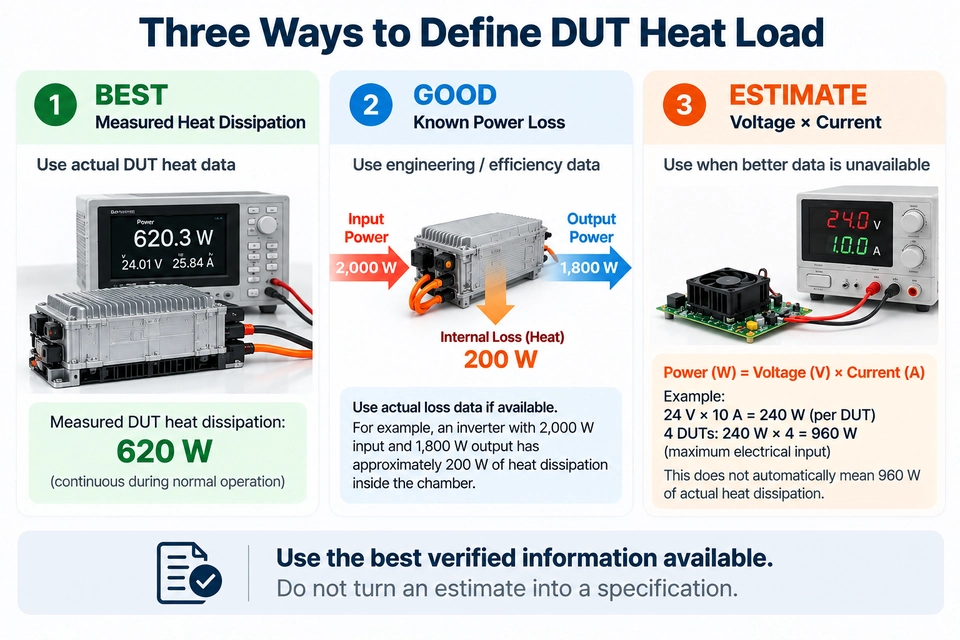
1. Best: Use Measured Heat Dissipation
If the DUT manufacturer or your engineering team already knows the actual heat dissipation under the required operating condition, use that value.
For example:
Measured DUT heat dissipation: 620 W
When possible, also state the operating condition:
DUT heat dissipation: 620 W continuous during normal operation.
This is more useful to the chamber supplier than estimating heat from a maximum electrical rating.
2. Good: Use Known Power-Loss Data
Electrical input and heat dissipation are not always the same.
Consider an inverter. It may receive substantial electrical power while delivering most of that energy to a load outside the chamber. In that case, the full electrical input should not automatically be treated as heat released inside the test space.
If engineering data is available for the actual losses, provide that information instead.
The practical question is not simply:
How much power enters the DUT?
It is:
How much heat is released inside the chamber?
3. Estimate: Use Voltage × Current
If actual heat-dissipation data is unavailable, electrical input can still provide a useful starting estimate.
For a simple DC-powered DUT:
Power (W) = Voltage (V) × Current (A)
For example, a 24 VDC device drawing 10 A has a maximum electrical input of:
24 × 10 = 240 W
If four identical DUTs operate simultaneously:
240 × 4 = 960 W maximum electrical input
This does not automatically mean 960 W of actual heat dissipation.
But it gives the chamber supplier useful information when better data is unavailable.
In the RFQ, identify it correctly:
Maximum electrical input: 960 W; actual heat dissipation not measured.
That is better than presenting an estimate as measured heat-load data.
When Should You Not Estimate Heat Load Yourself?
For a simple powered electronic component, electrical input may be enough to begin an application review.
More complex DUTs require additional information.
Typical examples include motors, inverters, power converters, battery charge/discharge systems and high-power electronics. The same applies when electrical or mechanical output leaves the chamber, or when DUT power changes significantly between operating modes.
In these cases, provide the available information about:
input power
operating mode
efficiency or loss data
where the output energy goes
normal and maximum operating conditions
The chamber supplier can then determine which value is relevant to the refrigeration calculation.
“My DUT Is 800 W.” What Else Do We Need to Know?
An RFQ sometimes says:
“The DUT is 800 W and we need −40°C.”
That is useful, but it is not yet a complete chamber requirement.
First, what does 800 W mean?
Is it nameplate power, maximum electrical input, normal operating power or measured heat dissipation?
Second, when is the DUT powered?
An 800 W DUT operating throughout the cooling cycle creates a different requirement from one that is switched on only after the chamber reaches its dwell temperature.
Third, is the 800 W continuous or peak?
If the DUT normally operates at 300 W but briefly reaches 800 W, provide both values and explain when the peak occurs.
Finally, what does −40°C mean in the test profile?
There is a substantial difference between:
Hold −40°C with the DUT powered
and
Cool from +85°C to −40°C at 5°C/min with the DUT powered.
This is why heat load should always be provided together with the actual test condition.
Why Temperature Matters to DUT Heat Load
One of the most important purchasing points is that heat-load capability should not be treated as one fixed wattage across every chamber temperature.
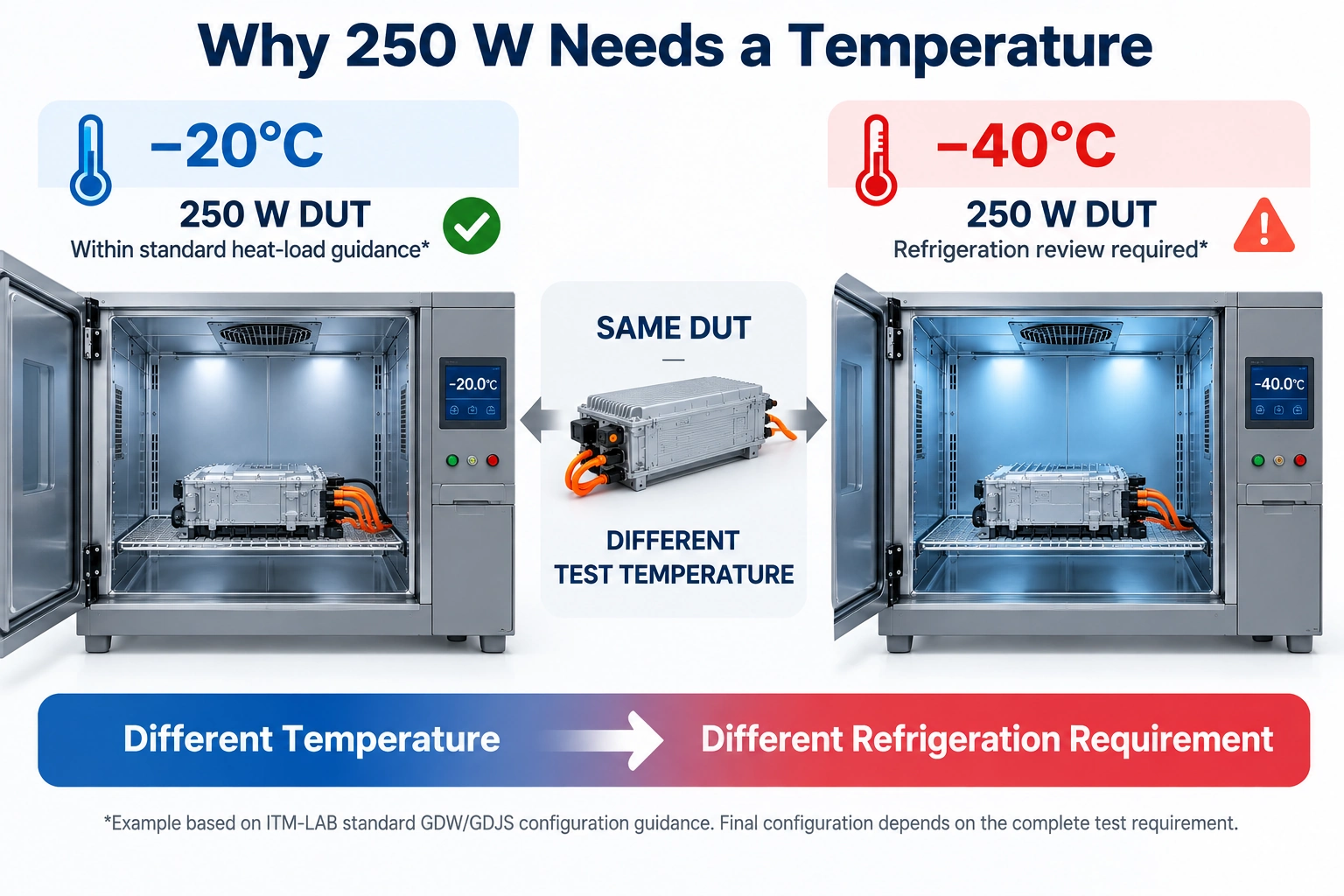
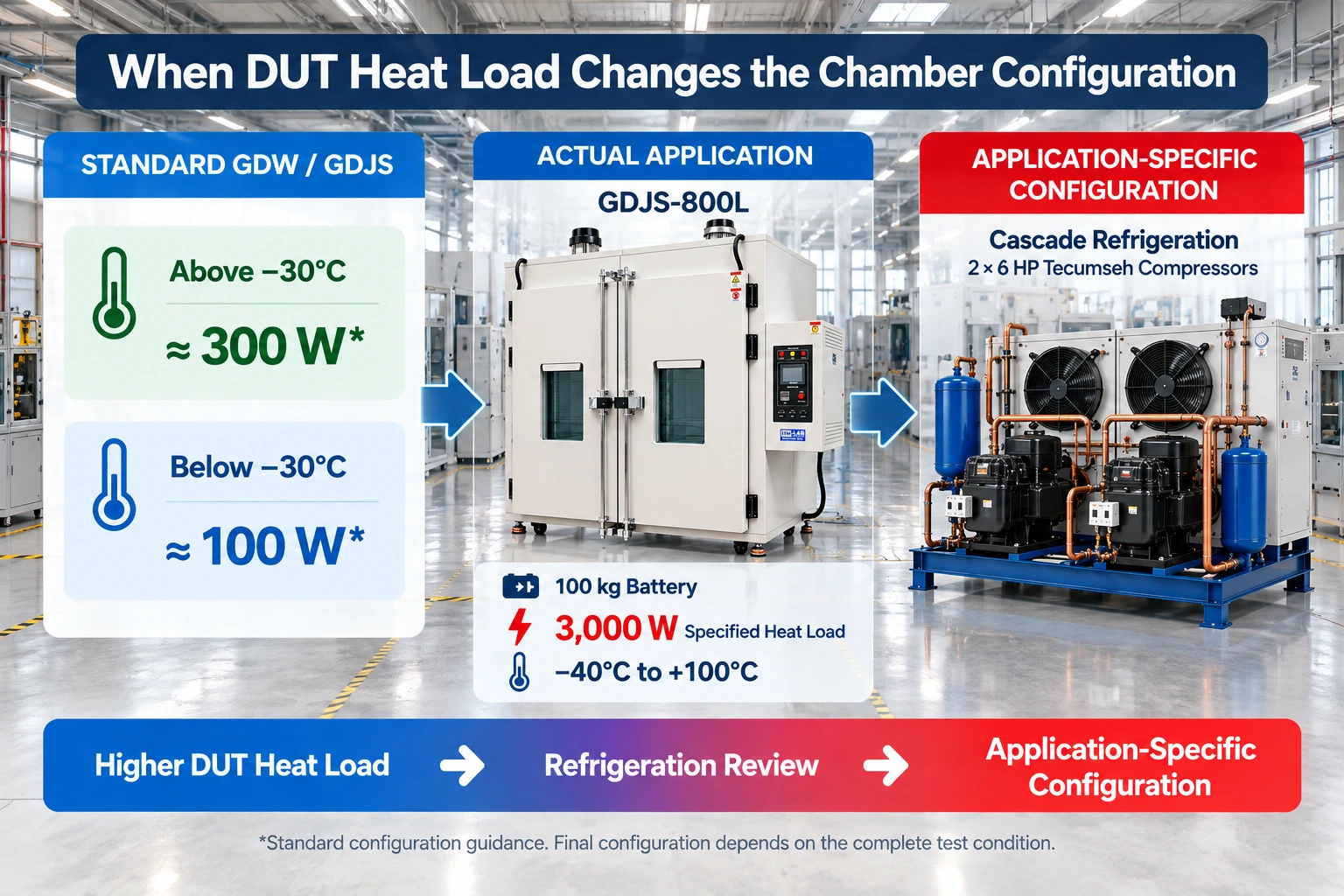
For standard ITM-LAB GDW high and low temperature chambers and GDJS temperature and humidity chambers, current configuration guidance is:
| Chamber Temperature | Standard DUT Heat-Load Guidance |
|---|---|
| Above −30°C | Approximately 300 W |
| Below −30°C | Approximately 100 W |
| Higher heat load | Refrigeration configuration should be reviewed before ordering |
These figures are standard configuration guidance, not universal performance limits for every chamber size and test profile. DUT mass, fixture mass, operating mode and temperature-change requirements still need to be considered.
The purchasing lesson is straightforward:
The same DUT can require a different refrigeration configuration at a different test temperature.
Consider a 250 W powered DUT.
At −20°C, 250 W falls within the standard guidance above.
At −40°C, the same 250 W exceeds the standard low-temperature guidance and should be identified before ordering so that the refrigeration configuration can be reviewed.
The DUT has not changed.
The required test condition has.
Higher Heat Load Does Not Simply Mean a Larger Chamber
Suppose two customers both need an 800 L workspace.
Customer A has a passive DUT.
Customer B has a powered DUT generating several kilowatts of heat.
The required workspace may be the same, but the refrigeration demand is not.
A higher DUT heat load may require increased refrigeration capacity or an application-specific refrigeration configuration.
So:
Chamber Volume ≠ Refrigeration Capacity
Choosing a larger chamber simply because the DUT generates more heat does not address the underlying requirement.
The workspace should be selected around the DUT dimensions, quantity and airflow needs.
The refrigeration system should be evaluated around the actual thermal requirement.
ITM-LAB Application Example: 3 kW Battery Heat Load
An ITM-LAB chamber configuration provides a useful example of why DUT heat load should be discussed before the chamber is ordered.
The application involved:
| Requirement | Actual Project |
|---|---|
| Chamber | GDJS-800L |
| DUT | Battery |
| DUT weight | 100 kg |
| Temperature range | −40°C to +100°C |
| Specified DUT heat load | 3,000 W |
| Refrigeration system | Cascade refrigeration |
| Compressor configuration | 2 × 6 HP Tecumseh compressors |
A standard refrigeration configuration was not used for this application.
The GDJS-800L was configured with a cascade refrigeration system using two 6 HP Tecumseh compressors to address the application requirements.
The important point is not compressor horsepower by itself. Look at the requirements that came first:
100 kg DUT
3,000 W specified heat load
temperature range down to −40°C
These conditions had to be considered when configuring the refrigeration system.
For a buyer, the lesson is simple:
The workspace tells us whether the DUT fits. The DUT heat load helps determine what refrigeration configuration the test requires.
Engineering Note: The project specified a 3 kW DUT heat load and a −40°C to +100°C chamber range. These values should not be interpreted as meaning the DUT continuously dissipated 3 kW at every temperature point unless that operating condition is separately defined by the test requirement.
DUT Weight and Fixture Weight Still Matter
Heat load does not replace DUT weight as a selection input.
They describe different thermal demands.
A passive 50 kg DUT may have essentially no continuous heat generation, but the chamber still has to change the temperature of 50 kg of material.
Add a 20 kg aluminum fixture and the chamber now has to change the temperature of:
50 kg DUT + 20 kg fixture
A powered DUT adds live heat on top of that thermal mass.
This becomes particularly important when the test specifies a temperature-change rate.
For this reason, provide both:
DUT and fixture mass
and
DUT heat generation.
Holding −40°C Is Not the Same as Cooling at 5°C/min
Consider an 800 W powered DUT.
Test A
Maintain −40°C
DUT powered
Test B
Cool from +85°C to −40°C
5°C/min required
DUT powered throughout the cooling ramp
These are not equivalent refrigeration requirements.
A specified ramp rate introduces another performance demand while the chamber is also dealing with the thermal mass of the DUT and fixture and the heat generated by the powered specimen.
This is why buyers should distinguish between:
temperature range
and
loaded temperature-change performance.
A chamber capable of reaching −40°C does not automatically meet every loaded cooling-rate requirement at −40°C.
Holding capability ≠ loaded ramp capability.
What If Humidity Is Required?
Heat-generating DUTs also require attention during temperature-humidity testing.
A powered DUT can create warmer local conditions around the specimen, affecting the local relationship between temperature and relative humidity and potentially influencing condensation behavior.
For a GDJS application, avoid providing only:
Temperature range: −40°C to +100°C
Humidity range: 20–98%RH
Instead, provide the actual required temperature-humidity test points, for example:
+40°C / 93%RH
along with the DUT heat load and powered operating state.
The chamber should be evaluated against the actual temperature-humidity condition, rather than by combining separate maximum values from a datasheet.
Four Typical Buying Scenarios
The following examples show how apparently similar DUTs can lead to different chamber requirements.
Scenario A — Passive DUT
30 kg mechanical component
0 W live heat
−40°C to +85°C
No specified rapid ramp
The main inputs are workspace, DUT/fixture mass and temperature range.
Scenario B — Powered DUT
30 kg electronics assembly
300 W heat load
−20°C to +85°C
Now DUT heat generation and operating condition must also be considered.
Scenario C — Same Powered DUT, Lower Temperature
30 kg electronics assembly
300 W heat load
−40°C to +85°C
The DUT has not become larger and the nominal heat load has not changed.
But the lower-temperature condition changes the refrigeration requirement. Under the standard GDW/GDJS guidance above, this application should be reviewed before ordering.
Scenario D — Powered DUT + Rapid Temperature Change
30 kg electronics assembly
800 W heat load
−40°C to +85°C
5°C/min required
Now the chamber must be evaluated for:
workspace + thermal mass + live heat + low-temperature condition + loaded ramp performance
At this point, the purchasing question is no longer:
“Which chamber reaches −40°C?”
It becomes:
Which chamber configuration can run my actual test with my actual load?
Which Environmental Chamber Should You Start With?
DUT heat load affects the configuration, but the test requirement still determines the chamber family.
| Test Requirement | Start With | What Still Needs to Be Confirmed |
|---|---|---|
| Temperature only | GDW | DUT, fixture, heat load, temperature |
| Temperature + humidity | GDJS | Heat load + actual T/RH conditions |
| Rapid temperature change | KTB | Loaded ramp requirement + DUT load |
| Thermal shock | CTS | Transfer, dwell and recovery requirements |
You can review the complete ITM-LAB Environmental Test Chamber range.
Do not select the chamber from DUT watts alone.
A better sequence is:
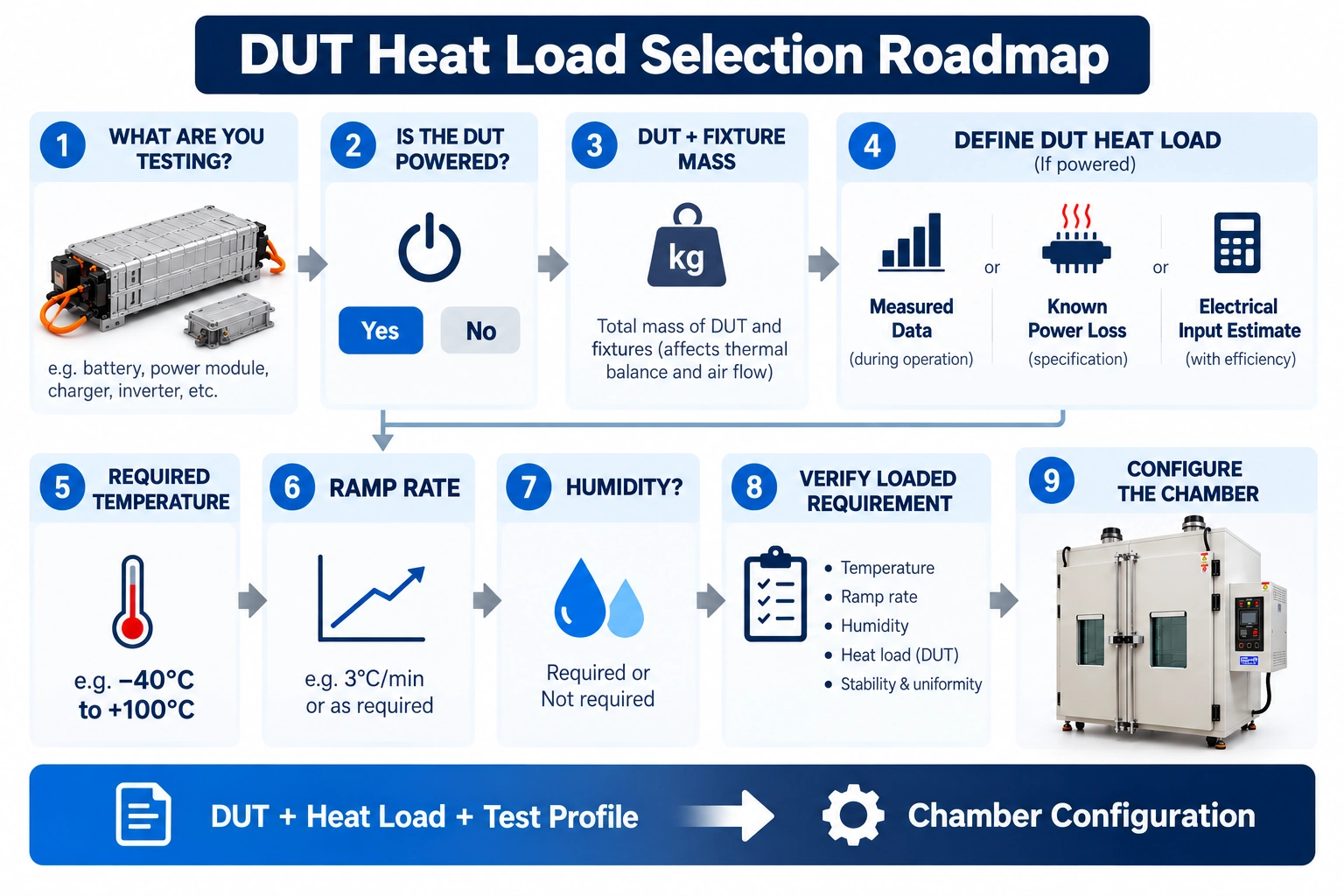
Test Method → DUT → Heat Load → Temperature → Ramp Requirement → Chamber Configuration
What Should You Put in the RFQ?
You do not need to send the chamber manufacturer a complete thermal engineering report.
For a powered DUT, the following information is normally enough to begin an application review:
| Information | Example |
|---|---|
| DUT | Automotive electronic module |
| Quantity | 4 pcs |
| DUT dimensions | 300 × 200 × 80 mm each |
| Total DUT weight | 24 kg |
| Fixture | 10 kg aluminum |
| Power supply | 24 VDC |
| Maximum current | 5 A each |
| Heat dissipation | Provide measured value if available |
| Powered during test | Yes — cooling and dwell |
| Temperature | −40°C to +85°C |
| Ramp rate | 5°C/min loaded |
| Humidity | No |
| Dwell | 60 min |
If actual heat dissipation is unknown, say so.
For example:
24 VDC, maximum 5 A per DUT; actual heat dissipation not measured.
That is useful engineering information.
Guessing a heat-load value is not.
A Weak RFQ vs a Useful RFQ
Weak RFQ
Need 800 L environmental chamber.
−40°C to +100°C.
Please quote.
A supplier can quote a chamber, but important configuration questions remain unanswered.
Useful RFQ
DUT: Battery assembly
Total DUT mass: 100 kg
Required workspace: approximately 800 L
DUT heat load: 3,000 W
Temperature range: −40°C to +100°C
Powered during test: [state operating condition]
Humidity: [required / not required]
Ramp rate: [state if required]
Now the supplier can evaluate the refrigeration requirement rather than selecting a chamber from volume and temperature range alone.
Common Mistakes to Avoid
Treating kilograms as heat load. DUT mass and DUT heat generation are different inputs.
Treating nameplate power as measured heat dissipation. Use actual heat-dissipation data when available. Otherwise, clearly identify electrical input as an estimate.
Giving watts without temperature. A heat-load figure needs an operating condition.
Assuming chamber volume determines refrigeration capacity. An 800 L workspace does not tell you how much powered-DUT heat the refrigeration system can handle.
Comparing an empty-chamber ramp rate with a loaded requirement. If loaded ramp performance matters, specify the DUT, fixture and powered condition.
DUT Heat Load Selection Roadmap
FAQ
How many watts of DUT heat load can an environmental chamber handle?
There is no universal wattage for all environmental chambers and operating temperatures.
For standard ITM-LAB GDW and GDJS configurations, current application guidance is approximately 300 W above −30°C and approximately 100 W below −30°C. Higher heat loads should be identified before ordering so that the refrigeration configuration can be reviewed.
How do I calculate DUT heat load?
Use measured heat-dissipation data when available. If it is unavailable, known electrical losses can be used. For a simple DC DUT, voltage × current provides an initial estimate of electrical input, but electrical input is not always equal to heat released inside the chamber.
Is a 300 W DUT the same requirement at −20°C and −40°C?
No. The required refrigeration configuration depends on the operating condition. Under ITM-LAB's standard GDW/GDJS configuration guidance, −20°C and −40°C fall into different heat-load ranges.
Does a 1,000 W DUT require exactly 1,000 W of cooling capacity?
No. Do not size an environmental chamber using a simple one-to-one wattage comparison. Refrigeration selection also depends on operating temperature, DUT and fixture mass, ramp rate, chamber design and other thermal loads.
Does DUT weight affect heat load?
DUT weight affects thermal mass rather than continuous heat generation. Both weight and heat generation should be provided because both can affect loaded chamber performance.
Does DUT heat load affect cooling rate?
Yes. A powered DUT adds heat while the chamber is trying to cool. If a specific loaded ramp rate is required, provide the rate together with DUT mass, fixture mass and operating heat load.
What if I do not know the actual DUT heat dissipation?
Provide the available electrical data, DUT quantity and operating mode, and clearly state that actual heat dissipation has not been measured. The chamber supplier can then determine what additional information is required.
Can an environmental chamber be customized for a higher DUT heat load?
Yes, depending on the application. Higher heat-load requirements should be reviewed before ordering so that the refrigeration system can be configured accordingly. The GDJS-800L battery application described above is one example of an application-specific refrigeration configuration.
Before You Request a Quote
For a powered DUT, avoid specifying only:
800 L / −40°C to +100°C
Those numbers describe workspace and temperature range, but they do not fully describe the thermal requirement.
A more useful RFQ includes:
DUT dimensions and quantity
DUT and fixture weight
actual or estimated DUT heat load
temperature range
when the DUT is powered
required ramp rate
humidity condition
test standard or test profile
This gives the application engineer enough information to determine whether a standard configuration is suitable or whether the refrigeration system needs to be adjusted.
Need to Configure a Chamber for a Powered DUT?
Send ITM-LAB your DUT information and test profile.
We can review the DUT size and mass, fixture load, heat generation, temperature and humidity conditions, temperature-change requirement and powered operating condition to determine an appropriate environmental chamber configuration.
Primary CTA:
Submit Your Test Requirement
Secondary CTA:
Upload Your Test Specification
