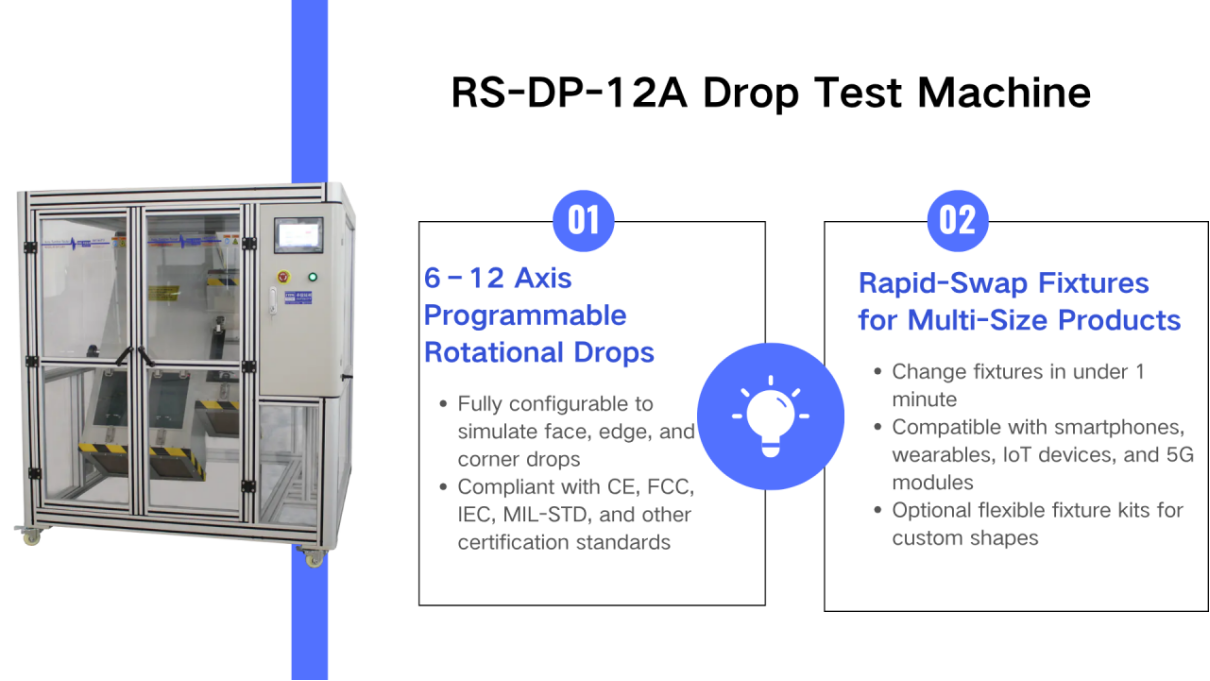
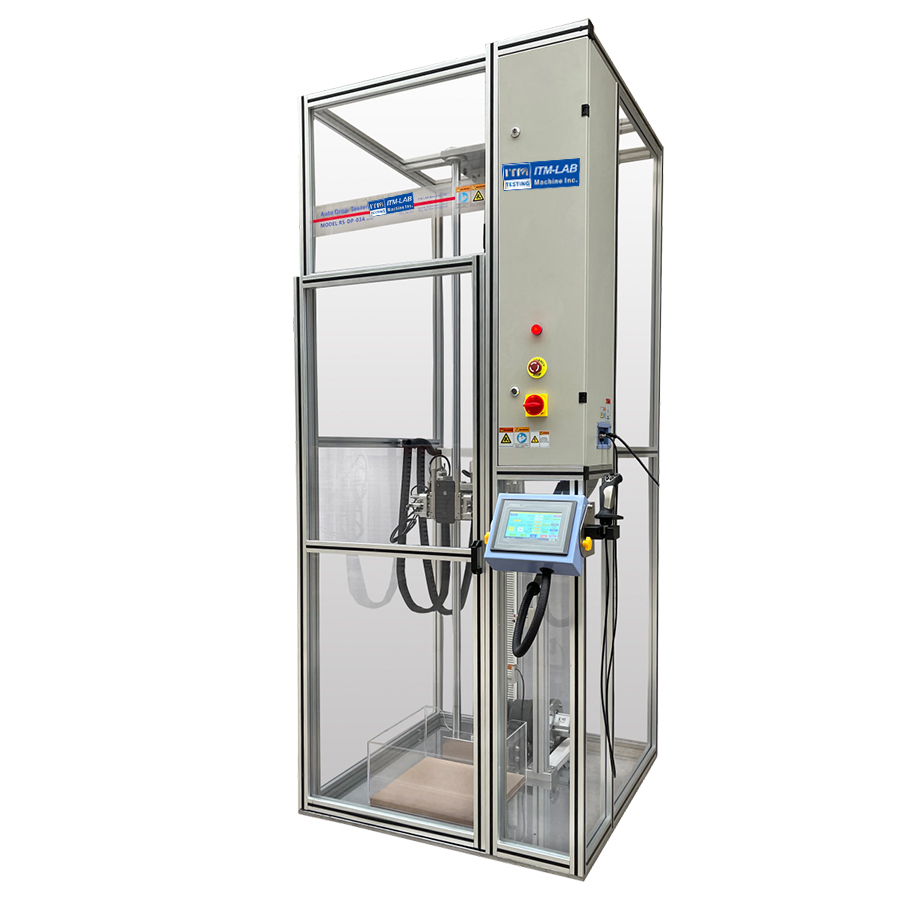
In high-precision 3C consumer electronics engineering, reliability testing is a game of micro-seconds and millimeters. During the intensive R&D stage of a modern flagship smartphone, a single device model must typically undergo up to 500 drop validations to identify fatal internal structural vulnerabilities. These evaluations target micro-cracks in fragile ceramic substrates, latent wire-bonding fractures in multi-layered PCBAs, and delamination in high-capacity lithium polymer batteries.
However, many quality assurance (QA) laboratories run into a frustrating engineering roadblock: data inconsistency. The exact same batch of prototype devices, dropped from identical heights, yield wildly conflicting structural damage profiles. The root cause of this data variance is rarely the phone's industrial design—it is almost always an unmonitored 1-degree mechanical orientation error during the drop release sequence.
# # The Destructive Reality of Off-Axis Kinetic Pathways
When a smartphone strikes a surface during a critical edge or corner test, the resulting shockwave propagates along a strictly defined physical vector. If the laboratory hardware allows the device to tilt by even 1 degree prior to release, the kinetic energy pathway is instantly redirected.
Instead of isolating the structural durability of the outer aluminum frame, the shockwave shears laterally into internal components, forcing fragile components like the optical image stabilization (OIS) camera springs or magnetic wireless charging coils to absorb the peak force. This 1-degree deviation masks structural flaws that should have been caught in R&D, leading to catastrophic warranty return rates once mass production hits global distribution networks.
# # Why Conventional Clamping Mechanisms Fail Precision Electronics
Traditional single-arm or pneumatic drop testers rely on manual mechanical clamping jigs to hold a phone at a specific angle. This legacy methodology introduces three severe variables:
First, Operator Bias. No two laboratory technicians can manually position a lightweight phone at the exact same spatial angle across hundreds of continuous cycles.
Second, Clamping Pre-Stress. Mechanical clamps can warp thin-walled smartphone glass or polymer shells, introducing internal stresses before the impact even occurs.
Third, Release Trajectory Interference. Frictional dragging between mechanical jaws and a lightweight 200g phone causes the device to wobble or rotate during the first 100mm of the drop trajectory.
# # The Robotic Evolution: ITM-LAB’s Patented 6-Axis Automation Architecture
To permanently eliminate human error and frictional variables from high-end electronics quality control, ITM-LAB developed the RS-DP-03R Six-Axis Robot Auto Drop Tester (Patent No.: 201710788643.0). By replacing legacy mechanical drop wings with a precision-programmed 6-axis robotic automation arm, the system completely standardizes multi-axis positioning.
The robotic system utilizes a specialized end-effector that executes automated picking and precise spatial orientation. Through an integrated MCGS touchscreen and Mitsubishi PLC control network, engineers can lock the target angle with absolute accuracy. Height precision is maintained at an ultra-tight ±0.5 mm, while the drop angle remains strictly locked within real-world design limits, fully adhering to IEC 60068-2-32 and JIS C 60068-2-32 standards.
For laboratories requiring high-efficiency semi-automatic workflows, the ITM-LAB RS-DP-03A3 High-Precision Drop Test Machine provides an alternative solution. Utilizing an advanced SMC vacuum suction cup mechanism driven by a Panasonic servo motor and a synchronous belt system, the RS-DP-03A3 locks the device via negative pressure rather than mechanical squeezing. This system supports independent multi-axis rotation, completely eliminating operator bias and clamping pre-stress for electronic payloads up to 2 kg.
# # Micro-Second Synchronization with High-Speed Vision Networks
https://www.itm-lab.com/product/repeating-dropping-tester-rs-dp-04-2.html
To analyze latent component failures, reliability engineers must observe the exact micro-second of structural deformation upon impact. The ITM-LAB RS-DP-03R features a built-in hardware-level TTL high-speed machine phase trigger signal port. This port interfaces directly with industry-standard high-speed imaging systems, such as American Phantom (Vision Research) cameras.
The precise instant the robot executes the release sequence, a millisecond-accurate trigger signal fires, allowing the high-speed camera network to capture unshielded, non-resonant deformation data at thousands of frames per second. This technical capability turns a standard destructive test into a precise, quantifiable engineering audit.
# # Standardizing Global Supply Chain Quality
For global electronics brands managing decentralized contract manufacturers (EMS) across multiple regions, hardware uniformity is the ultimate safeguard. Deploying an advanced testing platform like the RS-DP-03R or the repeated micro-drop fatigue specialist, the RS-DP-04-2D (engineered for high-frequency 10-300mm desktop drop simulations with Japanese SMC pneumatic components), ensures that every reliability report generated at an offshore supplier matches the strict engineering benchmarks of the corporate headquarters.