
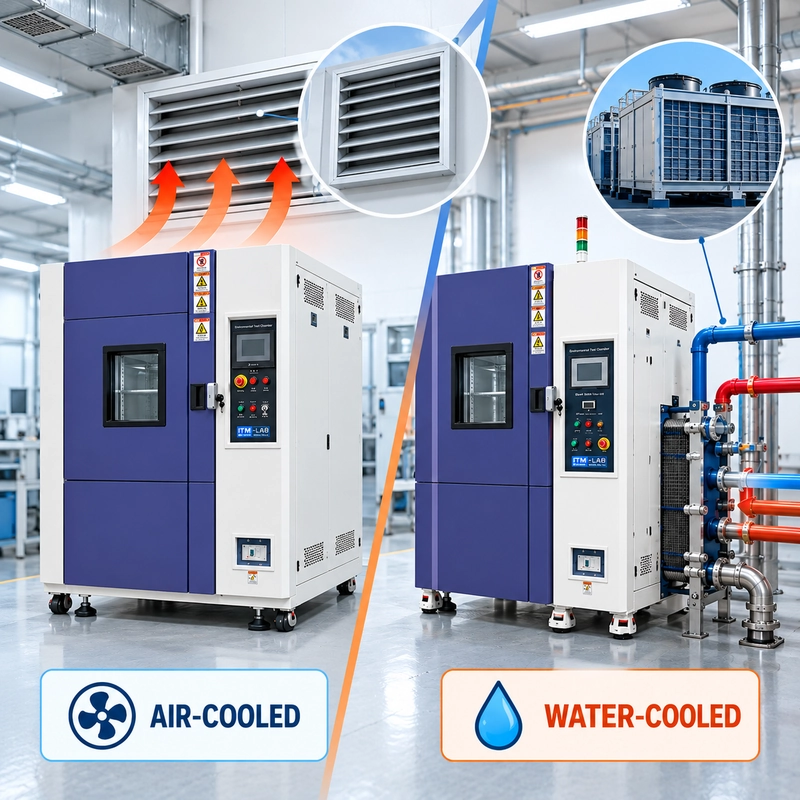
“Do I need an air-cooled or water-cooled environmental chamber?” sounds like a simple equipment question.
In practice, it is usually a test requirement and facility question.
A constant temperature and humidity chamber, a conventional high/low temperature chamber, and a rapid temperature change chamber may all use mechanical refrigeration, but they do not necessarily place the same demand on the refrigeration system. The required temperature-change rate, DUT load, live heat and operating profile can be very different.
That difference matters because an environmental chamber does not make heat disappear.
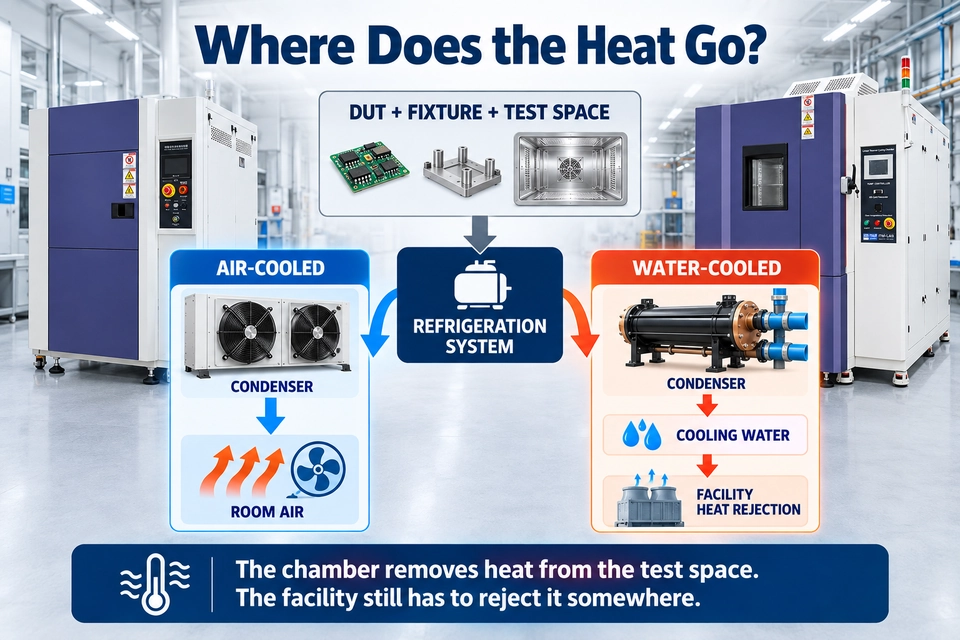
During cooling, the refrigeration system removes heat from the test space and rejects it somewhere else. An air-cooled condenser transfers that heat to the surrounding air. A water-cooled condenser transfers it into a cooling-water circuit.
So before choosing between an air-cooled and water-cooled environmental test chamber, start with three questions:
What does the test require?
How demanding is the refrigeration duty?
How can the facility reject the resulting heat?
There is no universal answer based on chamber volume or minimum temperature alone.
Air-Cooled vs Water-Cooled Chambers: The Short Answer
Air cooling is commonly used when the chamber's refrigeration duty can be handled effectively through an air-cooled condenser and the installation room has suitable ventilation and HVAC capacity.
Water cooling becomes attractive when the refrigeration duty is more demanding or when transferring condenser heat to a facility water system is more practical than releasing it directly into the laboratory.
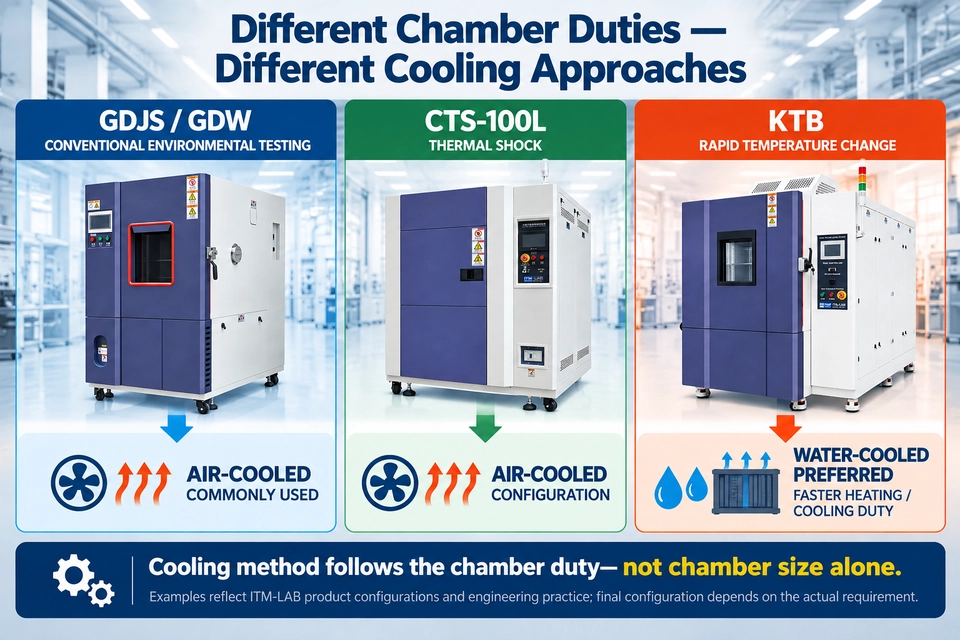
At ITM-LAB, air cooling is commonly used for constant temperature and humidity chambers and conventional high/low temperature chambers. For the KTB rapid temperature change series, water cooling is generally preferred because these systems are designed for faster heating and cooling rates.
That is a product-engineering approach—not a universal rule that should be applied to every environmental chamber.
| What to Compare | Air-Cooled | Water-Cooled |
|---|---|---|
| Condenser heat goes to | Room air | Cooling-water circuit |
| Main facility dependency | Ventilation / HVAC | Cooling-water infrastructure |
| Cooling-water connection | Normally not required | Required |
| Direct room heat rejection | More important to evaluate | More heat carried away by water |
| Installation | Usually simpler | Requires water-side planning |
| Main condenser-side concern | Airflow and room heat | Water conditions and heat transfer |
| Multiple chambers | Combined HVAC load | Combined water-system capacity |
| Final decision | Test + chamber + facility | Test + chamber + facility |
The important point is that cooling method is part of the chamber configuration, not a performance grade by itself.
First, Understand Where the Heat Goes
Consider a powered electronic assembly inside a chamber during a cooling transition.
The refrigeration system may be dealing with the thermal mass of the DUT, fixture mass, heat entering through the chamber structure and heat continuously generated by the operating product.
All of that heat eventually has to leave the refrigeration system.
With an air-cooled chamber:
DUT + Test Space → Refrigeration System → Condenser → Room Air
With a water-cooled chamber:
DUT + Test Space → Refrigeration System → Condenser → Cooling Water → Facility Heat Rejection
This is the basic difference between the two approaches.
It is also why the facility belongs in the chamber-selection discussion.
How an Air-Cooled Environmental Chamber Rejects Heat
An air-cooled condenser uses airflow across a heat exchanger to reject heat from the refrigeration circuit.
The installation advantage is straightforward: a dedicated condenser-water circuit is normally unnecessary.
For many conventional environmental testing applications, that makes air cooling a practical solution.
At ITM-LAB, air cooling is commonly used for GDJS temperature and humidity chambers and GDW high/low temperature chambers. The CTS-100L thermal shock configuration discussed for this project is also air-cooled.
But “no cooling water required” does not mean “no facility requirement.”
The condenser still releases heat into the installation environment.
That means the room needs to be evaluated for adequate ventilation, ambient conditions, condenser clearance and HVAC capacity.
Where the hot discharge air goes matters too. Poor clearance or recirculation of hot condenser air can create a less favorable operating environment around the machine.
For an air-cooled chamber, the room effectively becomes part of the heat-rejection system.
How a Water-Cooled Environmental Chamber Rejects Heat
A water-cooled condenser transfers refrigeration-system heat into a cooling-water circuit instead of rejecting most of that condenser heat directly into the room.
This can be advantageous when the refrigeration duty is more demanding or when direct heat release into the laboratory is difficult to manage.
The trade-off is infrastructure.
The facility now needs to provide suitable cooling water and ultimately reject the heat carried by that water.
Depending on the actual chamber configuration and facility, this may involve requirements for:
water temperature, flow, pressure, piping arrangement, water quality and external heat-rejection capacity.
A plant water loop, cooling tower or chiller may be part of the installation.
Water cooling therefore does not eliminate the facility requirement.
It moves part of the heat-rejection problem from the room-air system to the water system.
Cooling Method Is Not the Same as Cooling Performance
This is one of the most important distinctions when comparing environmental chamber quotations.
Cooling method describes how condenser heat is rejected.
Temperature range describes where the chamber is designed to operate.
Temperature-change rate describes how quickly temperature changes under a defined condition.
Refrigeration capability comes from the complete system design.
These specifications interact, but they are not interchangeable.
A water-cooled chamber is not automatically faster simply because it uses water cooling.
Likewise, an air-cooled chamber should not automatically be treated as a lower-performance system.
The useful purchasing question is:
Can this exact chamber configuration meet the required test profile with the actual DUT inside it?
That is what the performance specification should answer.
How ITM-LAB Typically Approaches Air vs Water Cooling
There is a useful pattern in actual chamber applications, but it should be understood as an engineering approach rather than a universal threshold.
For ITM-LAB constant temperature and humidity chambers and conventional high/low temperature chambers, air cooling is commonly used.
These applications generally differ from rapid temperature change testing, where the chamber is deliberately required to move through a large temperature interval at a specified rate.
For the KTB rapid temperature change series, ITM-LAB generally prefers water cooling because the system is designed around faster heating and cooling rates.
The difference is not simply:
small chamber vs large chamber
or:
−40°C vs −70°C.
The more useful distinction is the duty the refrigeration system is being asked to perform.
That is why the chamber type, required ramp rate, test load and facility should be reviewed together before the condenser configuration is finalized.
Case Study: What a KTB Ramp-Rate Specification Really Tells You
The KTB series provides a good example of why this matters.
A referenced ITM-LAB KTB-1000L 5K Linear Thermal Cycling Chamber has a 1000 L test space and is configured for rapid temperature change.
More importantly, its ramp-rate specification is not just a headline number.
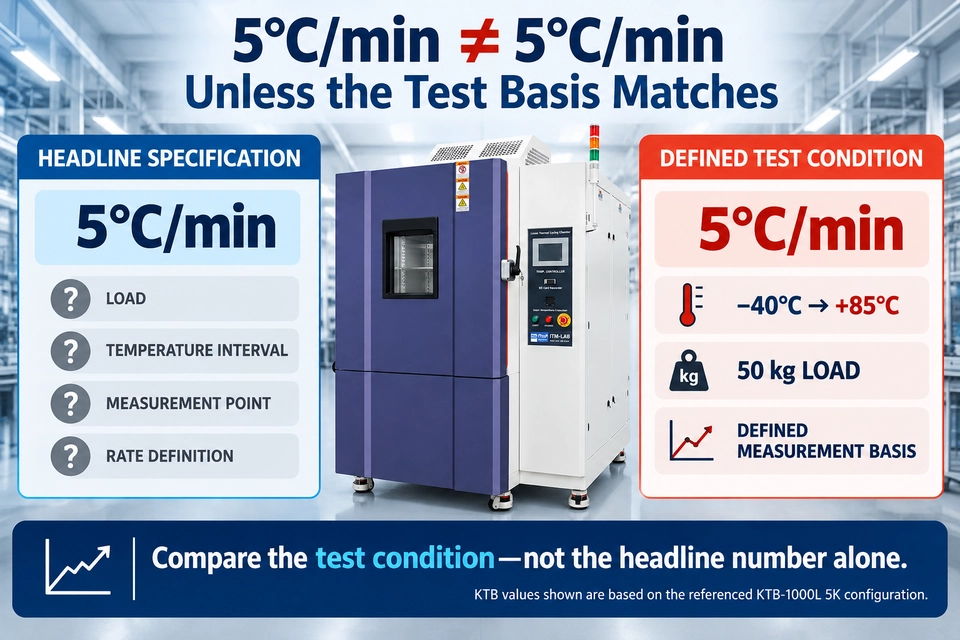
For the referenced configuration, performance is defined around a specific temperature interval and a 50 kg aluminum load.
The refrigeration system is water-cooled.
KTB-1000L / 5K Example
| Parameter | Defined Configuration |
|---|---|
| Workspace | 1000 L |
| Internal dimensions | 1000 × 1000 × 1000 mm |
| Chamber temperature range | −70°C to +180°C |
| Defined ramp interval | −40°C to +85°C |
| Ramp specification | 5°C/min with specified tolerance |
| Test load | 50 kg aluminum |
| Condenser configuration | Water-cooled |
| Condenser type | Shell-and-tube |
This is much more useful than a specification that says only:
5°C/min
because the buyer can see the basis behind the number.
If another supplier quotes the same nominal rate, several questions still need answers:
What temperature interval was used?
Was the chamber empty?
What load was inside?
Where was temperature measured?
How was the rate calculated?
Two chambers can both say “5°C/min” without necessarily describing equivalent test conditions.
[ Loaded vs No-Load Temperature Change Rate: What Chamber Buyers Need to Know]
What the KTB Example Does — and Does Not — Prove
The KTB case is a real example of a rapid temperature change system using water cooling under a defined performance condition.
It does not mean:
1000 L = water cooling
or:
5°C/min = water cooling
or:
−70°C = water cooling
Those shortcuts remove too much of the engineering context.
What the KTB example actually shows is that a rapid temperature change requirement can place substantial demand on the thermal and refrigeration system, and ITM-LAB generally prefers water cooling for the KTB series because of its faster heating and cooling duty.
That is a much more useful purchasing principle than trying to create a universal threshold from one specification.
A Different Example: Where Air Cooling Is Commonly Used
Now compare the KTB with conventional environmental testing equipment.
ITM-LAB commonly uses air cooling for constant temperature and humidity chambers and high/low temperature chambers.
The CTS-100L configuration discussed here is also air-cooled.
These are different systems serving different test profiles.
The important conclusion is not:
Air cooling is for simple machines.
Nor is it:
Water cooling is for advanced machines.
Instead:
Different chamber duties can lead to different heat-rejection solutions.
An air-cooled system can be entirely appropriate when its refrigeration design and operating conditions support the required performance and the installation environment can handle the condenser heat.
DUT Weight Is Not the Same as DUT Heat Load
The chamber itself is only part of the thermal system.
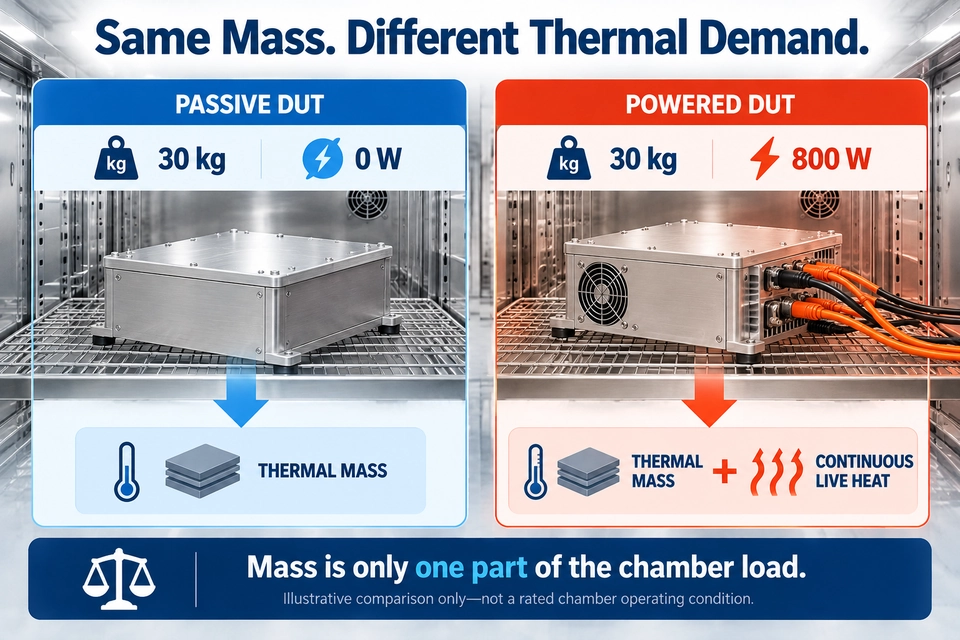
Consider two DUTs.
DUT A: 30 kg, unpowered.
DUT B: 30 kg, powered and releasing 800 W during the test.
Their mass is identical.
Their effect on the chamber is not.
The passive DUT introduces thermal mass that must be heated or cooled.
The powered DUT introduces thermal mass and continues adding heat while the refrigeration system is trying to cool the chamber.
Fixtures add more thermal mass. Specimen geometry can obstruct airflow. Multiple specimens can change both effects.
This is why:
DUT mass ≠ DUT thermal load.
For powered testing, give the chamber manufacturer the maximum heat generation during the relevant part of the temperature profile whenever possible.
[ How to Size an Environmental Test Chamber for Your DUT]
Internal Airflow and Condenser Cooling Are Different Problems
Another common mistake is treating condenser cooling and test-space airflow as the same problem.
They are not.
Inside the chamber:
DUT → Circulating Chamber Air → Evaporator
At the refrigeration-system side:
Refrigeration Circuit → Condenser → Room Air or Cooling Water
Switching to water cooling does not fix poor airflow around the specimen.
A large DUT can block circulation and affect temperature distribution or DUT response even when the refrigeration system has sufficient condenser-side heat rejection.
This is why DUT dimensions, orientation and occupied chamber volume still need to be checked independently.
[ How Much Chamber Space Should Your Test Specimen Occupy?]
Why Ramp Rate Changes the Conversation
A chamber intended primarily for temperature exposure or steady-state conditioning is not doing exactly the same job as a chamber designed to repeatedly move through a large temperature interval at 5°C/min, 10°C/min or 15°C/min.
As the required transition becomes more demanding, the complete thermal system becomes more important.
That includes:
refrigeration capacity, heater capacity, internal airflow, DUT load, fixture mass, live heat and condenser heat rejection.
This is why ITM-LAB's KTB rapid temperature change series is treated differently from conventional GDW or GDJS applications when cooling configuration is considered.
But the condenser type should never be used as a substitute for actual performance data.
If you require 10°C/min with a loaded DUT, specify exactly that.
Do not assume:
Water-cooled = 10°C/min capable.
Ask whether the selected chamber can deliver the required rate with your load and over your required temperature interval.
[ 5°C/min vs 10°C/min vs 15°C/min Temperature Ramp Rate]
Before You Choose Air or Water, Walk Through the Installation Site
The chamber can meet the test requirement and still be a poor match for the building.
For an air-cooled system, look at the room.
Where will the condenser discharge air go?
Is there enough ventilation?
Can the HVAC system handle the chamber during demanding operation?
Is there adequate clearance around the condenser?
Will other chambers or heat-generating equipment operate nearby?
For a water-cooled system, look at the water infrastructure instead.
Is suitable cooling water available?
What supply temperature can the facility provide?
What flow and pressure are available?
Where does the return water go?
How will the facility ultimately reject that heat?
These questions should be answered before installation—not after the chamber arrives.
One Chamber May Be Fine. Four Can Be a Different Facility Problem.
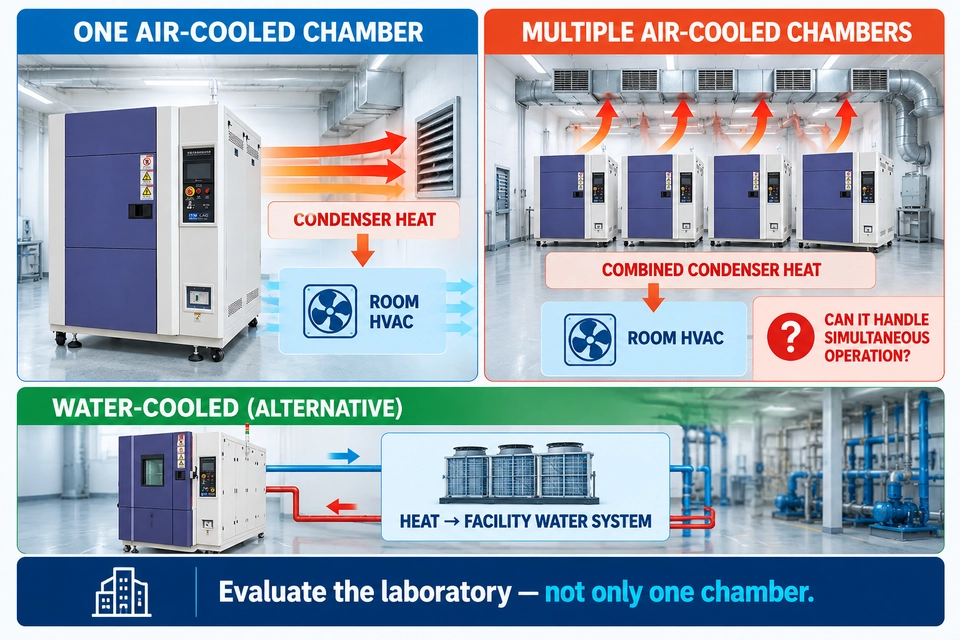
A single air-cooled chamber may operate comfortably in an existing conditioned laboratory.
Four chambers running demanding profiles simultaneously can create a very different HVAC requirement.
The question changes from:
Can the room handle this machine?
to:
Can the facility handle the combined condenser heat from all operating chambers?
This does not mean multiple chambers automatically require water cooling.
If the room has sufficient HVAC and ventilation capacity, air cooling may still be completely practical.
But if direct room heat rejection becomes difficult to manage and suitable cooling-water infrastructure exists, water-cooled configurations may become more attractive.
Plan for the Laboratory You Are Building
Facility planning should also consider what comes next.
A laboratory may buy one chamber today and add several more over the next few years.
If that expansion is already likely, future heat rejection is worth considering before today's utilities are finalized.
For air-cooled equipment, that means looking ahead at room HVAC and ventilation capacity.
For water-cooled equipment, it means considering the future capacity of the water system and its heat-rejection equipment.
A solution that is convenient for one machine is not automatically the best infrastructure strategy for an expanding test laboratory.
Does Water Cooling Make a Chamber Faster?
Water cooling alone does not define the chamber's temperature-change rate.
Ramp performance depends on the complete system and test condition.
That can include the refrigeration design, chamber volume, temperature interval, DUT mass, fixture mass, live heat, internal airflow, control strategy and measurement method.
The KTB example illustrates the point well.
Its 5°C/min figure is meaningful because it is associated with a defined test condition rather than presented as an isolated marketing number.
So instead of asking:
Is a water-cooled chamber faster?
ask:
What temperature-change performance does this exact configuration achieve with my DUT over my required temperature interval?
That is a much better RFQ question.
What Changes in Maintenance?
Neither cooling method is maintenance-free.
With an air-cooled condenser, maintenance attention tends to stay on the air side: keeping heat-exchange surfaces clean, preventing dust buildup and maintaining unobstructed intake and exhaust airflow.
With a water-cooled condenser, maintenance moves toward the water circuit. Water quality, scaling or fouling, flow condition, piping connections and leak inspection become relevant, along with whatever facility equipment supports the cooling-water system.
Water cooling therefore does not remove maintenance.
It changes what has to be maintained and which facility systems are involved.
Compare Installed Cost, Not Only Chamber Price
Air cooling may simplify installation because dedicated condenser-water piping is not required.
But the room still needs to deal with the condenser heat.
Water cooling can reduce direct heat release into the laboratory, but it may require water piping and external heat-rejection infrastructure.
Which option is more economical depends heavily on the facility.
A laboratory with an existing suitable cooling-water loop starts from a very different position from a facility that would need to install one specifically for the chamber.
Likewise, an air-cooled chamber can become a larger facility project if additional HVAC capacity is required.
For purchasing purposes, compare:
Chamber + Facility Infrastructure + Operating Environment
—not the chamber quotation alone.
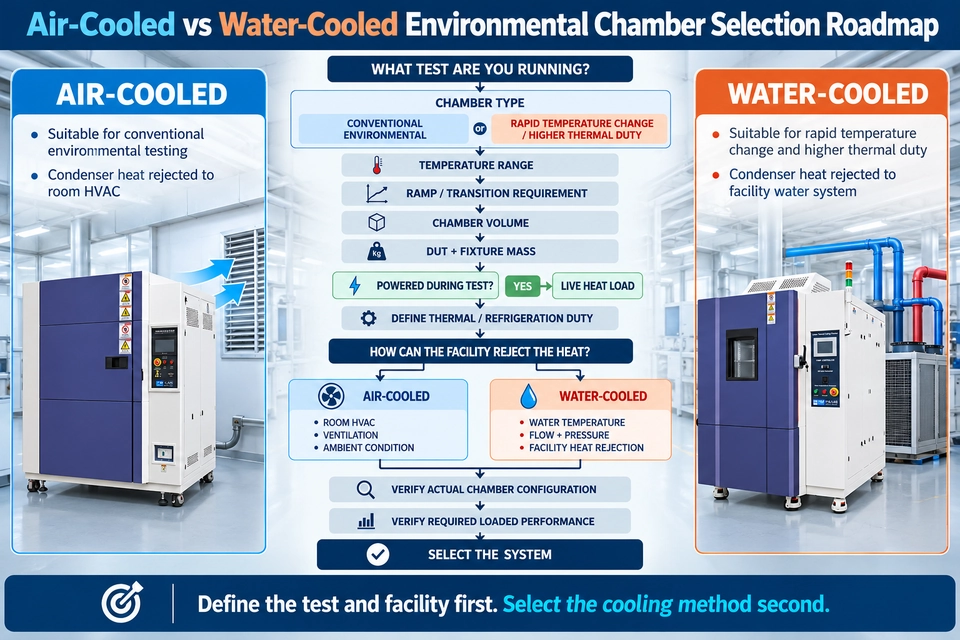
Air-Cooled vs Water-Cooled Chamber Selection Roadmap
A reliable selection process starts with the test.
What Should You Send the Chamber Manufacturer?
You do not need to decide “air-cooled or water-cooled” before contacting the manufacturer.
In many cases, the cooling method should be selected after the test requirement and installation conditions are understood.
A useful RFQ provides four groups of information:
| Information | What to Provide |
|---|---|
| Test Profile | Temperature range, ramp/transition rate, dwell time, heating/cooling sequence, applicable standard |
| DUT | Dimensions, weight, quantity, fixture weight, powered/unpowered condition |
| Thermal Load | Maximum heat generation during testing, if powered |
| Facility | Ambient conditions, number of chambers planned, HVAC/ventilation information, cooling-water availability, electrical supply |
For rapid temperature change testing, also tell us whether the required ramp rate must be achieved with the DUT loaded.
If cooling water is available, provide the water temperature, flow and pressure if you already know them.
If you do not know those values yet, that is not a reason to delay the initial review.
Send what you have. The missing conditions can be identified during configuration.
FAQ
Is an air-cooled or water-cooled environmental chamber better?
Neither is universally better. Air cooling is commonly practical for conventional environmental chambers when the room can handle condenser heat. Water cooling can be preferable for more demanding refrigeration duties or where transferring condenser heat to a facility water system is more suitable. The actual chamber and facility determine the answer.
Why does ITM-LAB prefer water cooling for KTB rapid temperature change chambers?
The KTB series is designed for faster heating and cooling rates than conventional environmental exposure chambers. ITM-LAB therefore generally prefers water cooling for this series as part of the overall refrigeration and heat-rejection design. The required ramp rate and actual load still need to be defined when selecting a configuration.
Are GDJS temperature and humidity chambers air-cooled?
Air cooling is commonly used for ITM-LAB constant temperature and humidity chamber applications. The final configuration should still be confirmed for the specific model and requirement rather than assumed from the product category alone.
Does a water-cooled environmental chamber cool faster?
Not simply because it is water-cooled. Ramp rate depends on the complete thermal and refrigeration system and on the test condition. Compare loaded performance, temperature interval and measurement basis for the actual chamber configuration.
Does an air-cooled environmental chamber require HVAC?
An air-cooled condenser releases heat into the installation environment, so room ventilation and HVAC capacity should be considered. The actual facility requirement depends on the selected chamber and its operating condition.
Does a water-cooled chamber always need a dedicated chiller?
Not necessarily. The chamber requires cooling water that meets its specified conditions. Depending on the facility, that may come from an appropriate existing water loop, cooling tower, chiller or another suitable system.
Can chamber volume determine whether I need air or water cooling?
No. Chamber volume matters, but it is only one input. Chamber type, temperature range, ramp rate, DUT and fixture load, live heat, refrigeration design and facility conditions should also be considered.
Is there a temperature at which every chamber must switch from air cooling to water cooling?
No universal temperature threshold should be applied across all environmental chambers. Different chamber architectures and refrigeration systems can use different solutions. Select the cooling method from the actual chamber configuration and required operating duty.
Not Sure Which Cooling Method Fits Your Test?
You do not need to choose air cooling or water cooling first.
Tell ITM-LAB what the chamber actually needs to do.
For an initial configuration, send us:
Required temperature range
Ramp or transition rate
DUT dimensions and weight
Fixture weight, if applicable
DUT heat generation, if powered
Required workspace
Number of chambers planned
Available cooling water, if known
Applicable test standard or customer specification
ITM-LAB can review the test profile, DUT load, required performance and installation conditions together, then configure the appropriate chamber and cooling method around the requirement.
Not sure about cooling-water flow or HVAC capacity?
Send what you know. We can identify what still needs to be confirmed.
Primary CTA
Secondary CTA
Upload Your Test Specification
