
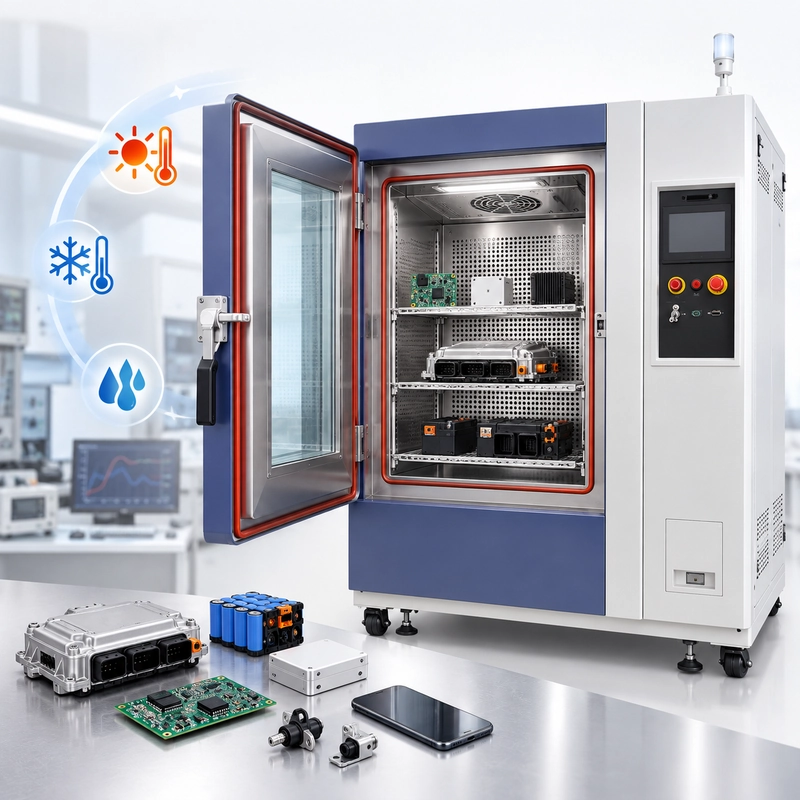
“We need a 408 L temperature and humidity chamber.”
That is a common starting point for an RFQ. But 408 L tells us surprisingly little about whether the chamber is actually large enough.
Take a controller measuring 420 × 300 × 180 mm. One unit looks small relative to a 408 L workspace. Put four of them on a rack, add power cables, thermocouples and clearance around the air-return path, and the sizing question changes completely.
There is another issue. If those four controllers are powered and release 450 W during a low-temperature test, workspace is no longer the only concern. Refrigeration capacity under load matters too.
Chamber volume is a useful catalog number. It is not a loading specification.
That distinction matters whether you are comparing a compact 100 L environmental chamber, moving from 225 L to 408 L, or deciding whether an 800 L or 1000 L chamber is justified.
This guide compares these common environmental chamber sizes from a practical purchasing and engineering perspective: what actually changes as the chamber gets larger, what should make you move up one size, and what a larger chamber does not solve.
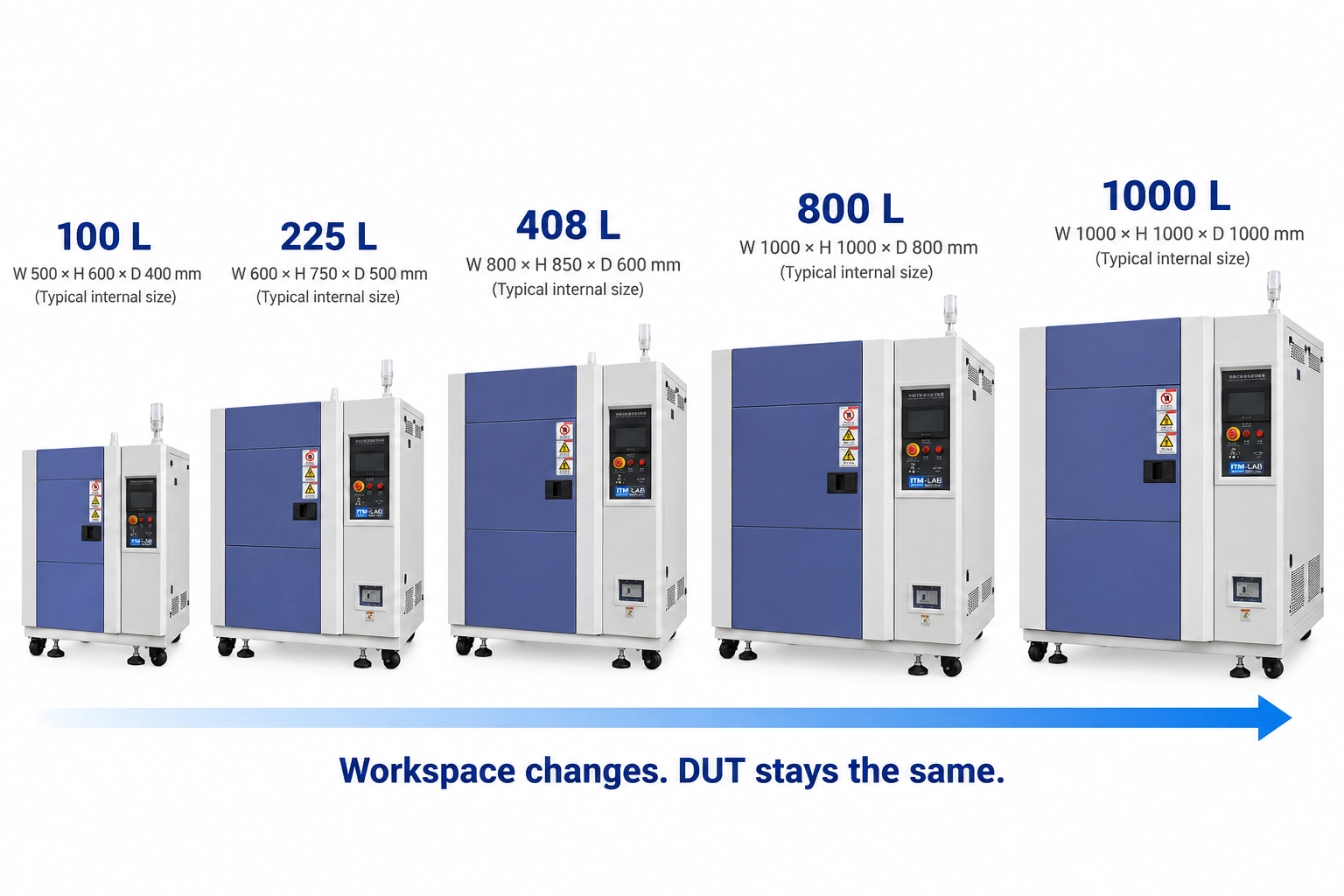
100L vs 225L vs 408L vs 800L vs 1000L: Quick Comparison
There is no fixed rule assigning a particular product to a particular chamber volume. Still, this comparison is useful as a first screening step.
| Chamber Size | Usually Makes Sense When... | Reconsider If... |
|---|---|---|
| 100 L | One compact DUT, simple fixture and low cable density | The DUT or fixture begins to dominate the workspace |
| 225 L | Small assemblies need more setup and circulation space | Multi-DUT loading becomes crowded |
| 408 L | Fixtures, racks or several DUTs need greater layout flexibility | Batch layout or DUT footprint becomes the constraint |
| 800 L | Larger assemblies or batch testing justify the additional workspace | Much of the chamber would remain unused |
| 1000 L | Large racks, integrated products or high specimen counts require it | It is being selected mainly as future insurance |
The important question is not:
Which chamber is bigger?
It is:
What test requirement forces you to move to the next size?
Liters Tell You Volume. They Don't Tell You Fit.
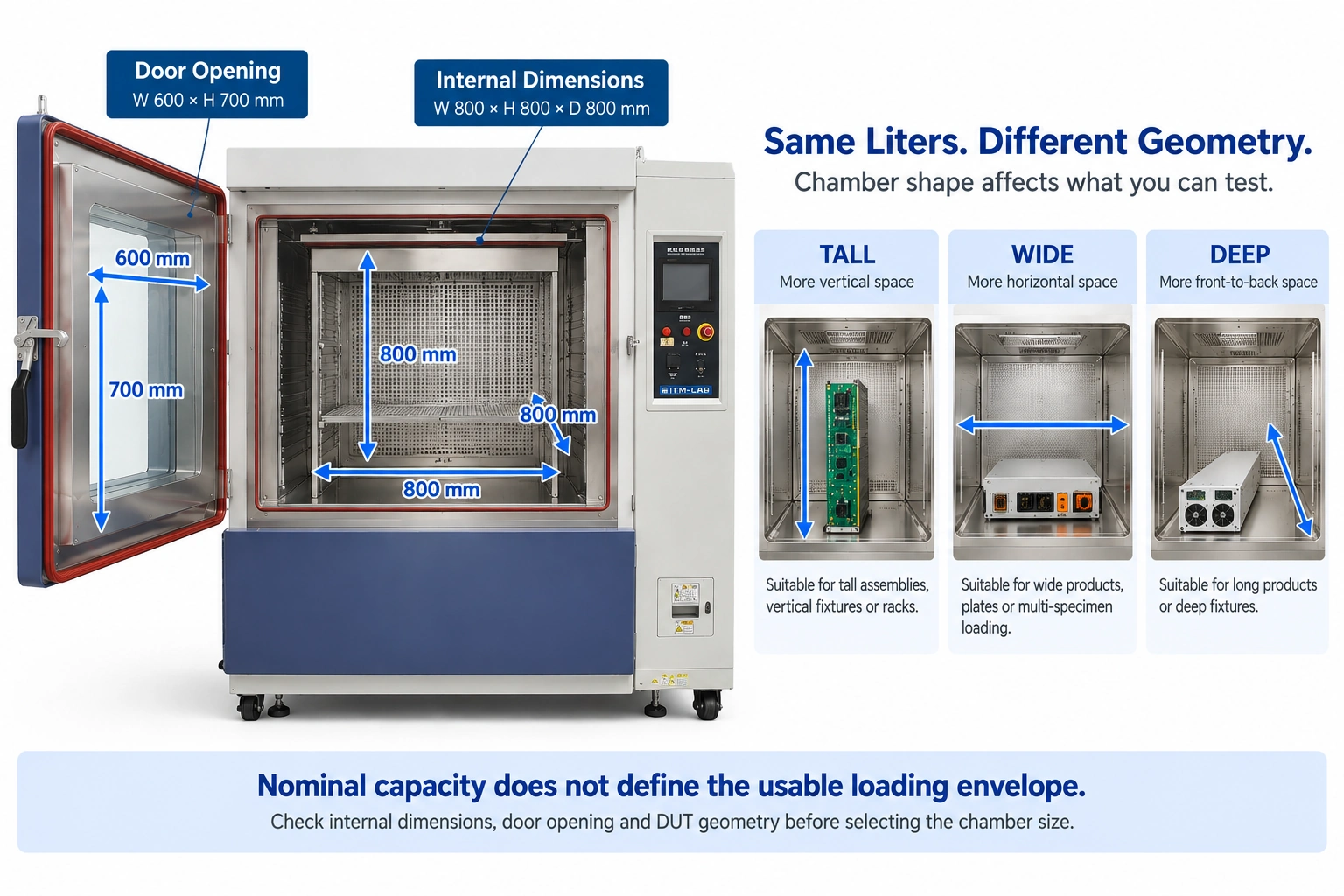
A chamber's nominal capacity is based on its internal volume:
Internal Width × Internal Height × Internal Depth
That number is useful. It lets you distinguish a 100 L class chamber from a 408 L or 1000 L system.
But the calculation hides something important: shape.
A tall, narrow workspace and a wide, shallow workspace can have similar volumes while accepting very different products.
Suppose your DUT is a tall electronics assembly mounted vertically. Internal height may determine whether the chamber works at all.
Replace it with a wide fixture plate and width becomes the limiting dimension.
Neither problem is visible from the liter rating.
For serious environmental chamber size selection, move from:
408 L
to:
Internal W × H × D
as early as possible.
The Dimension Buyers Often Forget: Door Opening
There is another catch: the door.
Internal dimensions tell you whether a loaded DUT can exist inside the workspace.
The door opening tells you whether you can get it there.
For example:
Internal workspace: 800 × 800 × 800 mm
Loaded fixture: 700 × 650 × 600 mm
On paper, there is room.
But if the usable door opening is only:
600 × 700 mm
the loading concept may already have a problem.
This matters especially for rigid racks, battery assemblies and products that cannot be rotated freely during loading.
100L vs 225L: When Small Starts Getting Crowded
A 100 L environmental chamber can be entirely appropriate for a compact test.
Think of a small sensor, connector assembly, PCB, electronic module or material specimen mounted in a simple fixture.
If the product has plenty of clearance around it and the test requires only a few cables, there is little engineering value in buying several hundred liters of unused workspace.
The situation changes when the chamber starts to feel crowded.
And “crowded” does not simply mean the DUT touches a wall.
A 100 L chamber may still close normally while leaving poor space for a mounting fixture, cable routing, thermocouples, multiple DUTs or air circulation.
This is where moving to 225 L can become useful.
The extra capacity is not valuable because 225 L is inherently better than 100 L. It is valuable if it solves a specific loading constraint.
A practical way to evaluate the step from 100 L to 225 L is:
Can the DUT fit?
If yes:
Can the DUT and fixture fit?
Then:
Can they fit without crowding the airflow path?
And finally:
Can the setup be loaded, wired and serviced easily?
If the answer begins turning into “barely,” the smaller chamber is probably no longer giving you enough working margin.
On the other hand, one genuinely small DUT in a simple fixture does not automatically become a better test because it is placed in a 225 L chamber.
225L vs 408L: The Important Step-Up
For many electronics and component laboratories, the comparison between 225 L and 408 L is more interesting.
A 225 L chamber may handle one assembly comfortably.
Then the test plan changes:
We need four specimens per run.
Or:
The customer requires the product to be mounted in its actual operating orientation.
Or:
We have added a stainless-steel fixture and several powered connections.
Now the issue is no longer whether one product fits.
It is whether the complete test setup fits.
That is the point where a 408 L environmental chamber can become more practical.
The additional workspace may provide more fixture clearance, more loading options, easier cable routing and more room around the specimens.
It can also make one chamber more adaptable when an R&D laboratory handles several product families rather than one fixed DUT.
But none of those benefits is guaranteed by the number 408.
You still need to check the actual internal dimensions and loading arrangement.
This is why:
225 L → 408 L
should be an engineering decision, not simply the next entry in a catalog.
The 90.7L Example: Why DUT Volume Can Mislead You
Here is where liter-based sizing starts to break down.
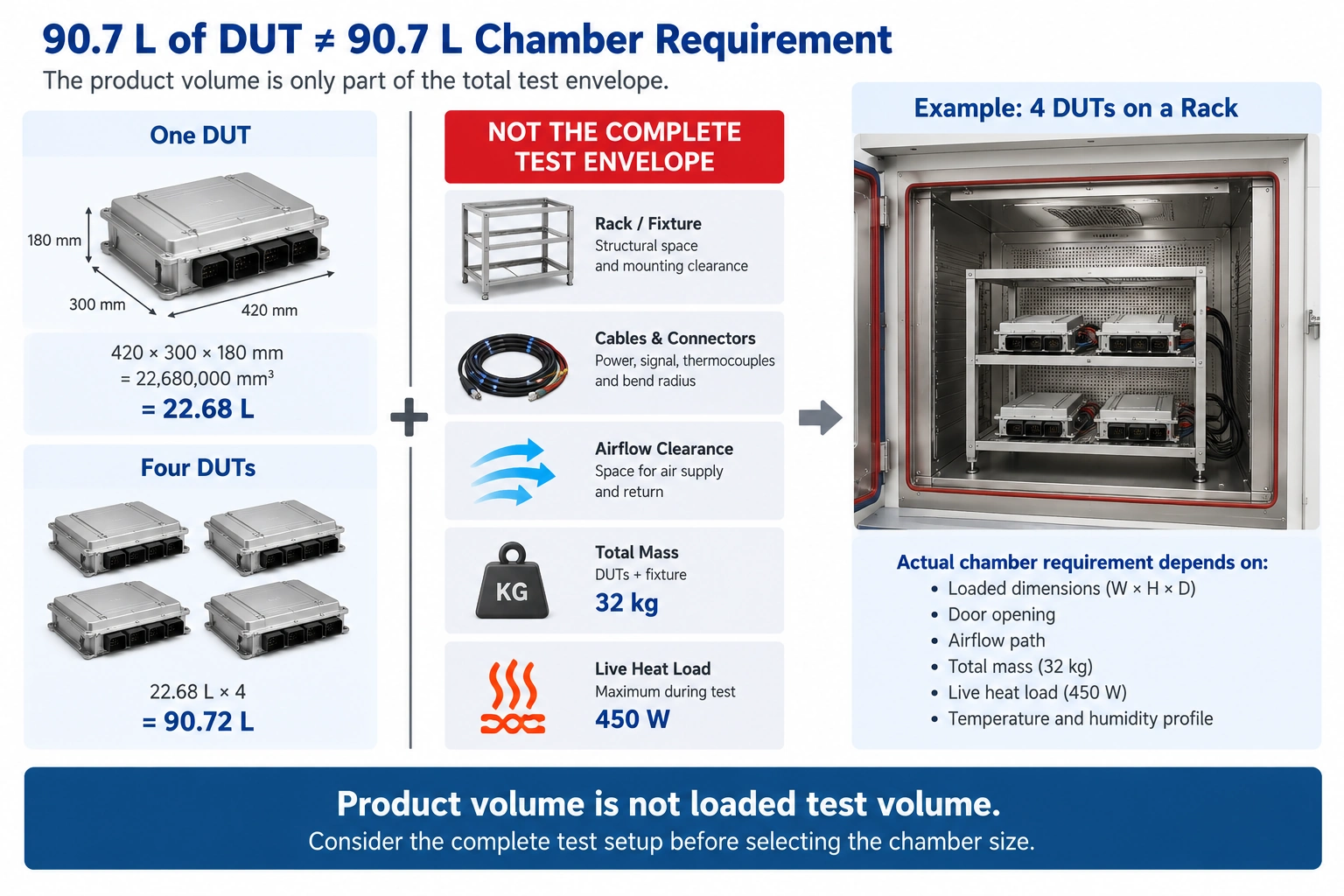
Suppose an automotive electronics project has four identical controllers.
Each DUT measures:
420 × 300 × 180 mm
The arithmetic is easy.
For one DUT:
420 × 300 × 180 mm = 22.68 L
For four DUTs:
22.68 × 4 = 90.72 L
It is tempting to reason:
Four products occupy only about 91 L. A 225 L chamber should therefore be enough.
That conclusion is premature.
Those 90.72 L describe only the product housings.
Now add the rack.
Add spacing between the controllers.
Add power and signal connectors.
Add cable bend radius.
Add thermocouples.
Leave access for installation.
Leave an unobstructed circulation path.
Check whether the complete rack can pass through the door.
Now add another two pieces of information:
Total DUT + fixture mass: 32 kg
Maximum live heat load: 450 W
The original 90.72 L calculation has not become mathematically wrong.
It has simply stopped answering the engineering question.
90.7 L of product does not equal a 90.7 L chamber requirement.
A DUT-to-chamber volume ratio can be useful for rejecting an obviously undersized chamber. It cannot approve a final chamber configuration.
For a deeper explanation of loaded envelope, DUT clearance and airflow, see our guide on How to Size an Environmental Test Chamber for Your DUT.
408L vs 800L: Is the Problem Size—or Throughput?
Once you reach the 408 L vs 800 L environmental chamber decision, the reason for moving up should normally be fairly clear.
Sometimes the DUT is simply too large.
But not always.
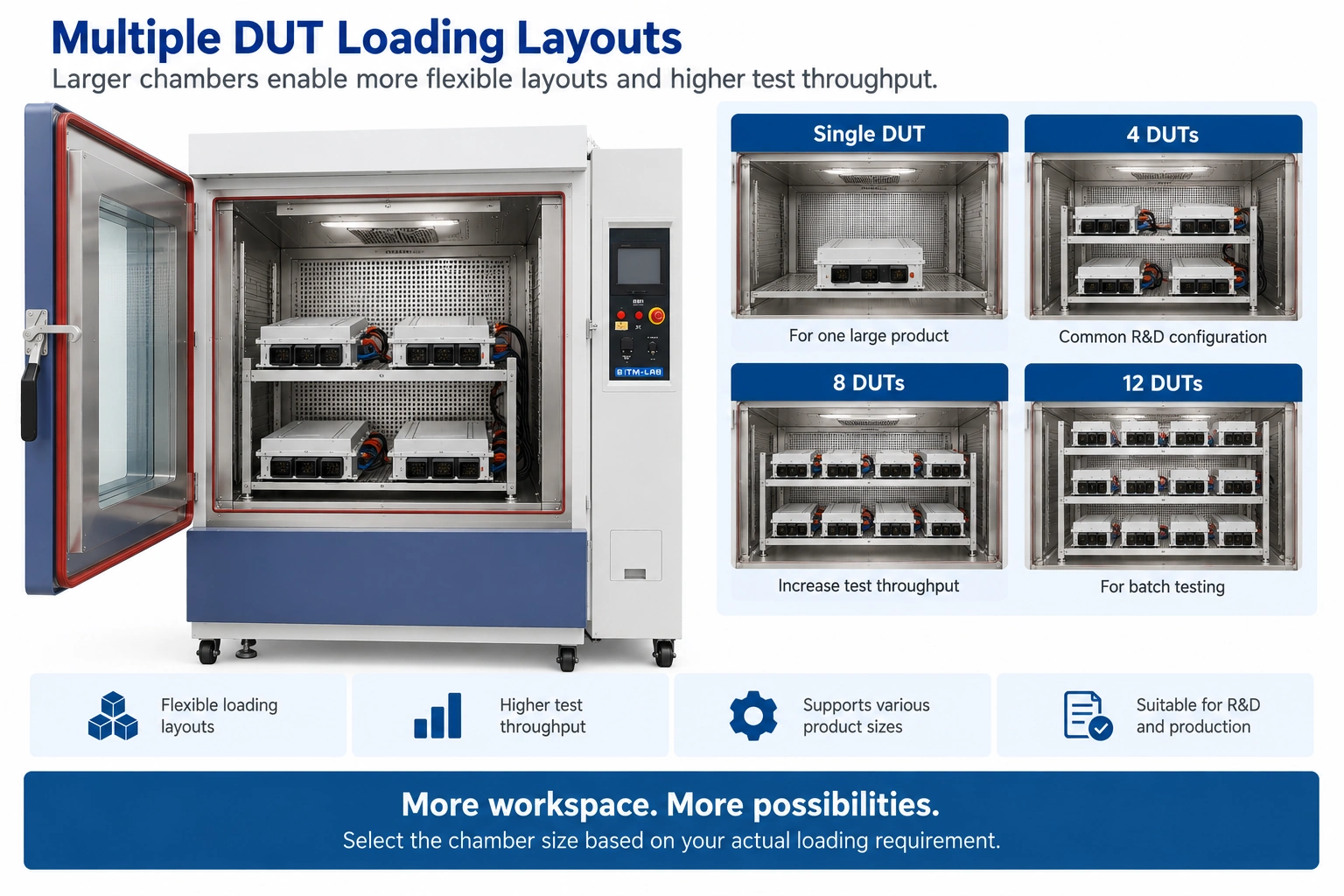
One of the strongest reasons to consider an 800 L chamber is test throughput.
Suppose an environmental test profile takes 48 hours.
If the validated 408 L loading arrangement holds four DUTs, you can test four specimens every 48 hours.
If a properly configured 800 L chamber can accommodate eight specimens under the same required conditions, the larger workspace may reduce the number of test runs.
That can matter more than the physical size of any individual product.
But you cannot assume:
2× chamber volume = 2× specimen capacity
Loading does not scale that neatly.
Twelve identical DUTs could be arranged in one wide layer, distributed across several shelves, or mounted in a dedicated fixture rack.
The number of products has not changed.
The required width, height, depth and airflow path have.
For this reason, a simple loading sketch is often more useful during chamber selection than another capacity calculation.
When Does a 1000L Environmental Chamber Actually Make Sense?
A 1000 L environmental chamber starts to make sense when there is a real requirement for the additional workspace.
That might be:
- a large integrated product,
- a substantial fixture or rack,
- multiple large specimens,
- a high specimen count,
- or a product family with clearly defined future dimensions.
There is nothing wrong with allowing reasonable expansion margin.
The problem is using chamber size as insurance against an undefined future.
“We need 408 L today, but let's buy 1000 L in case we need something bigger later.”
Maybe. But what is “bigger”?
If the next product generation is already expected to increase from 450 mm to 700 mm in width, that is useful engineering information.
If test plans are expected to move from four to twelve specimens per batch, that is useful too.
If nobody knows what the future DUT will look like, the additional capacity may simply become unused workspace.
A larger chamber also affects the wider installation decision: machine footprint, utilities, heating and refrigeration requirements, and loading ergonomics all deserve consideration.
Bigger is useful when the test needs bigger.
Not simply because bigger exists.
A Larger Chamber Does Not Automatically Give You More Test Capability
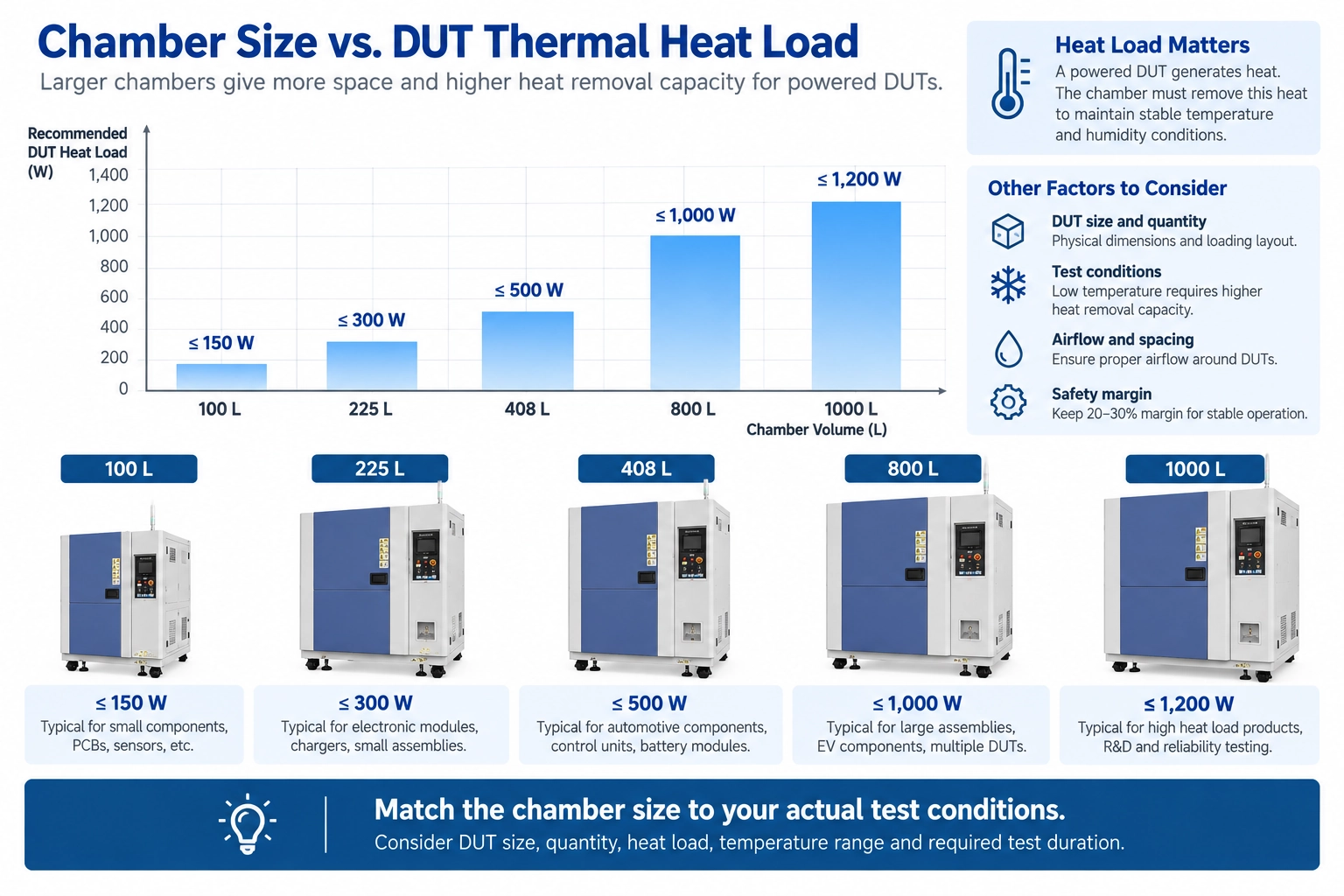
Workspace and chamber performance are related, but they are not the same thing.
There are really three different questions.
1. Space
Can the complete setup fit?
That includes:
DUT dimensions · Quantity · Fixture / rack · Loading orientation · Door opening · Airflow clearance
2. Thermal Mass
How much material must the chamber heat or cool?
That includes:
DUT mass + fixture mass
A 40 kg metal assembly and a 5 kg plastic housing may occupy similar volumes. They will not respond to a temperature transition in the same way.
3. Live Heat Load
Does the DUT generate heat while operating?
A powered electronics assembly may continuously release 200 W, 450 W, 800 W or more depending on the product.
That heat has to be managed during the test.
This becomes particularly important at low temperatures.
Consider two test setups with identical external dimensions.
Setup A:
20 kg unpowered metal assembly
Setup B:
20 kg powered electronics assembly producing 800 W
They occupy the same space.
They do not impose the same thermal demand.
Likewise, moving from 408 L to 800 L solves a workspace problem. It does not, by itself, prove that the system can maintain −40°C while removing an 800 W live heat load.
The chamber configuration has to be verified against the actual test condition.
If temperature transition speed is also part of the requirement, compare it separately rather than assuming a chamber's nominal size determines ramp performance. Our 5°C/min vs 10°C/min vs 15°C/min Temperature Ramp Rate guide explains this selection in more detail.
Five Checks Before You Choose a Chamber Size
Once you have narrowed the choice to perhaps 225 L vs 408 L, or 408 L vs 800 L, stop comparing liters for a moment.
Check these five items instead.
1. Internal Dimensions
Start with the complete loaded envelope:
Width × Height × Depth
Not just the product housing.
If there is a rack, include it. If a connector protrudes 80 mm, include it. If the cable cannot make an immediate 90-degree bend, allow for that too.
2. Door Opening
Can the assembled test setup actually enter the chamber?
If the fixture will be assembled inside, is there enough access to install it?
A large workspace behind a smaller opening can change the loading plan completely.
3. Airflow Path
A DUT can fit physically and still be a poor load.
Large flat surfaces, dense racks and solid fixture plates can restrict circulation. This is why a fixed “DUT may occupy X% of chamber volume” rule is only a screening shortcut.
Geometry matters.
4. DUT + Fixture Mass
Do not quote only the product weight if a heavy fixture will remain inside the chamber.
A 12 kg DUT mounted on a 25 kg fixture is not a 12 kg test load.
It is a 37 kg loaded system.
5. Live Heat Load
For powered testing, provide the maximum expected heat dissipation in watts.
Do not assume that choosing 800 L instead of 408 L automatically solves an active heat-load problem.
That requires a performance check.
From Chamber Size to GDW / GDJS Configuration
Once the workspace requirement has been narrowed down, the next question is what environment the chamber must produce.
For an ITM-LAB configuration, the basic distinction is straightforward.
Temperature Testing
GDW Temperature Test Chamber
Configurable temperature ranges include:
−20°C / −40°C / −70°C to +150°C
Temperature + Humidity Testing
GDJS Temperature & Humidity Test Chamber
For temperature-humidity applications, the required temperature and RH profile should be defined together.
At this point, the equipment request becomes much more useful.
Instead of:
“Quote 408 L chamber.”
you might have:
408 L class workspace
−40°C to +150°C
20–98% RH
4 powered DUTs
32 kg DUT + fixture mass
450 W maximum heat load
Now the chamber configuration can be evaluated against an actual test requirement.
Worked Example: 225L, 408L or 800L?
Let's return to the four automotive controllers.
DUT: Electronic control module
Dimensions: 420 × 300 × 180 mm each
Quantity: 4
Fixture: Stainless-steel rack
Loaded Mass: 32 kg
Powered: Yes
Maximum Heat Load: 450 W
Temperature: −40°C to +85°C
Humidity: 85% RH dwell required
We already know the four bare products occupy approximately:
90.72 L
That does not answer the chamber-size question.
Could 225L Work?
Possibly.
First lay out all four DUTs.
If they require a wide single-layer arrangement, internal width and depth may become limiting. If two shelves are used, height and inter-shelf circulation become more important.
Then add the rack and cables.
The answer depends on the resulting loaded envelope.
What Changes at 408L?
A 408 L configuration may provide more practical clearance around the rack, easier cable routing and greater loading flexibility.
But that still needs to be checked against the actual internal dimensions.
Is 800L Necessary?
Not automatically.
If all four DUTs fit comfortably in the intended 408 L configuration and loaded performance is adequate, the additional workspace may not solve a current requirement.
If the laboratory expects to test eight or twelve DUTs per run, however, an 800 L configuration may be worth evaluating for throughput.
So the selection path is not:
90.72 L DUT → Choose the next available chamber above 90.72 L
It is:
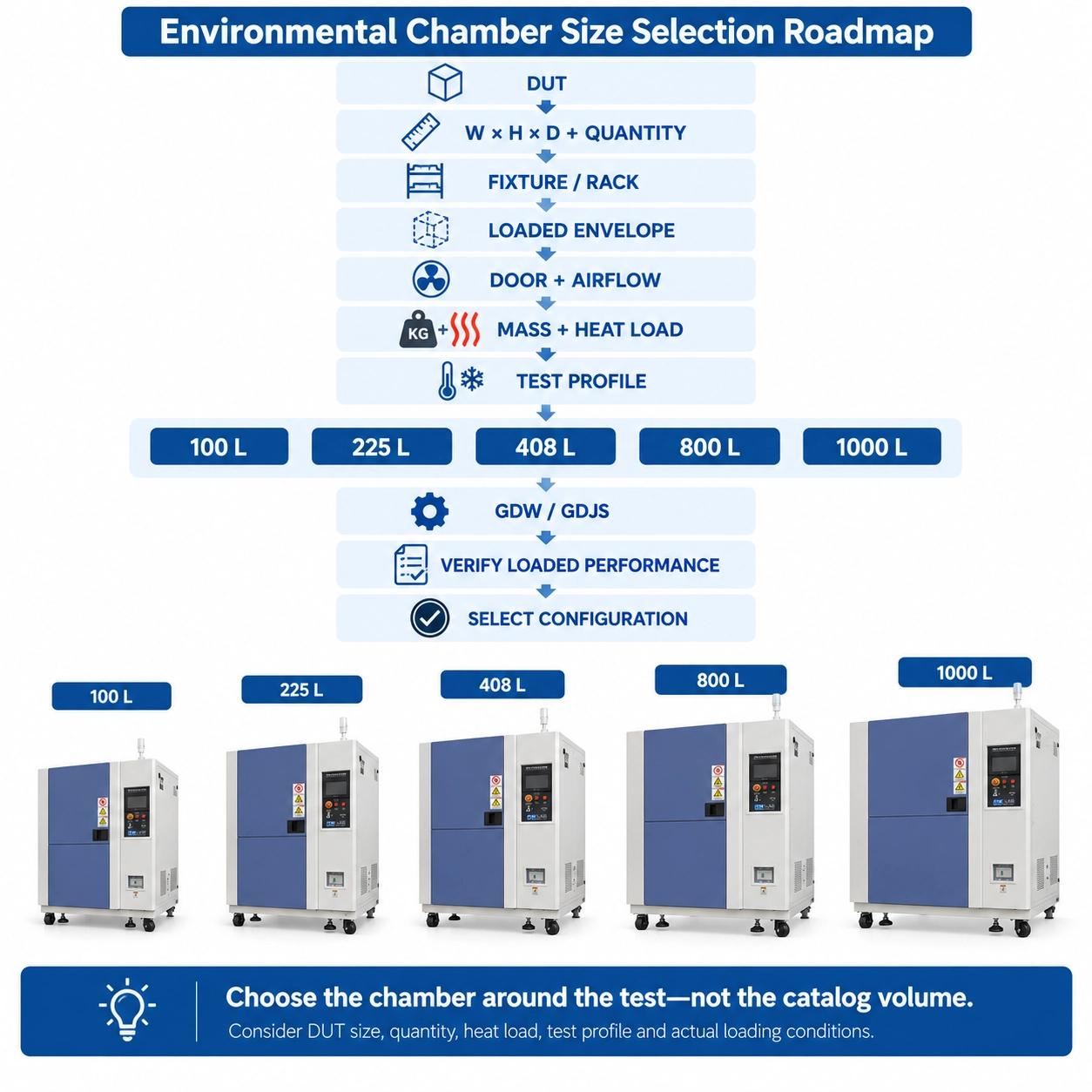
DUT → Loading Layout → Fixture → Loaded W × H × D → Door Opening → Airflow → Mass → Heat Load → Environmental Profile → Candidate Chamber
That is a much more defensible way to select an environmental chamber.
What Size Environmental Chamber Do I Need?
For a quick first-pass selection, use this sequence:
1. Measure the DUT.
2. Define how many DUTs will be tested at once.
3. Confirm the actual loading orientation.
4. Add the fixture or rack.
5. Define the complete loaded W × H × D.
6. Check the chamber door and circulation clearance.
7. Add DUT and fixture mass.
8. If powered, define the maximum live heat load.
9. Define the temperature, humidity and transition requirements.
Only then compare:
100 L vs 225 L vs 408 L vs 800 L vs 1000 L
Do not select the liters and then try to make the test fit.
Define the test first. Select the chamber second.
What to Send With Your Environmental Chamber RFQ
A useful RFQ does not need to be long.
For chamber sizing, these inputs are more valuable than simply requesting a nominal capacity:
| Information | What to Provide |
|---|---|
| DUT | Product / component type |
| Dimensions | W × H × D |
| Quantity | Number tested simultaneously |
| Orientation | Required test position |
| Fixture / Rack | Dimensions, material and approximate mass |
| Loaded Envelope | Complete W × H × D if known |
| Total Mass | DUTs + fixture |
| Powered? | Yes / No |
| Live Heat Load | Maximum watts |
| Temperature | Minimum / maximum / ramp requirement |
| Humidity | RH range and dwell if applicable |
| Standard / Profile | IEC, MIL, automotive, customer or internal procedure |
A product photo, CAD screenshot or simple loading sketch is often enough to resolve questions that a liter value cannot.
FAQ
What size environmental chamber do I need?
Start with the complete loaded envelope rather than DUT volume alone. Define the DUT dimensions, quantity, orientation, fixture or rack, door requirement, airflow clearance, total loaded mass and any live heat load. Then compare those requirements with the internal dimensions and loaded performance of candidate chambers.
Is 225L or 408L better for multiple DUTs?
Neither size is automatically better. A 225 L chamber may be sufficient for several compact DUTs arranged efficiently, while a 408 L chamber may provide more practical fixture, cable and circulation space. Define the loading layout before selecting between them.
How much of the chamber can the DUT occupy?
There is no universal percentage that guarantees a valid loading condition. Volume ratios can help identify an obviously crowded setup, but DUT geometry, fixture design and airflow obstruction still need to be evaluated.
Does a powered DUT require a larger environmental chamber?
Not necessarily. A powered DUT requires a heat-load evaluation. Increasing workspace volume does not by itself prove that the chamber can remove the generated heat while maintaining the specified temperature profile.
Should I buy a larger chamber for future testing?
It can make sense when future DUT dimensions, batch quantities or fixture requirements are already reasonably defined. If the future requirement is unknown, substantially oversizing the chamber may add footprint and system capacity without solving a specific testing need.
Choose the Chamber Around the Test
There is no natural progression that says:
Small product → 100 L
Medium product → 408 L
Large product → 1000 L
Real chamber selection is less tidy than that.
A 225 L chamber can be completely adequate for one project and awkwardly small for another DUT with almost the same physical volume.
A 408 L chamber may be selected because of fixture geometry rather than product size.
An 800 L chamber may make sense because eight specimens need to run at once.
And a 1000 L chamber may be unnecessary even when the budget allows it.
Each increase in chamber capacity should solve a specific constraint:
Geometry · Loading · Fixture · Airflow · Quantity · Throughput
Then there is a second question:
Can the chamber maintain the required environment with the actual loaded mass and heat generation?
Keep those two questions separate and environmental chamber sizing becomes much easier.
Before asking for a chamber size, send the test envelope:
DUT W × H × D · Quantity · Orientation · Fixture / Rack · Total Mass · Live Heat Load · Temperature Range · Humidity Range · Ramp Requirement · Applicable Standard
A product photo or loading drawing is even better.
